
A chief learning officer (CLO), also known as a talent development executive, vice president of training and development or chief talent development officer, is a senior executive responsible for driving the organization’s learning and development (L&D) strategy. The CLO ensures that learning initiatives enhance employee performance, leadership capabilities and overall organizational growth.
This executive oversees the design, implementation and evaluation of learning programs that align with business goals, foster a culture of continuous learning and prepare the workforce for future challenges.
Typically reporting to the CEO or another senior executive, the CLO collaborates across departments to ensure learning efforts support organizational priorities and drive measurable results.
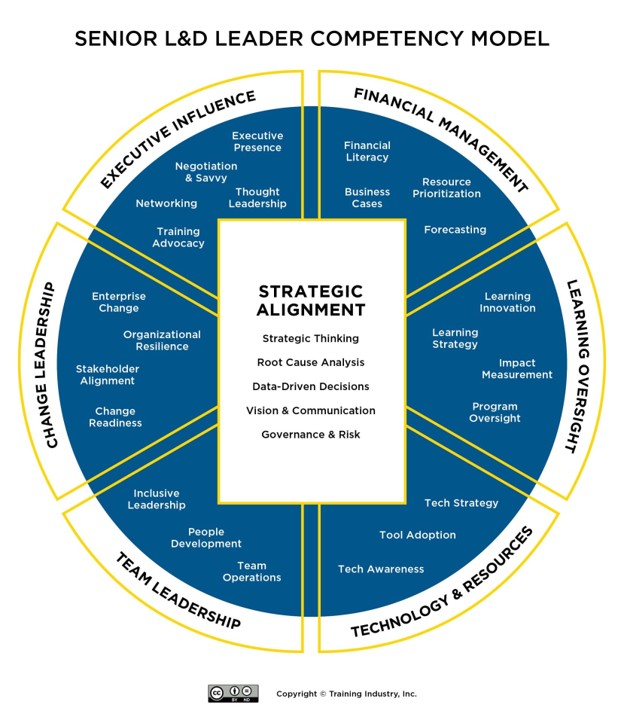
The Training Industry Senior L&D Leader Competency Model™
CLOs and other senior L&D leaders shape talent strategies, influence business decisions and lead organizational change. As expectations for the learning function expand, these professionals must develop many of the same capabilities expected of other business leaders, including strategic thinking, executive influence, financial acumen and change leadership.
The Training Industry Senior L&D Leader Competency Model™ provides a framework for understanding and developing the capabilities senior L&D leaders need to drive business impact and lead enterprise-wide transformation. Built on Training Industry, Inc., research, the model complements the Training Manager Competency Model™ while addressing the broader responsibilities and expectations of senior-level L&D leadership.
The Key Responsibilities of a CLO
The model outlines seven key responsibilities for senior-level L&D leadership:
- Strategic Alignment: Establish and steward a learning strategy grounded in data and aligned with business goals.
- Executive Influence: Position L&D as a strategic business function by building credibility and influence with senior stakeholders.
- Financial Management: Interpret budgets and financial data and align learning investments with business value.
- Learning Function Oversight: Lead a high-performing training organization focused on innovation, measurement and continuous improvement.
- Technology and Resource Management: Select and scale learning technologies and manage resources to support future-ready learning ecosystems.
- Team Leadership: Develop and lead inclusive, high-performing L&D teams.
- Change Leadership: Drive and sustain organizational change while building adaptability and resilience across the business.
These responsibilities reflect the shift from operational execution to strategic leadership. Developing these competencies can help CLOs and senior-level L&D professionals strengthen their leadership capabilities and position the learning function as a core business asset.
Career Paths to Becoming a CLO
There is no single path to becoming a chief learning officer, but most CLOs advance from roles in learning and development, talent management, or organizational development. Common career trajectories include:
- L&D Leadership: Many CLOs begin as corporate trainers, instructional designers or learning managers, gradually advancing to director- or executive-level roles in training and development.
- HR and Talent Management: Professionals with experience in HR leadership, talent management or organizational effectiveness often transition into the CLO role.
- Business and Strategy Roles: Some CLOs come from business strategy, consulting or operations roles, bringing expertise in aligning learning initiatives with corporate goals.
- Academia and Research: A smaller percentage of CLOs come from higher education, research or thought leadership in adult learning and workforce development.
Essential Skills and Capabilities of a CLO
- Strategic Thinking: Ability to align L&D initiatives with business goals and demonstrate their impact.
- Adult Learning Expertise: Strong knowledge of instructional design, learning technologies and modern learning methodologies.
- Leadership and Influence: Exceptional ability to lead teams, engage stakeholders and drive organizational change.
- Data-Driven Decision-Making: Competence in measuring learning effectiveness and leveraging analytics to refine strategies.
- Change Management: Skill in fostering a learning culture and navigating transformation efforts.
- Technical Fluency: Familiarity with learning management systems (LMS) platforms, AI-driven learning tools and digital learning ecosystems.
- Education and Experience: A bachelor’s degree in organizational development, HR, business, or education with 10+ years of experience in L&D, including 5+ years in a senior leadership role. A master’s degree can enhance career prospects.
Career Outlook for CLOs
The demand for CLOs is growing as organizations recognize the strategic value of employee development in driving business success. Several trends are shaping the role’s future, including:
- Increased Investment in Workforce Development: Companies are prioritizing employee reskilling and upskilling due to rapid technological advancements and evolving business needs.
- Rise of Digital Learning: The expansion of AI-driven learning platforms, virtual training and personalized learning experiences is reshaping corporate L&D.
- Strategic Business Alignment: CLOs are increasingly seen as key business leaders responsible for talent strategy, leadership development and cultural transformation.
- Expanding Opportunities Across Industries: While traditionally found in large corporations, the role of CLO is expanding into mid-sized companies, nonprofits and government agencies.