
Published in Summer 2026
Perhaps one of the most important takeaways from the advancing field of neuroscience and learning is that learning is difficult. As much as we try to ease the burden, learning requires effort, and the brain is designed to translate that effort into deep learning. Interleaving is an evidence-based approach that helps us make our learners’ effort more strategic and impactful.
What Is Interleaving?
One of the foremost scholars on neuroscience and education, Tracey Tokuhama-Espinosa, defines interleaving as a “process of reinforcing learning durability by returning to topics multiple times rather than exhausting all the information in a single block of time.” Interleaving helps create the effort needed for deeper learning and taps into many neuroscience principles for transferring that learning to unique contexts in the future.
In the same book, Tokuhama-Espinosa noted that as of 2021, there were over 63,000 scientific articles demonstrating that interleaving improves retention, transfer and durability. Yet this is not a concept many trainers are familiar with. And we are even less prepared to apply it in our work. I argue it is not common in training discussions for three reasons:
- Interleaving requires time and effort. We tend to train in ways that are quick and require less effort because we know our learners are busy with their actual jobs and lives.
- Modern training models favor information dumping then moving on, which is the opposite of interleaving.
- We don’t have many models for how to incorporate interleaving into our training design and strategy. We have used the information dump as a model for so many training and educational environments, it seems odd to question it.
Interleaving: Taking the Road Less Traveled
Let’s look at interleaving a bit deeper. I find that a metaphor helps to illustrate the neuroscience behind it.
Imagine you are in a huge field of tall grass. As you look around, you see well-worn paths that have been trodden over time. These paths are easy to take because they have been worn down for us. Those paths represent what we know. To learn, we have to blaze new trails. So in this same metaphor, learning requires wearing down the grass to make a new trail. There are no bulldozer shortcuts; the trail has to be walked several times before it is “learned.” Think about the effort it takes to go from tall, untouched grass to a well-worn path. That is the work of learning.
One of the ways we blaze new trails is allowing the brain the chance to forget. It sounds counterintuitive, but when we forget parts of something new, it requires effort for the brain to go back and retrieve it. The work of retrieval wears down the path and uses the extra effort to deepen learning.
Another way the brain wears down the path is by learning in multiple contexts. When we see, experience and use new knowledge, skills and abilities in different contexts and under different circumstances, it helps deepen the learning. When we no longer associate the learning with just one setting, we are better able to use and recall what we learn in future settings. In their book “Make It Stick,” Brown, Roediger III and McDaniel cite a study in which hockey players rehearsed the same skill on different sections of the rink — a technique that used interleaving to reinforce their learning.
The Value of Forgetting and Relearning
Interleaving is a wonderful tool. The more we revisit concepts, experience new contexts, connect new learning to other learning and allow enough time in between for some forgetting to happen, the deeper learning gets.
Compare this to how we typically train. We have one training session where we try to exhaust an entire subject, hope people remember it, then move on. Interleaving weaves several training topics together and revisits them over time.
Let’s use onboarding as an example to illustrate a typical information dump training. Onboarding traditionally sets aside the first day or two of the job for a whirlwind of information thrown one at a time at new employees. We stack up presentations on everything they need to know to work at the company in just a few hours. We assume that if we throw all of the information at them, we will have efficiently exposed them to everything they need to know as an employee.
Yet neuroscience continues to provide evidence that this is not an effective way to train. We need to interleave our training so learners can do the hard work of blazing those new trails. But how can we start to change this process when the information dump seems so much more efficient?
Creating a Visual Map of Learning
One technique I have found especially useful in my work with training and development (T&D) clients is visual mapping the learning design. This allows us to see what we are doing in individual trainings as well as the overall system and approach to our training department. When we visually represent what people are learning and how they are learning it, it helps us interleave in more intentional ways.
When I can visualize everything that people need to learn, I can make connections between topics. I can see where to introduce concepts that I will be doing full trainings on later, and I can note where I should revisit previous trainings. Intentionally mapping learning in this way allows me to build in opportunities for learners to forget, recall and see learning in multiple contexts.
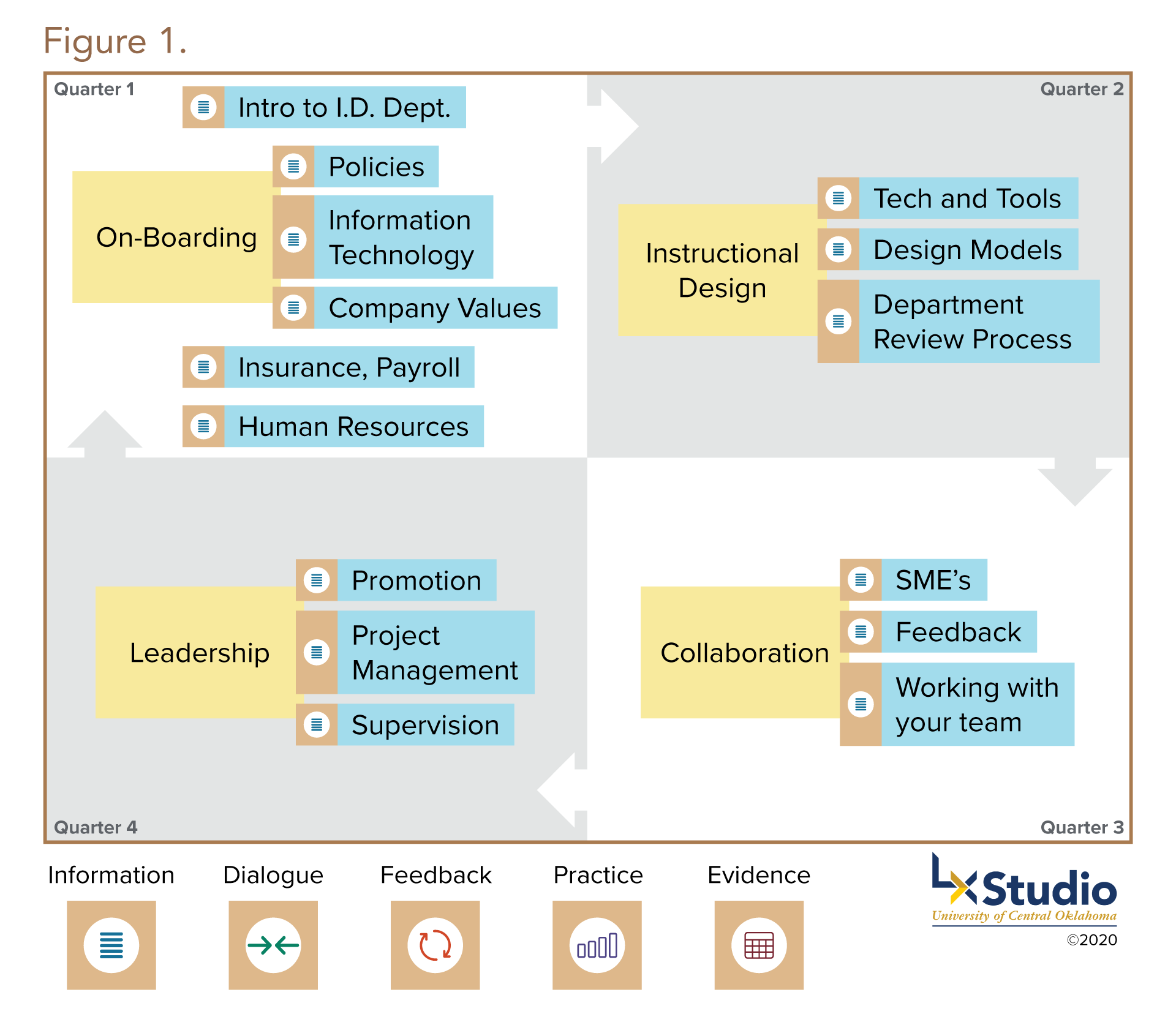
Figure 1 represents a year of training for an instructional designer (ID) with a typical information dump approach to onboarding and other training you might find in a given year. Each topic is presented as an information dump and only taught once.
Now, let’s look at how an interleaving approach compares (Figure 2). Some information dumping is necessary in onboarding. Insurance, payroll and policies are all things you need to know when starting a new job. But now we are introducing dialogues around company values, tech and teamwork in the early stages. These dialogues, like company values, are repeated because we want to reinforce them frequently. Each quarter, the new employees have more experience to talk about how they see these values at work.
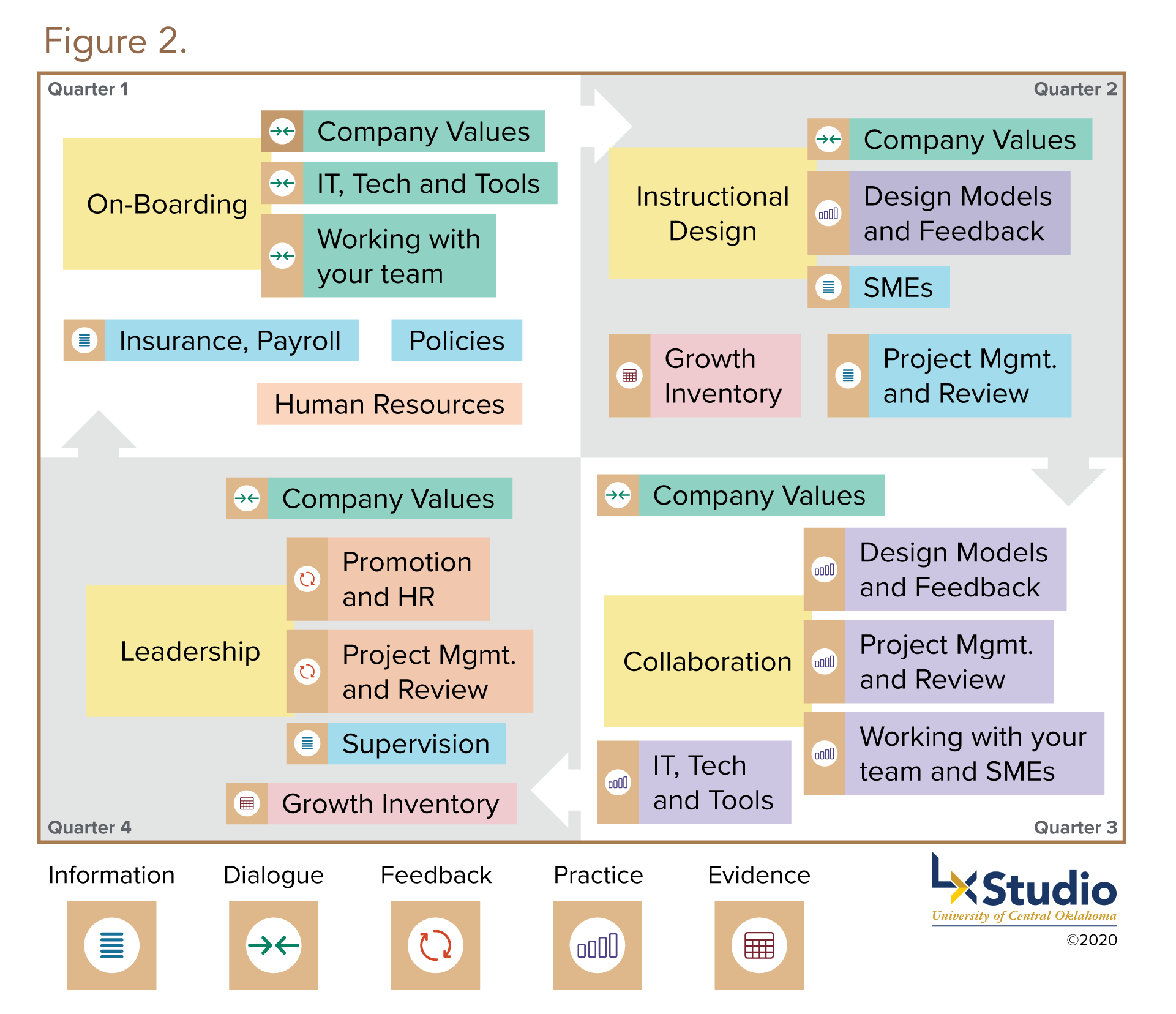
In the second quarter, we start linking company values to the actual work of an ID. We allow learners to start using design models and feedback in real scenarios or talk about how these operate. This becomes an experiential session to put models to work in their actual jobs. We also give them some information on project management and the review process as well as working with subject matter experts (SMEs). We could even provide employees opportunities here to ask questions about HR, policies, etc.
In the third quarter, we take each of the important elements of learners’ jobs and allow them to see how everything connects to company values like collaboration — whether it is the tech tools we use, the feedback we give and take, or the way we manage projects with our time.
Finally, we end with giving the learners feedback on how they are managing their projects and begin to prepare them for next steps in their career.
Importantly, in quarter two and four, we have added a growth inventory. A growth inventory allows learners to provide evidence of their learning, reflect on what they are doing well and what they need to improve.
Interleaving onboarding in this way allows learners to forget some of what they have learned and therefore creates recall when they revisit the topics. It allows them to practice what they learn and have a shifting perspective on it as they advance in their training. They can see how the learning applies to different contexts. It also allows them to reflect on what they need to continue to learn. All of that effort and time deepens those pathways.
In the interleaving model, we cover the same material as the traditional model, but we do so in ways that create opportunities to deepen the learning and help learners take ownership of their learning. You may not have to overhaul your current strategy to bring in elements of interleaving. Even the simple act of color coding to see where topics are revisited can make a huge difference. Now, rather than your learners passively sitting through an information dump, they experience the most important topics in multiple contexts, which helps them become more engaged and see how the topics directly apply to their success in their job.
Turning Training Into Deep Learning
Deep learning will always require effort, and that can feel like asking a lot of people who are busy. Our goal as trainers is to help learners turn that effort into deep learning. While neuroscience is an expanding field, we can make small changes in our approaches to training to help deepen learning. Interleaving is a great place to start because of the evidence of its effectiveness. And visual mapping helps us create strategic plans to make sure we are interleaving when we can and that our learners are blazing those new trails.