Published in Fall 2026
Learning and development (L&D) teams often report on training completion rates and assessment scores — and stop there. This is just the first step to L&D’s measurement strategy.
For L&D to function as a strategic partner, learning strategy needs to connect to business outcomes. Rather than building exactly what stakeholders ask for, L&D must design learning experiences that connect directly to the metrics that the business monitors.
With frontline, performance-based roles, there’s a clear, yet overlooked, path to closing the gap between designing learning strategy and business impact. What follows is a practical framework for making that connection.
Know When This Approach Applies
Not every measurement framework will be a good fit for every training initiative.
Sometimes a learner’s role has a clear and measurable behavior and a trackable output. For example, if a contact center identifies that the average call handle time is significantly higher than the target set by the business, operations has tools and processes in place to track this data regularly and can see if and when it improves after training.
Training initiatives like leadership development are more subjective in nature and lack visible output. These programs are still important and should be tracked appropriately, but it requires a different measurement approach.

Get In the Room Before Design Starts
The first and most important step is to get a seat at the table early. Attend the project meetings to gather firsthand knowledge of the issues and what needs to improve. As an added bonus, being included will improve L&D’s relationship with business leaders in the long run and provides a clear path for partnership.
If L&D is not already involved in project team meetings, reach out to the project manager or operations leader and ask to be included. They may not know that L&D needs to be involved at this stage. Be the one to open that door.
If there is no project manager, connect directly with the stakeholders who requested the training. They may be able to provide the information, or they may defer to someone else. L&D can advocate in these situations and find those with the answers. It is important to get into those early-stage meetings to align on what metrics matter and request baseline metrics before design begins.
Have the Right Stakeholder Conversation
Now that the conversation is happening, use the time wisely. Focus on what stakeholders need and how learning can support that. Don’t bog them down in learning science or design requirements. Instead, work with them to determine what metrics are driving the training request.
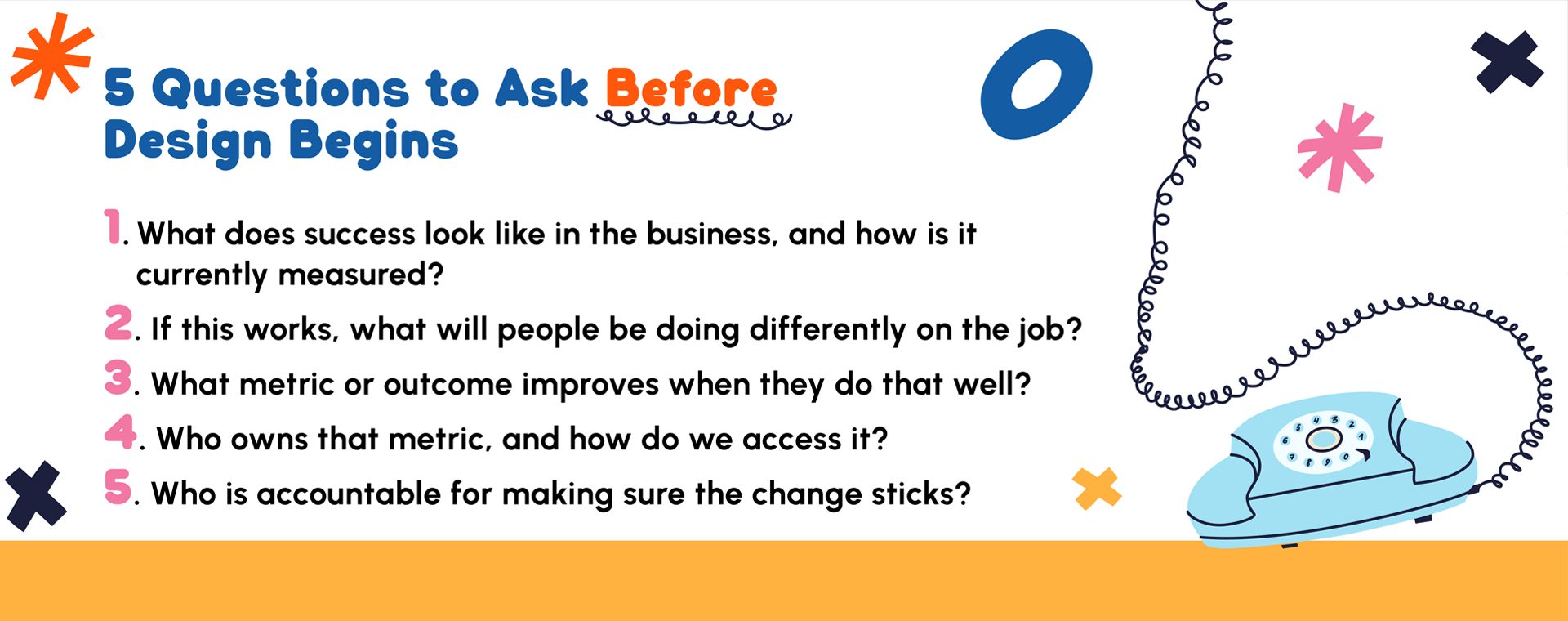
Start by asking questions that connect the business goal to the expected performance change:
- What does success look like in the business, and how is it currently measured?
- If this works, what will people be doing differently on the job?
- What metric or outcome improves when they do that well?
If the right metrics cannot be identified or the performance gap cannot be defined, that is valuable information. It may signal that training is not the right solution at this time.
Once the metric is identified, establish who owns it and who is responsible for tracking progress.
In the contact center example, operations brought the high call-handle time issue to L&D with a simple ask: “We need training.” By getting into the room early and asking the right questions, the conversation moved quickly from a vague request to a specific problem.
When L&D asked, “If this works, what will agents be doing differently on the job?” the operations leader described agents moving through calls more efficiently and closing out statuses promptly. That answer pointed directly to the issue. Agents weren’t using system statuses correctly, which was inflating handle time.
Diagnose the Performance Gap
Once the metric has been identified, the next step is understanding why the gap exists. Continuing with our example, this is where the partnership with operations becomes critical. L&D may not have direct access to performance data, but operations does. Together, they can identify what frontline employees are doing or not doing that’s causing the metric to move in the wrong direction.
Once average handle time was flagged as the issue, operations was able to confirm through their own data and observation that agents weren’t using system statuses correctly. L&D didn’t need to pull that data independently. Asking the right questions surfaced it. The metric pointed to where the problem lived and the operational data confirmed what the problem actually was.
At this point, the path to a solution becomes clear.
Design to Close the Gap, Not to Cover the Topic
Design is the next decision. Learning objectives should trace back to the specific behavior that needs to change, not the broader topic surrounding it.
The first questions to ask are: How complex is the behavior, and what are the stakes of getting it wrong? These two factors are fixed — they cannot be adjusted to fit a timeline or a budget. Everything else, including location, group size, trainer availability and delivery format, can be worked around. Development time must also be factored in early. Designers are often left out of the project timeline, which puts the quality of the solution at risk before it even begins.
Once complexity and stakes are established, L&D must choose the modality that fits the problem.
- Job aid: When the behavior is simple and reference-based, a job aid is often enough. It supports performance in the moment without requiring a formal learning experience.
- eLearning: When the concept is straightforward, the content doesn’t generate a lot of questions, and learners are in different locations or on different schedules, eLearning is a practical choice.
- Instructor-led training (ILT): When the content requires nuance, conversation or a facilitator to bring it to life, ILT is the right call — whether in person or virtual.
- Blended learning: When the content benefits from both individual preparation and group discussion, a blended approach combines the best of both. A pre-class eLearning module sets the stage; the ILT session allows for questions, demonstration and conversation; follow-up job aids or modules reinforce the behavior afterward.
- Coaching: When the behavior is people-forward and requires ongoing support and observation, coaching is the right fit.
- Simulations and scenarios: These can supplement any of the other modalities when practice is important, but they rarely should be the standalone solution.
In the contact center example, the wrong solution would have been a lengthy eLearning module covering everything there is to know about system statuses. That’s overkill for a behavior that simply needed a refresh and a reminder. Instead, a simple one-pager was created to reinforce when to use each status, paired with a quick reference sign posted in the agents’ workspace for easy access.
That’s it. No course build. No lengthy module. A targeted solution designed specifically to close the gap that was identified.
This is the payoff of doing the earlier work. Because the stakeholder conversation happened, and because the performance gap was diagnosed, the design decision was obvious. There was no guessing about what to build or how long it needed to be.
Measure Success After Launch
Launching the training is not the finish line. Reconnecting with operations after implementation is just as important as the work that came before it.
In a contact center environment, metric movement can be tracked immediately, but a realistic window for meaningful change is 90 to 120 days. This gives employees time to apply what they learned and allows the data to reflect a pattern rather than a blip.
How that follow-up happens depends on who owns the metric. If the training was part of a larger project, the check-in naturally fits into the ongoing meeting cadence or a post-project review. If it was a standalone initiative, L&D should proactively reconnect with the operations leader or project stakeholder to review the data together.
If the metric isn’t moving, resist the urge to immediately point to training as the culprit or the fix. Instead, dig into the possibilities. Speak with managers about what they are observing on the floor. Consider whether other factors changed after launch. Look at whether the training was completed and applied consistently.
Proving that training directly caused a metric to move is rarely possible. These initiatives do not live in a vacuum and there are other teams working toward the same goals. Claiming that training was the single reason for success can even undermine credibility. The stronger position is to frame training as a contributing factor and let the data tell the broader story. That approach reinforces the partnerships built throughout this process and keeps L&D at the table long after the training launches.
Closing
The shift from order taker to strategic partner doesn’t happen overnight, but it starts with one conversation. Getting into the room early, asking the right questions and designing to close a specific gap rather than cover a topic are practical moves that any L&D professional can make today.
The result is training that operations can see the value of, metrics that tell a clearer story and an L&D function that earns its seat at the table. That’s worth the effort.