


Published in Fall 2026
Key Takeaways
- Strategic fatigue is a portfolio problem, not simply a people problem. It develops when learning demand exceeds the capacity of teams and learners to successfully design, deliver, absorb and apply learning.
- L&D leaders should make prioritization tradeoffs explicit. Every new priority should be evaluated based on the capability need, consequences of delay, potential resource collisions and what existing work it will displace.
- Limit work in progress to protect learning quality and application. Integrated calendars, realistic capacity thresholds and protected consolidation periods can prevent simultaneous initiatives from overwhelming teams and learners.
- Measure capability and performance, not just learning activity. Alongside launches and completions, L&D should evaluate skill application, performance change, redundant offerings and whether evaluation findings lead to action.
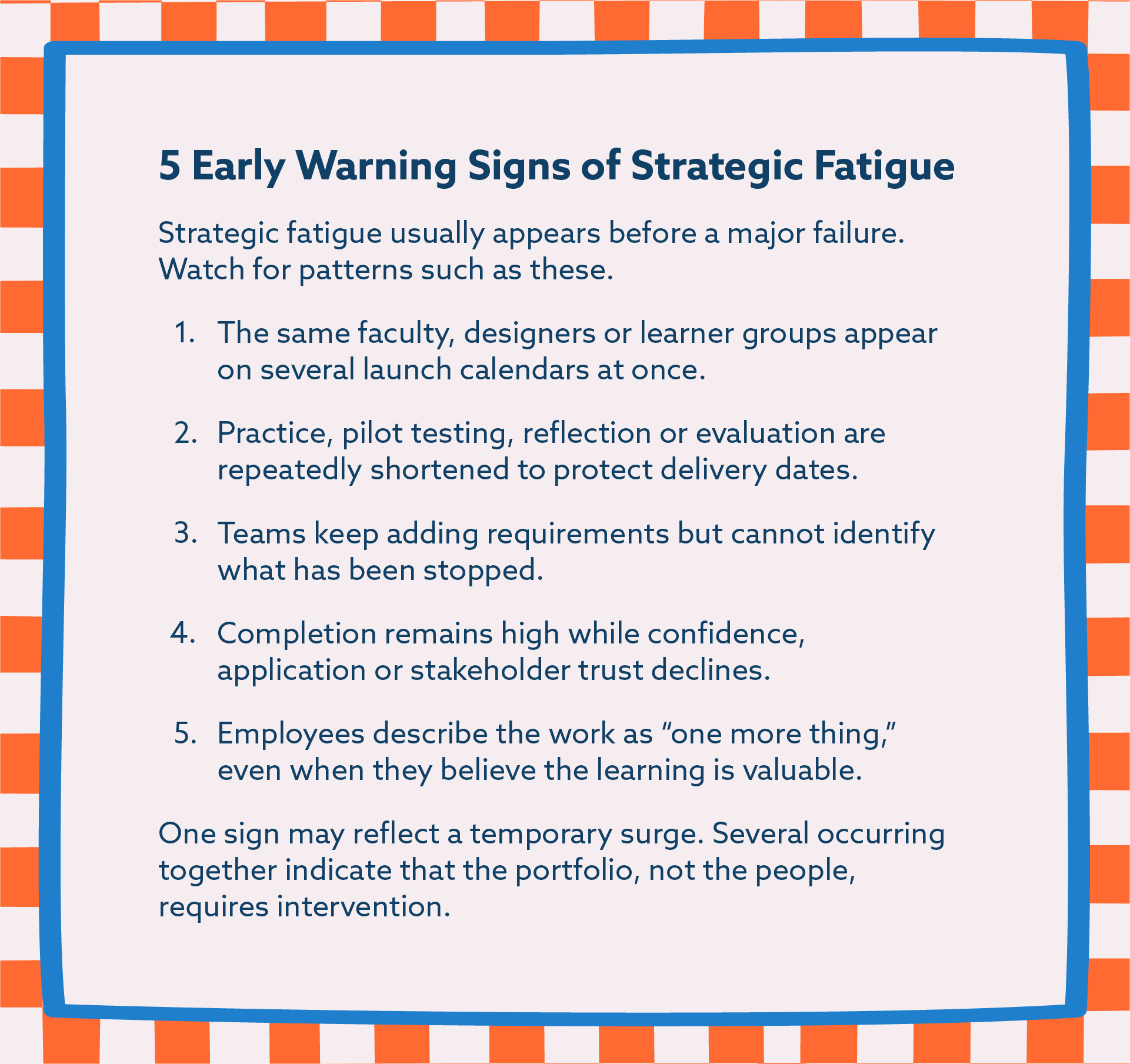
Many learning organizations are producing more than ever. New courses, revised programs, platform changes and urgent requests move through the same teams at the same time. Yet high output does not always create stronger capability. Faculty rush from one launch to the next, designers make decisions before earlier work can be evaluated and learners complete requirements without enough time to practice or apply what they learned.
I describe this pattern as strategic fatigue. It is the cumulative drain that develops when initiative demand exceeds the capacity of the people expected to design, deliver, absorb and use learning. It is not simply burnout, resistance or poor time management. It is a portfolio problem.
I have seen strategic fatigue emerge even when every initiative was individually reasonable. The problem was not that leaders chose bad work. The problem was that no one was looking at the combined demand placed on the learning system.
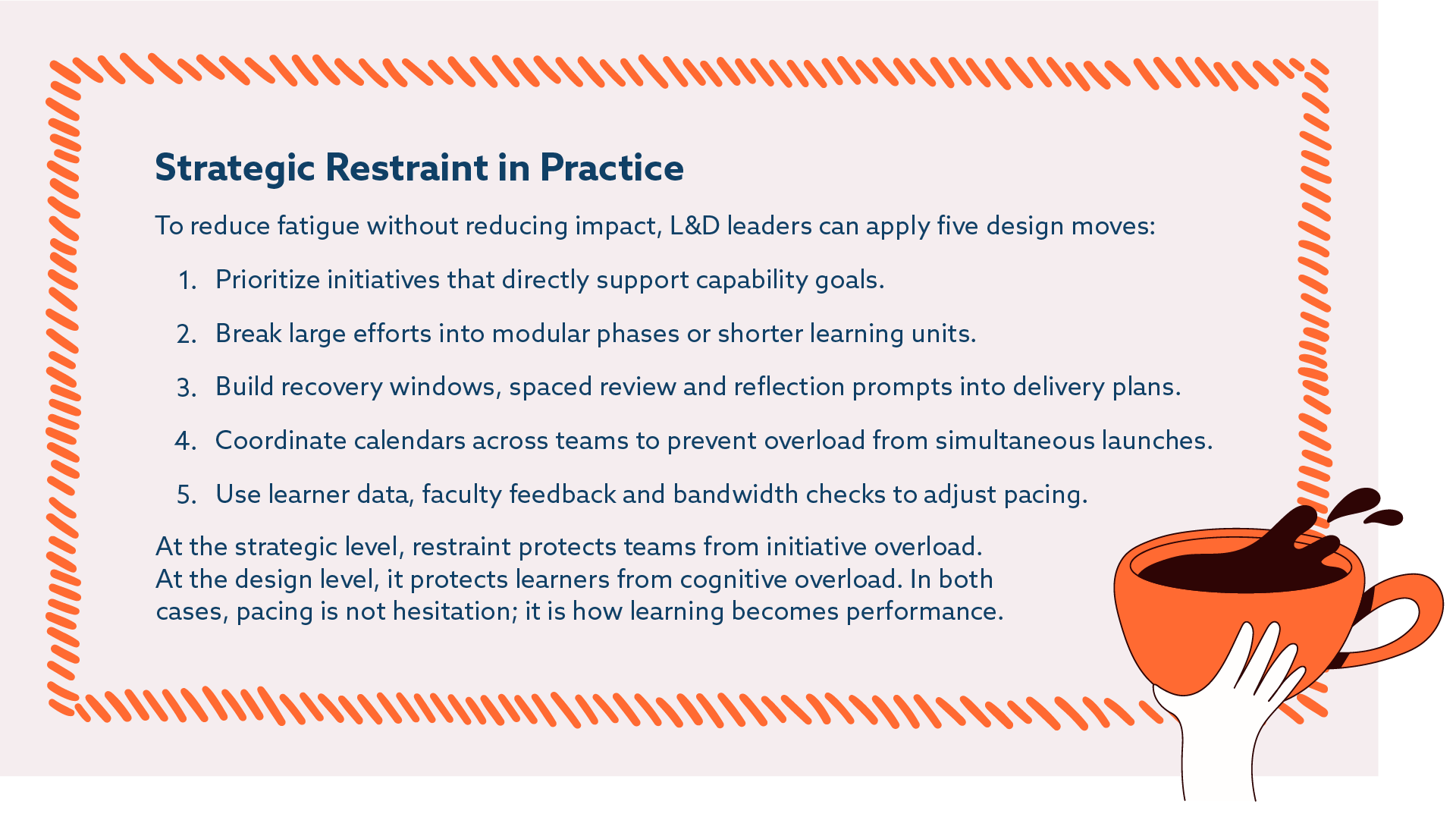
A practical response to strategic fatigue is strategic restraint, which is the deliberate discipline of sequencing, combining, deferring or stopping work so the highest-value learning priorities receive enough capacity to succeed. Strategic restraint does not mean slowing all work or resisting innovation; it means protecting the time, attention and reinforcement required for learning to become performance.
The following practices show how learning and development (L&D) leaders can recognize strategic fatigue early, make explicit tradeoffs and restructure learning portfolios so priority initiatives have the capacity to succeed.
When Good Priorities Collide
In one learning organization I supported, several major efforts converged. Courses were being converted to a new delivery format, requirements were changing, evidence expectations were increasing and additional learning products were being requested. Each effort had a sponsor, a deadline and a defensible purpose. Together, they created constant collision.
Faculty were pulled into overlapping design and review meetings. Content teams moved forward with incomplete decisions because waiting threatened the schedule. Evaluation was treated as something to add after launch rather than a source of information during development. Learners encountered new requirements while earlier changes were still settling into practice.
At first, the strain looked like an execution problem. More meetings, tighter deadlines and additional status reporting were used to regain control. Those actions increased activity but did not restore capacity.
Leaders responded by putting the entire portfolio into one view. They separated mandatory work from discretionary work, mapped the teams and audiences affected by multiple initiatives, staged launches and paused lower-value efforts. Beyond improving the schedule, teams had clearer ownership, fewer late-stage reversals and more room to pilot, review and adjust.
That experience changed how I assess learning strategy. A plan is only realistic when the portfolio can be executed without sacrificing design quality, learner attention or transfer to performance.
Make Tradeoffs Explicit
L&D leaders may not have the authority to reject every request, but they can make tradeoffs visible. A request is not truly prioritized until leaders answer four questions.
1. What capability or performance problem will this solve? A request tied only to visibility, preference or activity should not outrank work tied to a defined organizational need.
2. What is the consequence of delay? Urgent should mean that postponement creates a material operational, compliance or performance risk, not simply that a stakeholder wants a rapid launch.
3. Where will the work collide? Leaders should identify shared audiences, faculty, subject-matter experts, designers, platforms and review processes. Capacity is often exceeded at these intersections, even when individual project plans appear feasible.
4. What will be displaced? A new priority is not a priority until leaders identify what will stop, move or shrink. Without that decision, the organization has added demand rather than set direction.
Those answers should lead to one of four explicit portfolio decisions. Leaders can continue an initiative when the capability need is clear and sufficient capacity exists; stage a larger effort in deliberate phases; combine related requests that duplicate audiences, content or infrastructure; or stop an effort when its value no longer justifies the demand. The purpose is not to slow all work. It is to prevent every request from becoming simultaneous work.

Restructure the Learning Portfolio
A learning portfolio should be organized around capability, not around the number of products delivered. I have found three changes especially useful.
1. Create One Integrated Calendar
Course launches, program revisions, platform changes, evaluation activities and major stakeholder reviews should appear in the same view. Separate calendars hide cumulative demand.
2. Limit Work in Progress
Set a realistic threshold for how many major initiatives a team or audience can carry at once. New work enters only when capacity opens or another effort is displaced.
3. Build Protected Consolidation Periods
After a major launch, allow time for faculty feedback, learner practice, data review and revision. These are not empty weeks. They are part of the learning cycle.
In another project, a team was redesigning a learning offering while also revising outcomes, rebuilding assessments and preparing for a new delivery approach. Treating every component as a simultaneous deliverable created repeated rework because decisions in one area changed the others. The team shifted to a deliberate sequence. It clarified the essential outcomes, designed the minimum viable learning experience, piloted the assessment approach and then refined delivery. The project still moved forward, but ownership became clearer and evaluation was built into the design rather than attached at the end.
Protect Depth Through Governance
Strategic restraint must be reinforced by governance or it will disappear under the next urgent request. Require sponsors to define the capability need, affected audience and evidence of success before development begins. Review the portfolio at a fixed cadence, not only when a crisis occurs. Include faculty, designers and evaluation staff in prioritization because they often see capacity problems before dashboards do. Close major initiatives with a brief review of what should be sustained, revised, combined or retired.
Metrics are also important. Launch counts and completion rates are useful operating measures, but they should not be mistaken for evidence of impact. Leaders should also examine whether learners can use the skill, whether supervisors observe changed performance, whether redundant offerings have been reduced and whether the organization is acting on what evaluation reveals.
Applied consistently, strategic restraint gives worthwhile initiatives enough time, attention and reinforcement to work.
A Better Question for L&D Leaders
When strategic fatigue appears, the wrong question is, “How can we deliver all of this faster?” The better question is, “What must receive enough capacity to produce the performance we need?”
That shift changes the role of L&D leadership. The goal is no longer to absorb every request. It is to manage a coherent portfolio, expose tradeoffs and protect the conditions required for learning transfer.
Organizations do not build capability by launching the most. They build it by selecting what matters, sequencing it deliberately and allowing people to practice, apply and improve. Strategic fatigue begins when activity outruns capacity. It recedes when leaders make restraint part of strategy.