

Published in Fall 2026
We’ve all been there. Eyes glazing over from boilerplate training that has nothing to do with our real jobs, wincing at typos that fully change the meaning of a sentence, cringing at someone oversharing what feels like a way too personal story when we’re supposed to be focused on learning a specific skill.
We’ve probably been on the other side too, working against tightened budgets and timelines, automated processes and expected ROIs that we had no input on.
In our world of constant change and competing priorities, it’s more important than ever to write meaningful content. Here are four simple tips to do just that because an effective strategy doesn’t have to be complicated.
1. Know Your Audience
Don’t waste your time. It feels wrong, but you have to start slow to move fast.
Before you really get going on a project, pause to learn about your audience. You can only be impactful with your content if you understand who will use it, and when, why and how they’ll use it.
Here are some questions to consider:
- Who’s the primary audience? Know who you’re talking to and be aware of secondary or tertiary audiences who are also part of the journey or are in some way responsible for their performance. For everyone involved, consider what tone they’ll trust and be comfortable with.
- Why do people need this training? Think through what they specifically need to know and be able to do at the end. Determine what success will feel like.
- How do our different audiences feel about the topic? You’ll frame things differently if your audience has been requesting this training compared to thinking it’s a huge distraction.
- What do learners already know about the topic? You don’t want to repeat what everyone already knows. Instead, you’ll want to provide the most support where they tend to struggle.
- How does this training align with goals? This can include personal, departmental or organizational performance objectives.
- What happens before and after this training? Knowing how this fits into a larger curriculum or program can make everything feel more connected and useful.
- What boundaries and limitations do we need to keep in mind when thinking about modality? For example, you’ll want to consider access to technology, authoring tools or facilitators, time constraints, geography, number of learners, how often the content will need to be updated, if materials will need to be printed or translated, etc.
Knowing your audience — where they’re coming from, what they need and where they’re going — is vital to transforming source content into something valuable to them.
2. Use Realistic Examples
Don’t waste their time. Learners need training they can connect with and apply.
Being able to imagine themselves in similar situations makes it easier to follow through. Authenticity reduces distractions and provides the opportunity for better self-reflection.
Ask stakeholders to discuss pain points they’ve witnessed, take you through best-case and worst-case scenarios, share screens and talk about their personal experiences. These are all ways to get at what you need for creating examples.
You also want to provide safe opportunities for learners to share their own experiences, tied to the purpose of the training. And remember that even small adjustments can make a difference. Take some time to figure out the terms used in their everyday life.
- Are they employees or team members?
- Do they have standups, one-on-ones or check-ins?
- What acronyms are everyday jargon?
- What software do they use for communication?
Using the lingo means your learner is doing less unnecessary work and can focus their efforts on remembering and applying the content.
3. Be Consistent
Don’t lose it all on a technicality.
How you communicate your content matters. It impacts things like the perceived credibility of the content and even the cognitive load of your learner.
Personally, if I see a bunch of typos, mismatched text formatting and biologically-impossible images, I don’t care what you have to say, because I don’t trust the source. If you can’t take the time to clean up your message, how do I know you took the time to do any research? For less judgy folks, you’re — at best — making them work hard to figure out what you’re trying to say and prioritize. At worst, you’re giving them incorrect information that they believe. It’s our job to be better than that.
Ideally, you’re following a style guide, using active voice and plain language, being inclusive and remembering things like parallelism. When in doubt, prioritize being clear and consistent.
Inconsistencies like these can cause confusion:
- Having a mix of serial and non-serial commas
- Using a variety of terms to refer to one specific thing
- Switching the subject or tenses of your sentences
Most people and organizations have preferences, and that’s perfectly fine. You may even have divisions or programs with unique branding and styling choices. The key is applying those preferences consistently so your messages are clear. One thing you can always do is create a mini style guide or style sheet to document those nuances and decisions.
4. Trim the Fluff
Don’t forget: People are busy on all sides of training.
It’s our difficult job to balance what’s best for the learner without ignoring the contributions of subject matter experts (SMEs), decisions of key stakeholders or our own expertise.
When you take a final look through your content before passing it off for review, proofreading or publishing, check that you’ve included segues, used active voice and focused on the desired outcomes.
Some tactics to keep the focus tight while managing that balancing act could include:
- Providing supplemental materials to learners on great, but not vital, information
- Having hover states or callouts with foundational information, like definitions
- Including facilitator or instructor notes with extra background or contextual information
- Preparing parking lots for important topics that are outside of the current training
More information doesn’t mean more impact. Keep it short and simple. If it doesn’t resonate, cut it out.
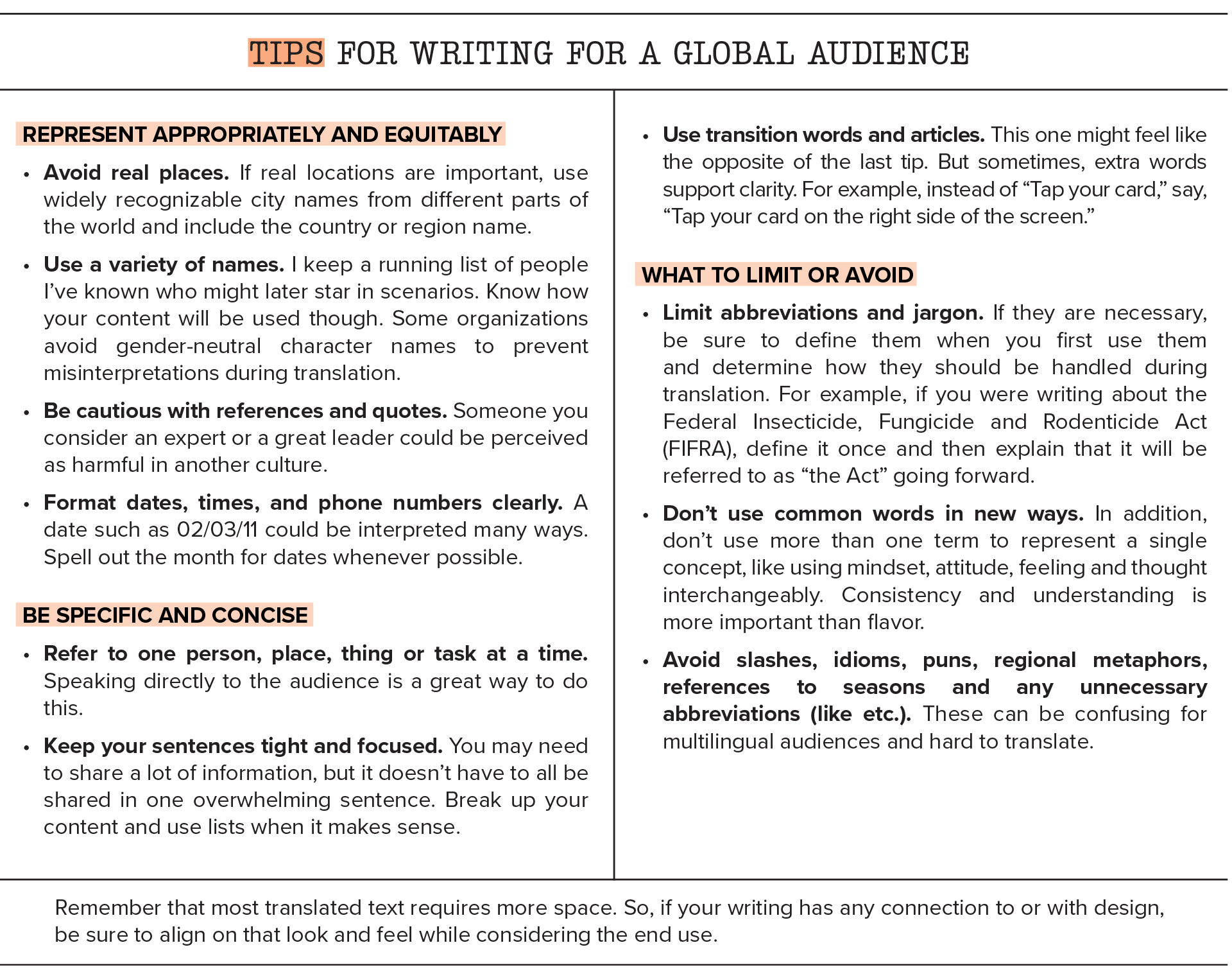
Good Writing Takes Work
Just because it’s not complicated, that doesn’t mean it’s easy. Good writing takes work and a growth mindset.
That’s our challenge to rise to. We get to connect all the dots in a consistent and meaningful way so they resonate with our learners.
I strongly believe clear communication outshines any evolving technology, or even the current favorite modality. Combining best practices, learner insights and a little moxie is how you write stuff people actually care about.