
Learning and Development Careers: A Guide to L&D Roles and Career Paths
Discover key insights regarding career path, job responsibilities and compensation factors in the learning and development (L&D) field.

Executive Summary
- Learning and development careers focus on helping organizations improve employee performance, build workforce capability and support business growth through training.
- Career paths in learning and development span industries and backgrounds, with professionals entering the field from education, HR, operations, the military and other disciplines.
- Professional certifications are increasingly valuable for advancement, with research showing certified learning professionals often report higher compensation and stronger career progression.
- Advancing into leadership roles such as training manager, L&D director or chief learning officer requires a blend of strategic thinking, business alignment and team leadership capabilities.
- High-performing L&D teams drive business impact by continuously upskilling, aligning their work with organizational priorities and strengthening cross-functional collaboration.
Overview of Roles in Learning and Development
L&D professionals play a critical role in building workforce capability, strengthening performance and supporting long-term business growth. The professionals who thrive in this field are the ones who build strategic skills, stay adaptable and position themselves as business partners.
As a result, roles in learning and development (L&D) can vary depending on the industry, organization size and team structure. Common job titles include training managers, directors of training, content developers and instructional designers.
What Are the Most Common Learning and Development Careers?
L&D roles typically operate across five core areas: administration, content development, training delivery, leadership and strategy, and specialized functions.
Specialized functions: Roles such as performance consultants and data analysts connect training initiatives to measurable organizational impact.
Administration: Oversee systems, scheduling, logistics and reporting to ensure programs run efficiently and learners stay on track.
Content development: Design, build and maintain engaging learning experiences across formats, from instructor-led training to digital and blended solutions.
Delivery: Facilitate programs and equip employees with the knowledge and skills they need, from onboarding to technical instruction to sales enablement.
Leadership: Set vision, define learning priorities and align development initiatives with broader business objectives.
💡L&D professionals often take on responsibilities across different areas.
While other roles exist within L&D, the ones listed above are the most common. See the associated job titles, average L&D salary and relevant courses for each of the L&D roles here.
How Roles Vary by Organization Size
L&D responsibilities often shift significantly depending on company size and maturity.
For example, in smaller organizations, one professional may manage everything from strategy to delivery and systems, requiring broad, adaptable skills.
By contrast, mid-sized companies begin to introduce role specialization, while large enterprises operate with highly specialized teams focused on governance, scalability and measurable business alignment.
So, understanding these differences can help professionals build the right capabilities as organizations grow.
Size of Training Team
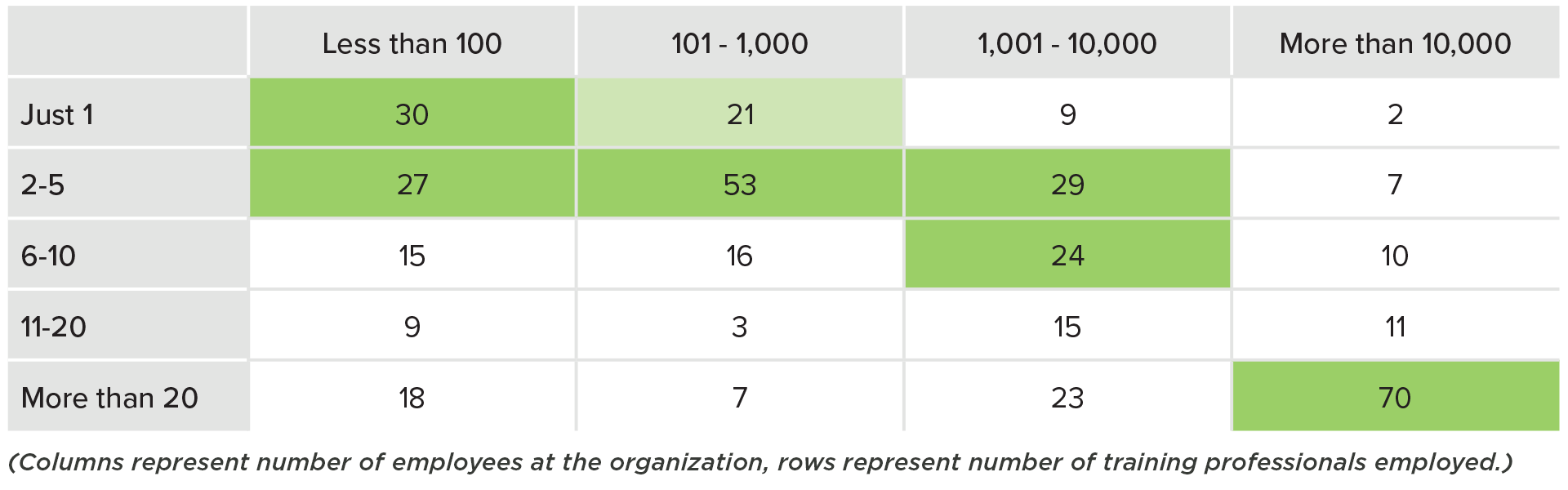
According to Training Industry’s Career and Salary Report, nearly 1 in 3 small organizations (less than 100 employees) employed just one training professional, whereas 1 in 5 moderately sized organizations (between 100 and 1,000 employees) employed only one training professional. Once organizations reach 10,000 employees or more, their training teams tend to grow, often exceeding 20+ training professionals.
How Learning and Development Roles are Changing
Over time, the scope of L&D has expanded well beyond traditional training delivery into strategic workforce development. Today’s professionals contribute to learning technology strategy, AI-enabled content creation, skills mapping, workforce planning and analytics-driven performance improvement.
Consequently, organizations now expect L&D to demonstrate measurable impact and support transformation initiatives, leading to the rise in learning leaders taking on a business partner mindset.
How L&D Teams are Structured
Centralized vs. Decentralized
A centralized training organization is one in which all resources and processes are managed within a single entity, reporting to one senior executive or leadership team, ensuring consistency and standardization across the organization. This approach is common in smaller or less geographically dispersed companies.
On the other hand, a decentralized training organization is one in which the training function is operated independently by certain entities throughout an enterprise. Larger organizations often use this structure to allow departments, such as IT, sales or manufacturing, to create specialized, audience-specific learning strategies under separate leadership.
How to Build High-Impact Training Teams
Typical Learning and Development Team Structures
The majority of L&D teams are housed either in their organization’s HR department or within a centralized L&D department. In some organizations, training teams sit within business units such as sales, customer service, operations or IT, depending on strategic priorities.
The “Department of One” Reality
In many small and mid-sized organizations, L&D is led by a single professional responsible for strategy, design, facilitation, systems administration and reporting. As a result, this structure requires broad capability, strong prioritization and the ability to influence without formal authority.
Structure by Organizational Maturity
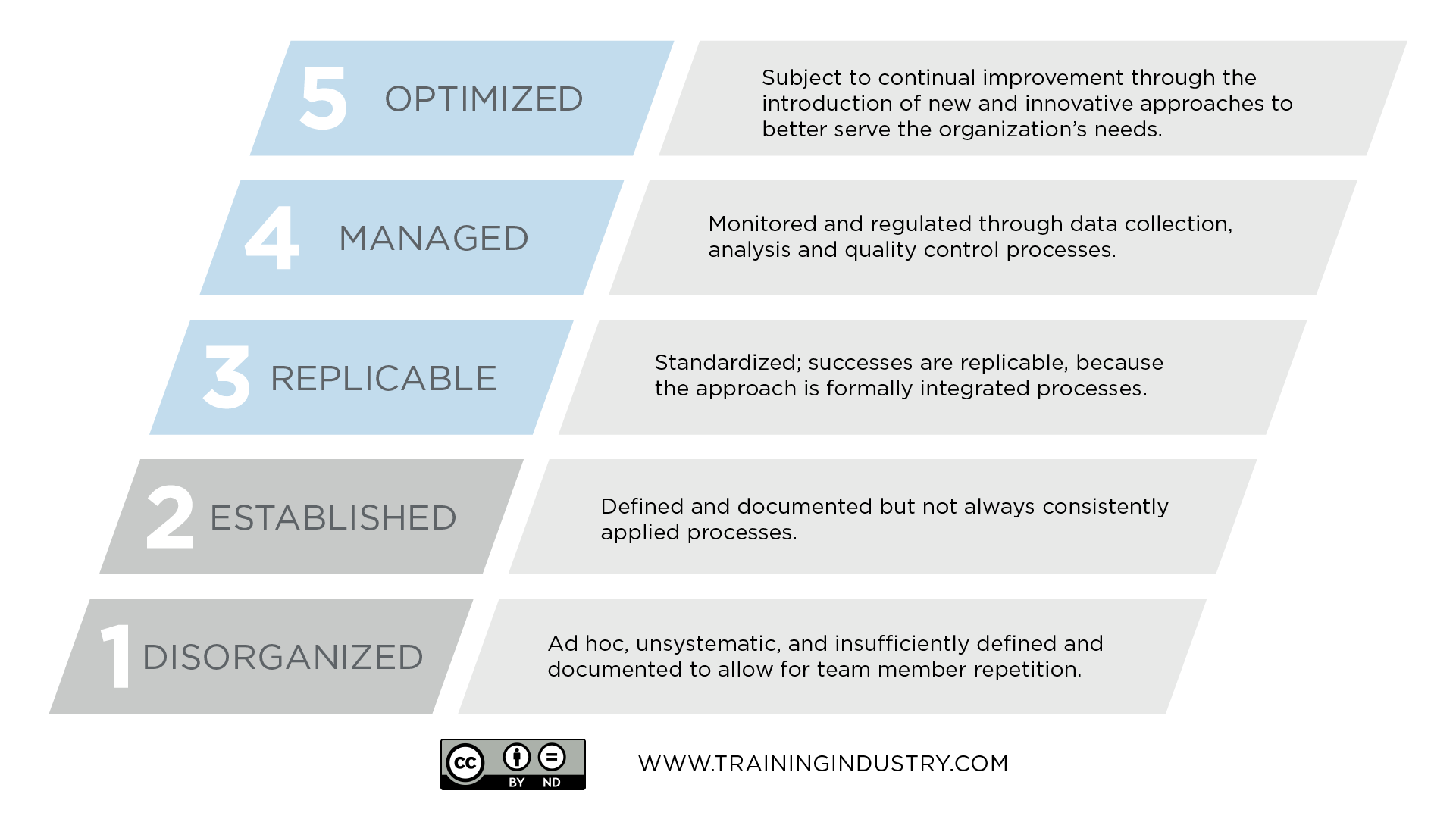
As training process capabilities become more defined and strategically aligned, teams tend to evolve from reactive program delivery to proactive workforce planning and performance consulting. The Training Organization Maturity Model provides a structured way to evaluate how consistently, effectively and strategically training activities are designed, delivered and managed across an organization.
What Skills are Required for a Learning and Development Career
As careers in learning and development continue to evolve, staying current is critical. The in-demand skills for 2026 focus on areas such as agility, empathy, critical thinking, innovation and artificial intelligence (AI) literacy. In particular, AI fluency is rapidly becoming a baseline expectation as organizations integrate AI tools into every day work. To support this shift, many leading professional development programs now cover these foundational concepts, helping L&D professionals understand both the capabilities and limitations of AI in L&D.
Additionally, ongoing learning through industry research, webinars and specialized programs can help L&D professionals keep pace with these changes and develop the skills most relevant to their roles.
For example, professionals can explore different L&D topic areas to identify the ones most relevant to their role and focus on continuous growth in those areas.

What are the Core Competencies for Training Managers?
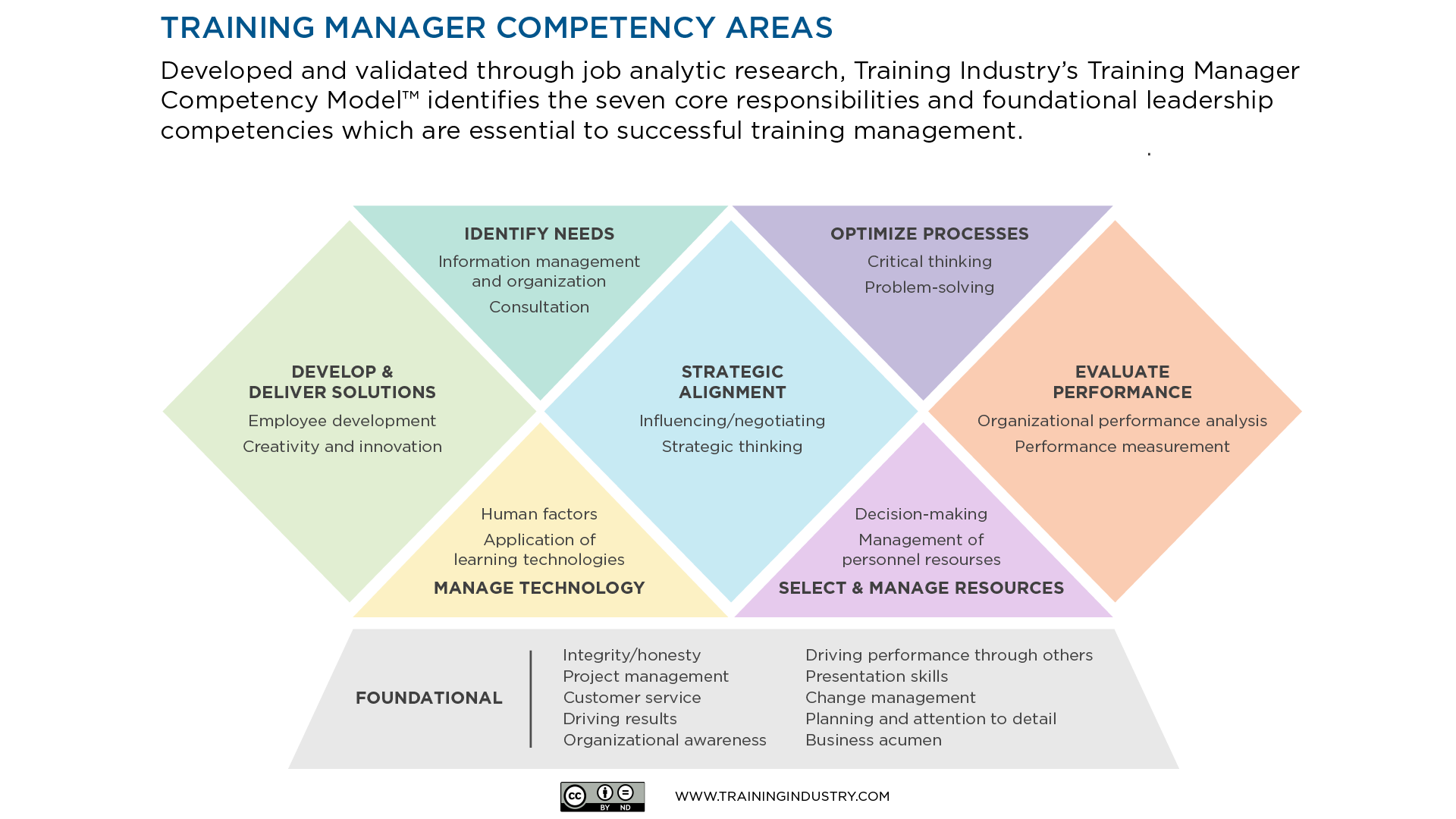
The Training Manager Competency Model™ is a tool providing current and future learning leaders with specific insight into the core responsibilities of a training manager and the competencies needed. The model grew out of Training Industry’s Great Training Organizations research and is the foundation for the only credential focused on the training manager job role, the Certified Professional in Training Management (CPTM™).

Frameworks and Capability Models in L&D
Frameworks and capability models are essential tools in L&D. They provide structured approaches for defining, assessing and developing the skills, knowledge and behaviors needed for organizational success. The most common frameworks and capability models in L&D are:
- 70-20-10: Commonly used formula within the training profession to describe the optimal sources of learning.
- ADDIE Model: Used by instructional designers and content developers when creating instructional course materials.
- Portfolio Rationalization Four Quadrant Model: Helps training organizations determine which courses are relevant and aligned to their training needs and which courses should be avoided or eliminated.
- Kirkpatrick’s Learning Evaluation Model: Defines four levels of training evaluation: reaction, learning, behavior and results.
- 5-4-3+ Framework: Guides L&D professionals in evaluating training programs and driving continuous improvement.
- Training Manager Competency Model: Outlines core responsibilities and leadership competencies for training managers.
What is an L&D Competency Model?
Competency models are frameworks that define the skills, knowledge and behaviors needed to succeed in a specific role or industry. For organizations, competency models are strategic blueprints used to recruit, hire, train and grow talent effectively. While challenging to develop, there are training programs that help L&D professionals build customized competency models for their organizations.
Aligning Frameworks to Career Growth
Frameworks and competency models are career accelerators. In other words, by understanding which capabilities drive business impact, L&D professionals can intentionally build expertise that positions them for leadership roles and expanded strategic influence.
Career Paths in Learning and Development
Career paths in L&D span a variety of backgrounds and areas of expertise. These careers exist across nearly every industry, from healthcare and technology to manufacturing, finance and government.

Business Services/ Education and Training

Information Technology and Services

Financial Services

Government

Retail and Consumers Services

Health and Medical Services

Manufacturing

Nonprofit

Utilities and Transportation
Can You Move Into L&D From Another Field?
Careers in learning and development attract professionals from many backgrounds, which means there’s no single pathway into the field and many professionals arrive in their roles unexpectedly.
For example, some enter the field through formal study in instructional design or adult education, while others transition after building expertise in operational roles such as sales, manufacturing, production, marketing, etc. In many cases, these employees become subject matter experts (SMEs) and are later asked to help train their teams. Meanwhile, others move into L&D from K–12 education, while some pursue the field after serving in the military.
Regardless of their starting point, a successful transition into L&D comes from showcasing a passion for learning, the ability to help others grow and a willingness to adapt and develop new skills. As a result, individuals with a strong commitment to continuous learning and supporting the growth of others are well suited for this career path.
Are Learning and Development Certifications Worth It?
According to Training Industry research, over 90% of learning professionals who engaged in some form of professional development over the past year found certification programs to be the most impactful. In fact, completion of a professional certification is one of the key attributes shared by the highest-salaried learning professionals.
However, not all programs are equal. Prioritize application-based programs that help translate knowledge into practical skills you can use on the job. As you evaluate options, be sure to read reviews and feedback from past learners to understand key outcomes and real-world impact. You can find a list of leading L&D certifications here.
| Average | Median | |
| CPTM Certification | Salary: $124,461 | Salary: $117,650 |
| Non-CPTM Certification | Salary: $112,716 | Salary: $100,000 |
| No Certification | Salary: $106,476 | Salary: $102,000 |

Leadership and Advanced L&D Roles
Leadership and advanced roles in L&D extend beyond delivering training to shaping learning strategy, driving organizational change and leading the learning function. Many professionals aspire to roles such as training managers, directors and chief learning officers (CLOs). And those who excel in or grow into these roles are energized by strategy and the opportunity to shape how learning supports the business. Explore what that looks like below.
What Do Training Managers Do?
Training managers play a central role in ensuring that an organization’s L&D efforts are effective, aligned with business goals and deliver measurable results. Their responsibilities are both strategic and operational, requiring a blend of leadership, project management and technical skills. To learn more, you can find the training manager competencies here.
Training managers usually have a bachelor’s degree or higher in a field such as human resources, education or business administration. Certifications are often required or preferred for training managers. For example, the Certified Professional in Training Management™ program is the only certification developed specifically for training managers.
What Does a CLO or L&D Director Do?
The CLO or L&D director is the senior-most leader responsible for the learning and development strategy across an entire organization. Their role is highly strategic, focused on aligning learning initiatives with business goals, and ensuring that L&D drives measurable impact. Therefore, they play a critical role in shaping organizational learning and workforce development.
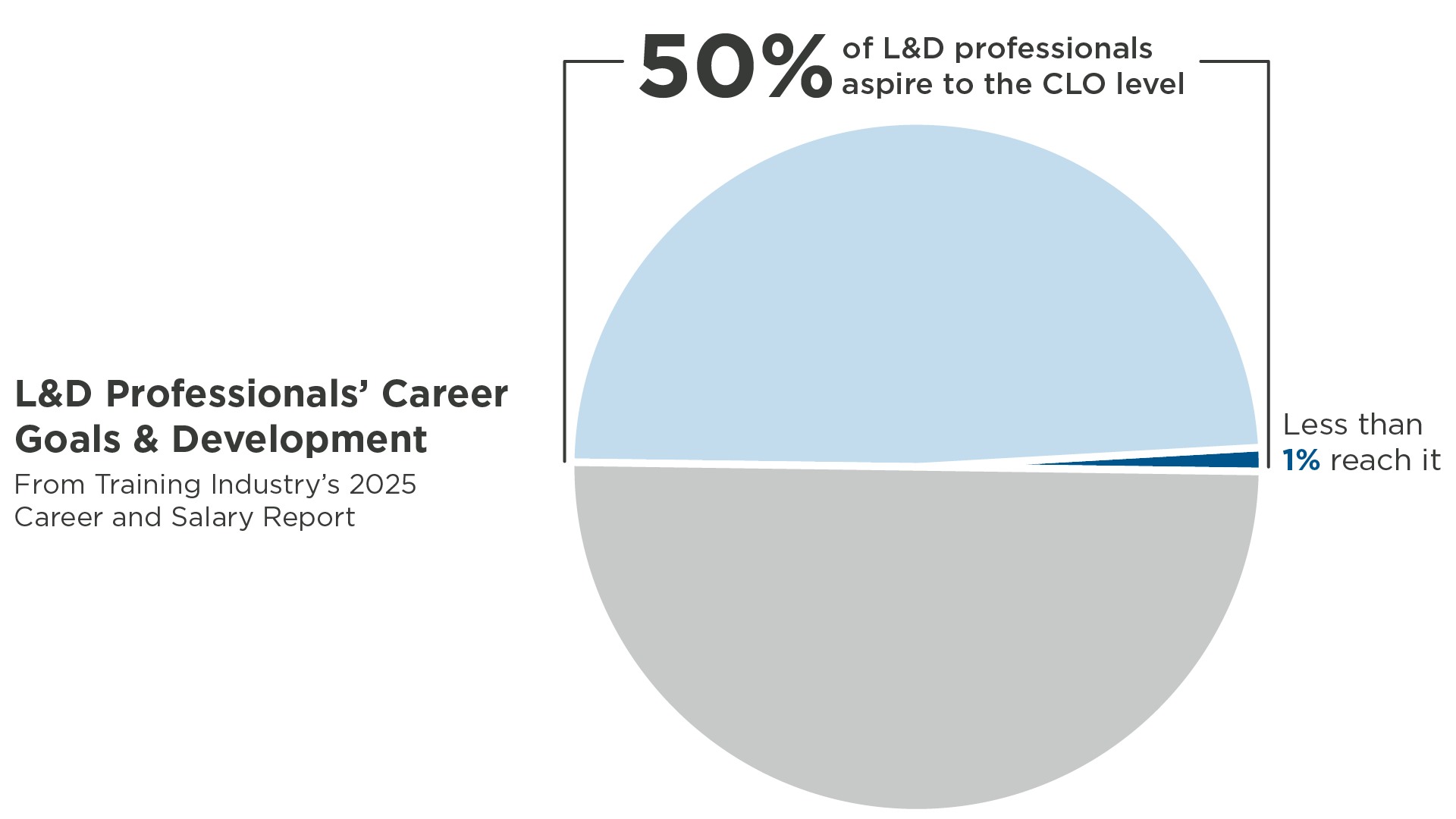
Becoming a director of training or CLO is the most common career goal for training professionals. About 50% aspire to the CLO level, yet fewer than 1% achieve that goal, according to Training Industry’s Career and Salary Report.
Competencies of a CLO
A successful CLO combines strategic, operational and leadership expertise, which includes:
- Strategic alignment: Connects L&D initiatives directly to organizational objectives and business outcomes.
- Executive influence: Engages and persuades senior leaders to champion learning initiatives and cultural change.
- Financial management: Oversees L&D budgets, optimizes resources and ensures ROI for training investments.
- Learning function oversight: Manages the L&D function, including programs, processes and performance measurement.
- Technology and resource management: Leverages learning technologies, platforms and tools efficiently to maximize impact.
- Team leadership: Guides and develops L&D teams, fostering collaboration, innovation and operational excellence.
- Change leadership: Drives organizational transformation, building a culture of continuous learning and adaptability.
How to Get Promoted to the C-Suite
While there is no single path to the CLO role, most advance from L&D, talent management or organizational development roles. Common trajectories include:
L&D leadership: Starting as trainers, instructional designers or learning managers, then advancing to director or executive roles.
HR and talent management: Transitioning from HR leadership, talent management or organizational effectiveness positions.
Business and strategy roles: Moving from business strategy, consulting or operations, bringing expertise in aligning learning with corporate goals.
Academia and research: Some CLOs come from higher education, workforce research or thought leadership in adult learning.
Education and Experience of CLOs
Typically, executive-level L&D roles require a bachelor’s degree in organizational development, HR, business or education, along with more than 10 years of experience in L&D and at least five years in senior leadership.
Many aspiring CLOs strengthen their readiness by participating in executive-level programs, such as the Training Industry Senior Leaders Program — an elite, cohort-based experience that equips senior L&D professionals with the mindset, tools and network to lead at the enterprise level and prepare for the C-suite. A master’s degree can also further strengthen career prospects.
Building and Developing High-Performing L&D Teams
High-performing L&D teams stand out by driving real business impact, fostering a culture of learning and continuously adapting to organizational needs. Therefore, it’s critical for organizations and leaders to empower and invest in their team to drive real business impact.
To ensure your L&D function becomes a key player in your organization’s employees’ long-term success, focus on upskilling, interdepartmental connections and creating effective leadership development programs.
Upskilling L&D Teams With Purpose
Building and maintaining a high-performing L&D function requires continuous learning. With that in mind, here are a few ways to upskill your L&D team:
- Conduct regular team skills audits to proactively identify strengths, gaps and development priorities. To get started, here’s a free team assessment.
- Create structured learning paths. Don’t just offer optional webinars or one-off trainings.
- Empower your team with role-specific development or shared experiences like team certification. Whether it’s together or individually, every member should be building toward strategic capability.
Plan Your Team’s Development
Organizational impact starts with a strategically aligned team. Training Industry Courses offers several professional development options for L&D teams.

Aligning Roles to Business Priorities
Strategic alignment is a core responsibility of training managers. As a result, ensuring that your L&D team is aligned with key business priorities is essential to achieve successful outcomes. Here are a few ways to ensure the team is aligned with the business:
Operate with an internal consulting mindset, moving beyond training to enable performance and business outcomes.
Sit in on strategic planning meetings and actively contribute. So, if you haven’t been invited to the “table,” make your own. Schedule a meeting and invite the necessary stakeholders.
Additionally, embed L&D into cross-functional conversations, from HR to operations to IT.
Measuring Team Effectiveness
L&D leaders must measure how effectively their teams operate, including the efficiency of core training processes and the skills and capabilities required to deliver results.
| Key Indicators of Team Effectiveness | How To Measure Team Effectiveness |
|---|---|
| Clear and open communication | Use surveys or pulse checks to assess communication, trust and engagement |
| Regular, constructive feedback among team members | Track progress toward shared goals and key performance indicators (KPIs) |
| High emotional intelligence (EQ) and psychological safety | Conduct skills assessments and performance reviews before and after major projects or training |
| Well-defined structures and processes for collaboration | Gather 360-degree feedback from team members, stakeholders and leaders |
| Accountability for results and behaviors | Review team processes and norms for clarity and efficiency |
| Alignment with organizational goals and strategy | Evaluate the team’s ability to adapt to change and solve problems together |
The Future of Learning and Development Careers
How Will AI Change L&D Jobs?
AI is fundamentally reshaping L&D roles, moving the focus from routine administration to strategic leadership and innovation. As a result, L&D professionals will spend less time on manual tasks (like scheduling, tracking and basic content creation) and more time on strategy and aligning learning with business goals.
As a result, understanding how to use, evaluate and integrate AI tools is fast becoming a core skill for L&D professionals. This includes selecting the right AI solutions, ensuring ethical use and balancing automation with human oversight. Many are completing specialized courses to do so, including the AI Essentials for L&D Certificate and the AI Workforce Adoption Certificate.
Emerging Roles in L&D
Several new roles are emerging within L&D teams to meet the changing needs of organizations and learners. These roles go beyond traditional training delivery and content development, focusing more on strategic partnership, technology integration and the employee experience. For instance, examples include learning engineer, AI simulation or scenario designer, performance consultant, learning analytics specialist, or L&D curator.
In-Demand Skills for L&D
Make sure you’re staying up to date with articles, webinars or specialized courses that focus on in-demand skills, such as agility, empathy, critical thinking, innovation and AI literacy.
Preparing for Continuous Change
As L&D functions are experiencing rapid and ongoing change, learning professionals must remain learner-centric, continuously align programs with shifting business priorities, build strong stakeholder partnerships to anticipate emerging risks and foster a culture of continuous learning.
Frequently Asked Questions About L&D Careers
What Skills Matter Most to L&D Professionals?
The most valuable skills for L&D professionals blend technical expertise, business acumen and strong interpersonal abilities. Here are the in-demand skills for 2026.
Are L&D Roles Becoming More Technical?
Technical skills in L&D are growing as organizations adopt new learning technologies and data-driven approaches. From data fluency to new roles like learning experience designers, learning technologists and content curators.
However, the shift is about blending technology with strategic, human-centered capabilities. Human skills like storytelling, stakeholder engagement and change management remain critical and are often enhanced by technology.
Are Certifications Helpful for L&D Careers? What Certifications are Valuable?
Certifications are increasingly valuable for L&D professionals. Earning a recognized certification can help you stand out, validate your expertise and demonstrate your commitment to continuous learning and professional growth.
The most valuable certification will depend on the skill or competency you are trying to build. Ultimately, prioritize application-based programs that help translate knowledge into practical skills you can use on the job. To help, here is a list of L&D certifications.
How Much Do L&D Professionals Earn?
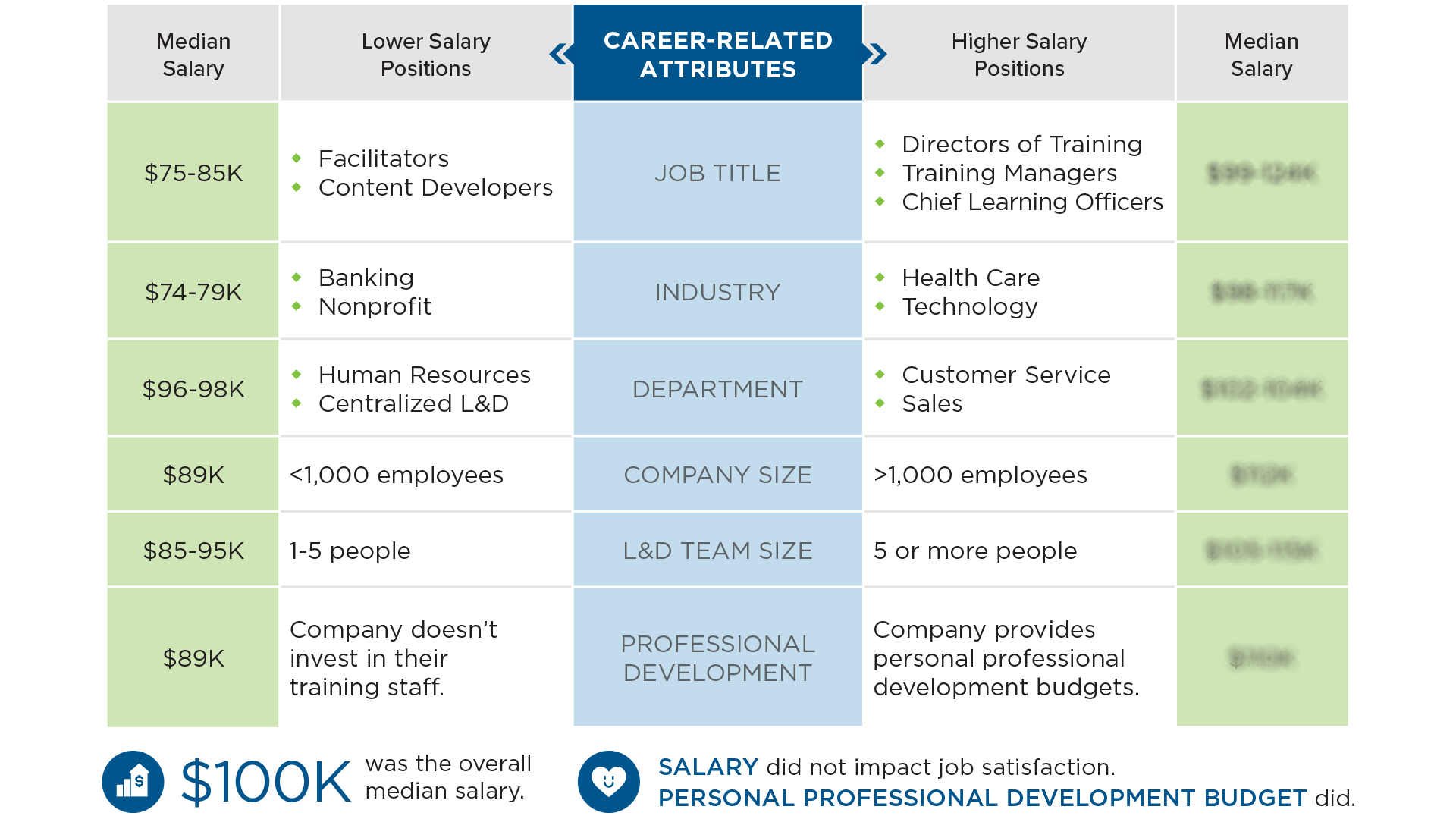
The median salary for L&D professionals is $100K, according to Training Industry’s Career and Salary Report. Actual salaries may vary based on experience, company size and location. You can see a breakdown of L&D job roles with median salary here.
Is Learning and Development a Good Career?
L&D is widely considered a rewarding and growing career path. As organizations increasingly prioritize employee development, demand continues to rise for roles such as training managers, instructional designers and learning specialists.
The field offers meaningful work by helping others build skills and grow in their careers, while also providing opportunities for creativity across areas like facilitation, coaching and leadership development. With flexible entry paths and a strong culture of collaboration and continuous learning, L&D attracts professionals from many different backgrounds.

Discover L&D Salaries, Skills and Career Paths
Reveal key insights regarding career path and compensation factors in the L&D field.