
Employee Onboarding Guide for L&D Leaders

Executive Summary
- Employee onboarding is a strategic learning experience that helps new hires build role readiness, accelerate productivity and transition into long-term success.
- An effective onboarding program extends beyond orientation, combining structured learning, manager support and practical application across the first several months of employment.
- Strong onboarding improves retention, engagement and time-to-productivity by giving employees clear expectations, relevant support and a more consistent early experience.
- The most effective onboarding programs are role-specific, manager-enabled and designed as phased journeys that continue past the first 90 days.
- L&D leaders can improve onboarding by aligning it to business outcomes, measuring impact and connecting early learning to long-term development and talent growth.
Overview of Employee Onboarding
Employee onboarding, also known as induction or assimilation, is a structured learning experience that helps new hires build the knowledge, skills and confidence needed to succeed in their roles. For learning and development (L&D) leaders, it is one of the most direct ways to influence both immediate performance and long-term talent outcomes.
An effective onboarding program bridges the gap between hiring and performance. It turns the expectations set during recruitment into day-to-day clarity by helping employees understand what success looks like, how their role supports business goals and where they fit within the organization. When onboarding is treated as a deliberate learning journey rather than a one-time event, organizations create stronger foundations for performance, engagement and growth.

What Is Employee Onboarding?
Employee onboarding is the process through which employees build the skills, knowledge and behaviors needed to contribute effectively within an organization. While it is most often associated with new hires, onboarding also applies to employees transitioning into new roles, taking on expanded responsibilities or moving into leadership positions.
In modern organizations, onboarding is a multiphase experience that extends beyond an employee’s first day or first week. It typically combines formal training, manager support, social integration and practical learning to help employees understand expectations, build role readiness and begin contributing with confidence.
Onboarding Versus Orientation
Onboarding and orientation are often used interchangeably, but they serve different purposes. Orientation is typically a one-time event focused on foundational information such as policies, benefits, compliance requirements and company basics. Its purpose is administrative and informational.
Onboarding is broader and more strategic. It is an extended process that helps employees understand their role, develop early competence, build relationships and transition into productive contributors. Orientation may be one part of onboarding, but it is not the full experience.
What Does Effective Onboarding Look Like in Practice?
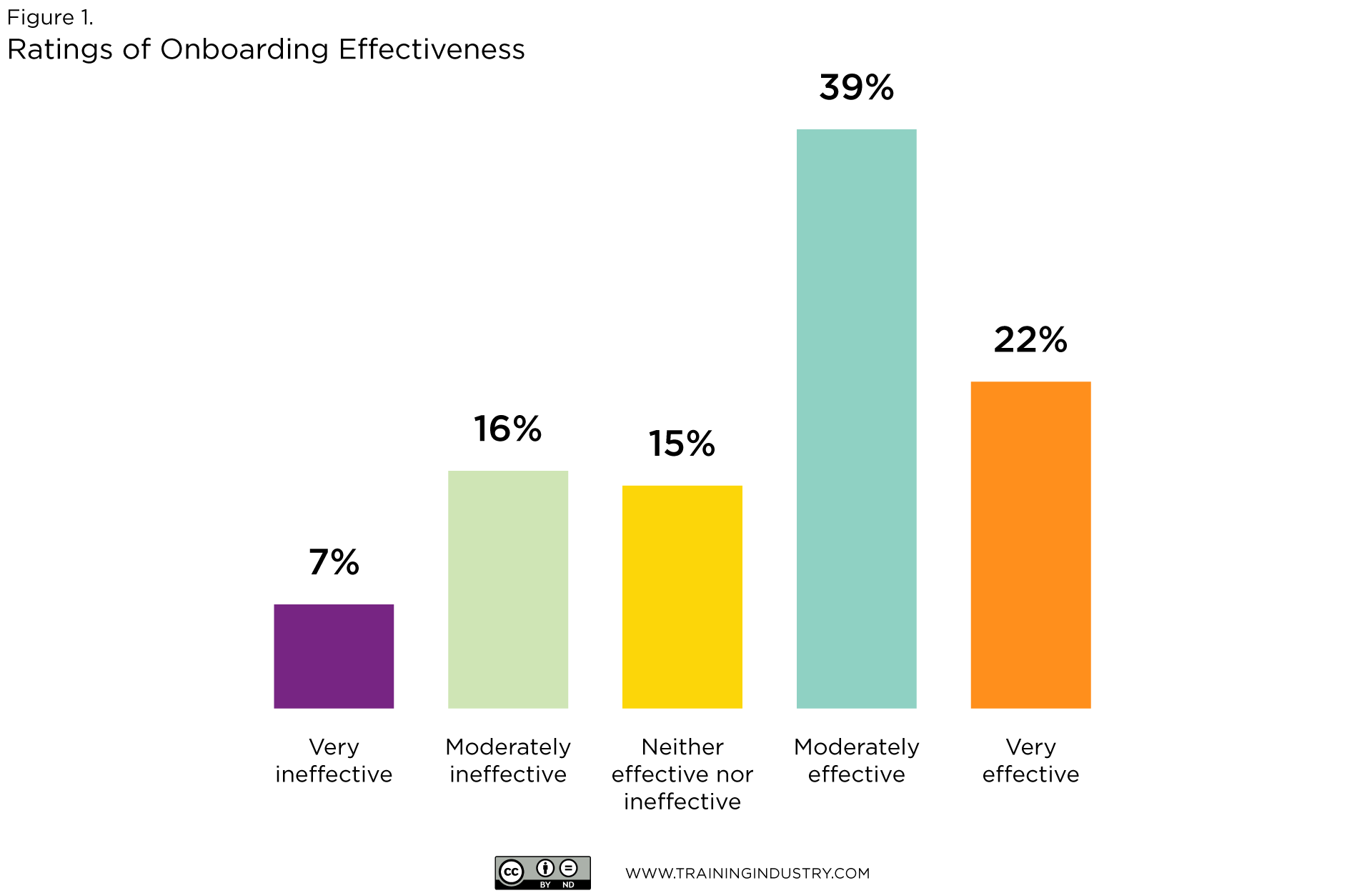
Only 22% of organizations describe their onboarding as highly effective, according to Training Industry research. Onboarding should do more than welcome new employees. It should give them the clarity, support and context needed to become productive and confident in their roles.
In practice, that means helping employees understand expectations, build role-specific capability, navigate how work gets done and form the relationships needed to contribute effectively. Strong onboarding also connects employees to team and business priorities, shortens time-to-productivity and creates momentum for long-term development.

Benefits of Onboarding for the Business
Onboarding has a direct impact on business performance. It influences how quickly employees become productive, how engaged they feel in their work and whether they stay long enough to create value. When it is intentional and well-structured, onboarding improves retention, strengthens employee experience and helps employees contribute faster.
Strong onboarding improves retention by helping employees feel prepared and connected from the start. It also shortens time-to-proficiency by delivering the right information, tools and support at the right moments, rather than overwhelming employees all at once. Just as importantly, onboarding shapes the employee experience. Early interactions influence how employees perceive the organization, its culture and their future within it, making onboarding a critical driver of both performance and engagement.
The Risk of Poor Onboarding
Ineffective onboarding creates avoidable risk. It can delay productivity, reduce confidence, weaken role clarity and increase the burden on managers and peers. Over time, this can lead to inconsistent performance, lower engagement and higher early attrition.
5 Employee Onboarding Best Practices
Designing employee onboarding effectively requires building a structured experience that aligns business goals, role expectations and employee needs across the first several months of employment. The strongest onboarding programs are intentional by design, helping employees build confidence, capability and connection in ways that support both immediate productivity and long-term success.
1. Define Onboarding Goals and Outcomes
Effective onboarding starts with clear outcomes. Before building content or scheduling sessions, organizations should define what employees need to know, do and demonstrate by the end of onboarding. Without that clarity, onboarding can quickly become a collection of disconnected activities rather than a purposeful learning experience.
At a minimum, onboarding goals should define what success looks like in the role, including performance expectations, early milestones and the knowledge employees need to work effectively. Employees should understand what they are responsible for, how their work contributes to broader business goals and what they should be able to accomplish in their first 30, 60 and 90 days. They also need enough organizational context to understand how decisions are made, how teams work together and where to go for support.
Clear outcomes create alignment across L&D, HR, managers and business leaders while giving employees a clearer sense of direction and progress.
2. Structure the Employee Onboarding Journey
Onboarding should be designed as a phased journey, not a single event. Employees build readiness over time through repeated exposure, practice and reinforcement. Structuring onboarding in stages helps organizations deliver the right support at the right time while reducing overload and improving retention.
Preboarding begins before day one and sets the tone for the employee experience by reducing uncertainty and preparing employees with practical information, early context and access to the tools they need.
The first 30, 60 and 90 days should then build progressively from foundational knowledge and relationship building to practical application, performance support and increasing independence.
Extend onboarding beyond the first 90 days. Continued reinforcement, coaching and skills development help employees move beyond basic readiness to sustained contribution.

3. Use Blended and Digital Onboarding Approaches
The most effective onboarding programs use a mix of learning methods rather than relying on a single delivery format. Employees need different types of support at different stages, and outcomes improve when learning is offered in a variety of formats.
For instance, instructor-led sessions help create context, answer questions and build connection early. Self-paced learning gives employees flexibility to absorb foundational knowledge at their own pace. Experiential learning, such as guided practice, simulations and shadowing, helps employees apply what they are learning in realistic settings. Peer learning and coaching reinforce learning through collaboration and informal support, while just-in-time resources give employees access to practical support in the flow of work.
Together, these approaches make onboarding more flexible, manageable and effective by improving retention and reducing cognitive overload.
4. Create Role-Specific and Personalized Onboarding
While all employees need a shared understanding of the organization, onboarding should also reflect the specific demands of the role, level and function. A one-size-fits-all approach often leads to unnecessary content, missed priorities and slower ramp-up.
Role-specific onboarding helps employees focus on the knowledge, tools and expectations most relevant to their work. This may include function-specific business context, team workflows, role-based systems training and tailored performance expectations. More personalized approaches may also include flexible learning pathways and adaptive experiences based on prior knowledge or experience level.
Personalization improves relevance, helping employees spend less time sorting through information and more time building useful capability.
5. Creating Continuous Early Talent Development
Onboarding should not end when employees complete required training. It should transition into ongoing development. Employees need reinforcement, continued coaching and opportunities to build capability beyond their initial ramp-up period.
Strong onboarding creates the foundation for continuous learning by establishing early habits of feedback, reflection and development. When onboarding is connected to broader development, employees are better positioned to build skills, navigate growth opportunities and contribute more strategically over time.
Onboarding by Audience and Role
Onboarding is most effective when it reflects the needs of different employee groups. Here are some key considerations:
Onboarding for Individual Contributors
For individual contributors, onboarding should prioritize role-specific training, practical application and early productivity. These employees need clear expectations, process knowledge and immediate role readiness.
Onboarding for First-Time Managers
First-time managers need additional support as they transition into leadership. Moving from an individual contributor into a manager role requires a greater focus on interpersonal dynamics, so training on coaching, delegation and feedback skills is essential.
Leadership and Executive Onboarding
Leadership onboarding should focus heavily on strategic alignment, stakeholder integration, organizational context and business priorities. Leaders and executives often need accelerated access to decision-making networks and strategic clarity.
Early Career and Entry-Level Talent
Early career employees benefit from more foundational support, including workplace norms, communication skills and visibility into career pathways. Their onboarding should help build confidence and establish strong developmental habits early.
The Role of Managers in Onboarding
Managers are one of the most important drivers of onboarding success because they translate formal training into day-to-day performance. While L&D and HR may design the broader experience, managers make it relevant to the employee’s role by setting expectations, providing context, reinforcing learning and helping employees apply what they have learned through regular check-ins, coaching and feedback.
Because managers play such a central role, L&D must equip them with the tools and guidance needed to support onboarding effectively. Clear expectations, structured check-ins and practical coaching resources help make manager-led onboarding more consistent across teams. When managers are prepared and engaged, onboarding becomes more connected to real work and more effective overall.
How to Create an Engaging Employee Onboarding Program
Onboarding is one of the earliest and most influential moments in the employee experience. It shapes how employees perceive the organization, their team and their future within the business. An engaging onboarding experience helps employees feel supported, while giving them the clarity and structure they need to begin contributing effectively.
Creating an engaging experience requires more than delivering information. Clear communication, predictable structure and well-paced learning help reduce uncertainty and make onboarding easier to navigate. Social learning, peer connection and collaborative experiences help employees build trust faster while reinforcing culture and team integration. When employees feel supported both socially and operationally, onboarding becomes more effective and more likely to create long-term momentum.
In this episode of The Business of Learning, sponsored by Wisetail, we spoke with Geoffrey Roche, director of workforce development at Siemens Healthineers, to explore how L&D can drive more human-centered, inclusive onboarding experiences that make a lasting impact.
Read the full episode transcript here
Measuring Onboarding Effectiveness
Organizations cannot improve onboarding without measuring its impact. Effective measurement helps L&D leaders understand what is working, where employees struggle and how onboarding contributes to business outcomes. Without clear data, it is difficult to know whether onboarding is accelerating readiness, improving retention or simply delivering information without measurable impact.
Performance and Productivity Metrics
Performance and productivity metrics help organizations evaluate how quickly employees become effective in their roles. Common measures include time-to-productivity, ramp-up time, early performance benchmarks and completion of key milestones such as required training, early deliverables or demonstrated proficiency in core responsibilities.
Retention and Engagement Metrics
Retention and engagement metrics offer a complementary view of onboarding effectiveness. Early turnover, new hire retention and employee satisfaction can reveal how supported and prepared employees feel in the first several months. Onboarding surveys and manager feedback can further validate whether onboarding is translating into stronger readiness and engagement.
Data-Driven Insights
Strong onboarding programs use both quantitative and qualitative data to improve continuously. Reviewing feedback, performance trends and employee insights helps L&D teams identify friction points, refine content and strengthen outcomes over time.
For example, if employees consistently report confusion at a specific stage, or if managers identify the same performance gaps across new hires, those patterns can signal where onboarding needs to be adjusted. Reviewing both quantitative metrics and qualitative feedback helps L&D make more informed decisions, improve the employee experience and ensure onboarding remains aligned to evolving business needs.
Employee Onboarding Technology and Tools
Technology plays an important role in scaling and improving onboarding, especially as organizations grow, hire across locations or support more complex employee experiences. Learning management systems (LMSs), onboarding platforms, automation tools and digital workflows help organizations create experiences that are more consistent, accessible and easier to manage.
Used well, technology can support learning delivery, workflow automation, progress tracking, content personalization and resource access. It can also make onboarding more flexible and scalable across teams, roles and locations. The goal is not to automate onboarding for its own sake, but to make it more efficient, learner-centered and easier to navigate while preserving the human connection that makes onboarding effective.

Common Onboarding Challenges
Even well-intentioned onboarding programs often fall short in predictable ways. Not because organizations lack effort, but because the experience is not designed with the learner in mind. Here are some common challenges:
Overloading new hires with too much information too quickly
In an effort to be thorough, organizations often front-load policies, systems and training into the first few days, leaving employees overwhelmed and less likely to retain what they have learned. Effective onboarding requires sequencing information in a way that supports application, not just exposure.
Lack of structure or clearly defined milestones
Without a consistent framework, onboarding can become reactive and fragmented, making it difficult for employees to understand what they should be learning, when they should be applying it and how progress will be measured. This often leads to inconsistent experiences across teams, where the quality of onboarding depends more on individual managers than on organizational design.
Poor manager involvement
Managers play a central role in helping employees translate formal training into day-to-day performance, yet many are not equipped with the skills or tools needed to do so effectively. When managers lack time, clarity or coaching capability, employees receive less support applying what they have learned.
Weak alignment between onboarding and business goals
Many organizations also struggle to connect onboarding to business outcomes. When onboarding is treated as an administrative process rather than a strategic business function, it becomes harder to align learning to performance or demonstrate impact.
How L&D Leaders Can Improve Onboarding Programs
Improving onboarding starts with treating it as a business-critical learning experience. For L&D leaders, that means shifting the focus from information delivery to performance readiness and designing onboarding around what employees need to know, do and demonstrate to succeed.
That starts with defining clear outcomes aligned to business priorities and building role-specific learning paths that reflect the needs of different employees, functions and levels. It also means equipping managers with structured tools, such as conversation guides and coaching frameworks, so they can reinforce learning more consistently in the flow of work.
L&D leaders can strengthen onboarding further by extending it beyond orientation and measuring outcomes continuously. Tracking productivity, engagement, retention and employee feedback helps teams identify gaps, refine the experience and improve results over time. For organizations looking to improve quickly, the highest-impact opportunities are often the simplest: clarify ownership, reduce overload, strengthen manager involvement and define measurable outcomes.
Onboarding Objectives
Create compelling onboarding objectives to immerse new hires in the training experience. Examples include:
- Reaffirm the organization is a great place to work by showcasing its benefits, culture and core values.
- Generate excitement toward the organization’s achievements, mission and goals when welcoming and inducting employees.
- Encourage a sense of belonging to the organization and the team by forming connections and guiding networking opportunities during onboarding.
- Create role engagement and satisfaction by establishing performance goals, management check-ins and an evaluation cadence.
- Integrate new hires into their team by highlighting established processes and workflows and creating a welcoming environment conducive to achieving team targets.
- Guide the consumption of learning, resources and activities for new hires to accomplish during onboarding.
Connecting Onboarding to Long-Term Development
The best onboarding programs do more than prepare employees for their first 90 days. They establish the foundation for long-term growth by connecting early learning to broader talent development goals. When onboarding is treated as the first stage of the employee development journey, organizations create stronger continuity between initial role readiness and long-term capability building.
Effective onboarding should introduce employees not only to their immediate responsibilities, but also to the skills, behaviors and development pathways that support future growth. Early visibility into career pathways, ongoing learning resources and development expectations helps employees see how growth happens over time.
As employees gain confidence and capability, onboarding can also serve as an entry point into internal mobility and succession planning. Employees who understand how skills develop across roles are better positioned to pursue future opportunities, build broader capability and contribute more strategically over time.
Frequently Asked Questions About Employee Onboarding
How long should onboarding last?
Onboarding often lasts 90 days or longer depending on role complexity and business needs. An effective onboarding experience helps employees continue to grow throughout their tenure at the company.
What is the difference between onboarding and orientation?
Orientation is a one-time event focused on administrative and foundational information. Onboarding is a broader process that helps employees build capability, integrate into the organization and become productive over time
How do you measure onboarding success?
Onboarding success is typically measured through time-to-productivity, ramp-up time, retention, engagement, milestone completion and employee feedback.
What makes onboarding effective?
Effective onboarding is structured, role-relevant, manager-supported and aligned with business outcomes. It helps employees build confidence, competence and connection over time.

Discover More Onboarding Resources
Download guides, e-books, templates and more to help you improve the impact of corporate learning and development.
