We have completed three related research pieces over the last year and a half, focusing on sustaining the impact of the sizable investment that corporations make in sales training.
Whether you call it sustainment, coaching or mentoring, the bottom line is that the best companies have a strategic plan to ensure that learned behaviors continue beyond the initial training event. It is interesting to note that our studies consistently indicated that the majority of organizations were not effective in their sales training sustainment efforts.
Specifically, across the 540 companies participating in the research, only 9.7 percent of respondents said their sustainment programs were very effective. A contributing factor to this low percentage may be the difficulty in identifying the right people to include in sustainment and coaching programs. More specifically, the people who most need coaching may not choose to participate in the training.
Remember, we’re talking about salespeople here, with a large percentage of their compensation tied to success. Some sales professionals can be motivated by an almost exclusive focus on closing sales deals, and they may not immediately recognize the benefits of participation.
So, our hypothesis is that successful organizations have found a way to incent employee participation in their sustainment programs through the introduction of gaming principles and mechanisms. Although the usage levels for gamification do not suggest a resounding endorsement by learning leaders, ranging anywhere from 8 percent to 20 percent across the three studies, there is an interesting dynamic when the companies rating their coaching or sustaining programs as very effective are compared with the rest of the market.
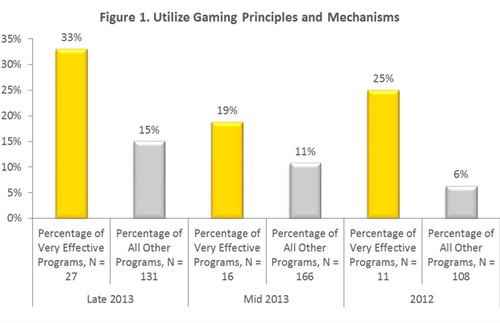
Our most recent study, “Elements of a World Class Coaching Program,” conducted in late 2013, revealed that only 20 percent of respondents use gaming principles to motivate participation in sales coaching programs. However, very effective companies were two times more likely to include gamification in their sales training programs as opposed to companies that were not rated as very effective (see Figure 1).
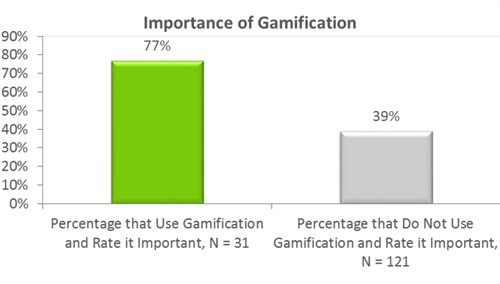
Even more interesting, respondents whose organizations included gamification in their training programs were almost twice as likely to rate the use of gaming principles in the design of their coaching program as important to its success (see Figure 2).
One of our earlier studies, “Strategies for Sustaining Sales Training,” conducted in mid-2013, indicated that while only 12 percent of sales coaching programs utilize gamification, effective programs used gaming principles almost twice as often as all other programs (see Figure 1).
Further support for the idea that the use of gaming principles impacts the quality of coaching and sustainment programs, comes from our study, “The Guide to Sustaining the Impact of Sales Training,” conducted in 2012. This study revealed that very effective sales coaching programs utilized gamification more than four times as often as those that were not rated very effective (see Figure 1).
The trend we’ve seen over the course of these three studies – starting in late 2012 through the end of 2013 – is the increase in the use of gamification (from a low of 8 percent in 2012 to a high of 20 percent in late 2013).
This upward trend may be explained in part by differences in the samples across studies, as they were drawn from the same population. However, each study contained a large enough sample to support the findings. Based on this information, I think we’re safe to say that the use of gamification is growing.
Summary
The use of gaming as a strategy to encourage participation in coaching and sustainment programs is gaining momentum, and its adoption in the most effective programs is substantially higher than that of the population of sales programs at large.
My recommendation would be for learning professionals to consider including gamification as part of their sales training sustainment program. This is further supported by the fact that the percentage of respondents rating gamification as important to the program nearly doubles when they have been exposed to its use as a strategy for motivating participation.