One constant theme that we encounter through the various research projects we conduct at Training Industry, and the work we have done for “What Makes a Great Training Organization,” is that best-in-class organizations are mindful of the impact that modality has on the design of a training program. This is not only from a media perspective, but also related factors such as duration, interactivity and the role of exercises or experiences in the program. Great training organizations even go as far as considering the extent to which the materials will serve as reference well after the end of the program.
In a recent research piece on the role of digital content delivery (DCD) platforms in corporate learning environments, we not only learned that tools were being adapted in many learning organizations, but there is a clear pattern emerging in terms of the role DCD platforms have in the learning initiative and how effective they are in playing that role.
Specifically, across the 280 participating organizations, 70 percent are currently or planning to use a DCD platform in support of training programs for technical skills training, leadership training, soft skills training, and as part of their new employee onboarding initiatives.
When analyzing the data to see which features of a DCD platforms best support training, we found that 50 percent or more of participants rated these nine features as very important when considering a DCD platform:
1. Supports multiple media formats
2. Supports multiple browsers
3. Supports learning assessments
4. Search text
5. Integrates with the LMS
6. Allows for a single sign on experience
7. Provides some degree of analytics
8. Supports a variety of document formats
9. Supports multiple devices
Many of the features listed are administrative in nature or involve the user experience within the platform before any content is consumed. But if we look at the nine features in terms of which ones impact design, then three strong contenders jump out, including supports multiple media and document formats and text search capabilities.
Crossing these content-related attributes of the DCD platform and the areas of use or planned use, participants revealed some important facts about how they intend to use the DCD platforms in support of their learning initiatives.
For technical skills training, we can really see the value of search through the technical manuals as reference after the program is complete. We can also see the integration of video examples demonstrating “how to” fix a problem. (See Figure 1.)
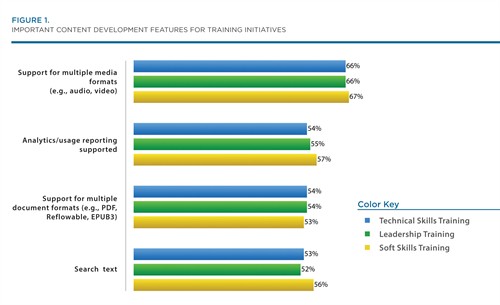
When looking at leadership training and soft skill training ─ which did surprise us as the second and third most likely area for use or planned use of a DCD platform ─ we can see video integration to model behaviors, audio only reinforcements for daily action, and search capabilities as features to consider when confronting a challenging employee or situation (see Figure 1). These actions suggest that designers are starting to see the potential of content being accessed after the training event when throwing a DCD platform into the mix. This clearly affects the long-term impact of the training program and its sustainability throughout the organization over time.
What Research Tells Us
Programming designers are dictating the direction of these DCD platforms by demanding a capability set that enables better learning. The ability to leverage these players to provide the learner with a robust offering by incorporating various media, document types and integrated analytics allows programs to be taken to the next level. A theme that seems to be surfacing in many of our research pieces is that blending various media and methods enhances the learning experience. We are also seeing learners demand the content in the modality they feel most comfortable with.
Our challenge is to design with these new realities in mind, and not to default to instructor-led programs with a paper manual. We can save money and improve the impact of our programs by pushing the envelope on the introduction of tools like DCD Platforms into the mix.
Summary
We often teach and direct learning professionals not to allow the technology or the modality to overcome the impact of the learning experience, in fact it has been shared with us as a best practice in several studies. I challenge us to change that way of thinking slightly. Let’s continue to push the technologies to better fit our needs, but more importantly, let’s leverage those technologies to develop better programs.
The use of DCD platforms for programs focused on soft skills may feel a bit out of the core way of thinking, but consider the benefits of a consistency of the modelling of the behavior you are trying to help your organization embrace. Also, remember that a well-designed set of learning support tools and leveraging the media types that today’s DCD platforms allow can improve the sustainability of your programs and impact employee effectiveness long after the training event.