
The concept of the “uncanny valley,” first coined by roboticist Masahiro Mori in 1970, describes the unsettling effect whereby robot faces, video games, CGI, and the like fall somewhere on a continuum of eerie to repulsive when they fall short of actually mimicking human appearance and motion. Said another way, the closer we get to the real thing, the less we start to like it. We’re better off with some technology not trying to masquerade as the real thing. The general shape of this relationship looks something like this, where the red arrow represents the cusp of “close but no cigar.”
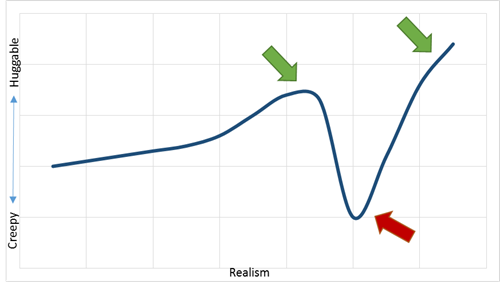
The same concept applies to many organizations’ approach to dealing with risk: it’s an attractive idea, few can deny the importance of it, and success stories of risk mitigation practices are not too difficult to find. So where’s the valley? Operational execution.
Whether it’s a preventative measure or a response to an adverse event, identifying what the risk is, what can be done about it, how to modify training, and what the desired end state looks like are the easy parts (well, easier by comparison). The big lift comes when it’s time to put all those plans into motion. It’s when executive buy-in and tending to organizational culture matters most, and when thoughtful preparedness makes the difference between a risk management training program that performs as intended versus a program that does little to dampen the specter of litigation. To have effective implementation, one must first have an effective training strategy, design and outcome metrics. What makes the valley so difficult to traverse is that it involves motivating people to action—to attend training, learn new skills and apply training back to the job. Addressing risk is very much like a change management initiative in the sense that it’s a process instead of a discrete event. Similar to the sustained effort required to pilot organizational change, a risk management strategy cannot succeed by force of its own good intentions on training day.
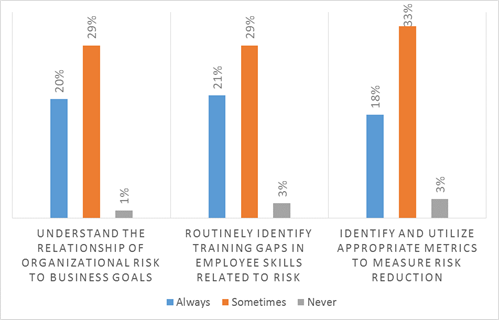
Forthcoming research from Training Industry on how organizations that operate in risky environments (e.g., manufacturing, health care) and volatile markets (e.g., banking/finance, technology) shows that not all organizations are thinking ahead. Below is an excerpt of the data, showing how many organizations (N = 153) are engaging in selected best practices when planning for strategy execution. As can be seen based on these three questions, roughly 20 percent of organizations are consistently taking a robust approach. The good news is very few organizations report never taking these tactical steps. However, the “sometimers” may get stuck in the valley, particularly if core pieces of their risk management strategy are never connected to outcomes. If you aren’t measuring the impact of training on risk, how will you know if you’ve made it out of the valley?
So how does an organization survive the uncanny valley of risk mitigation? The obvious answer is strategy, but hopefully it’s now a little more obvious how important training implementation can be and how central it is to success. For many organizations where uncertainty is part and parcel of their core business, they’ve navigated their risk portfolio because of their actions, not simply because they had ideas of what to do.


