

Leadership development doesn’t work.
This is a widely recognized challenge in today’s workplace. Charter Management Institute (CMI) research, “Taking Responsibility — Why U.K. PLC Needs Better Managers,” report 1 in 4 people in the workforce have a managerial role. Yet, in the study, “Companies Have Been Neglecting Their Leadership, And It Shows,” 75% of organizations do not believe their leadership development programs deliver high value to the company.
And since front-line managers make up one-half of a company and are responsible for 80% of the workforce, ongoing leadership development for front-line managers is a must. So, what is the source of this challenge? This article explores why leadership development is falling short in today’s workplace, and offers insights to shift your mindset to better support your front-line managers.
The Case for Front-line Management Training
A lack of leadership development can be particularly problematic in front-line industries like retail, food service, hospitality, and grocery, where employees are frequently promoted into management roles without formal training. In fact, the CMI report found 82% of managers are “accidental managers,” with no formal training.
Despite not receiving formal training, front-line managers are expected to do a lot: handle a pile of administrative duties, respond quickly to corporate requests, deal with challenging customers and put out unexpected fires that emerge as part of everyday operations. It can often be a difficult and overwhelming job — especially without the right training and support. And since many front-line managers feel like they’re making it up as they go, it’s no surprise 40% feel burned out on a daily basis, according to Axonify’s “The Deskless Report 2024.”
L&D must create a structured learning track for their leaders, with ongoing training opportunities customized to their schedule and role. We have to ditch the one-size-fits-all approach to leadership development. We must acknowledge that managers may not have the opportunity to complete training before taking the job and/or struggle to find time for training after being thrusted into a busy operation. We must ensure that all leaders receive this much-needed training, new or seasoned.
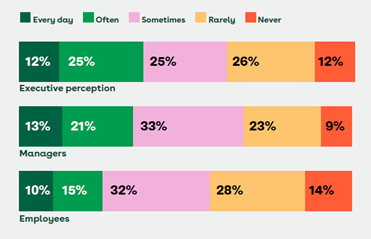
Studies show that 67% of front-line managers feel like they’re making it up as they go at least some of the time according to “The 2024 Deskless Report.”
Why Leadership Development for Managers is a Must
As managers rely on ongoing L&D to lead better, L&D needs front-line managers to guide employees through their learning journey. Front-line managers are the most important people in your organization: They are the connection between headquarters, where strategy is developed, and the front-line workforce, where the strategy is brought to life.
Workday’s 2022 report, “Frontline Workers: How to Connect, Enable, and Support Them in the Modern Workplace,” shows that employees are three times more likely to stay when they have a supportive manager. Yet, only 11% of front-line managers say their companies are structured to help managers support their direct reports through coaching and development.
L&D has to communicate employee training programs and activities to gain buy-in from managers and promote the company’s learning resources to them. Managers have to see the value of your learning projects so they can fully support their employees L&D through coaching or learning reinforcement, for example.
A Modern Approach to Management Enablement
eLearning courses will continue to be useful for managers’ L&D, especially when it comes to building complex skills. However, to help front-line managers do their best work from day one, courses must become a secondary tactic rather than the default solution. L&D must emphasize solutions that fit into the hectic manager workflow and provide guidance as people become increasingly comfortable in their roles.
The Modern Ecosystem framework from the book “The Modern Learning Ecosystem: A New L&D Mindset for the Ever-Changing Workplace,” can help L&D teams provide learning and support resources without disrupting the operation.
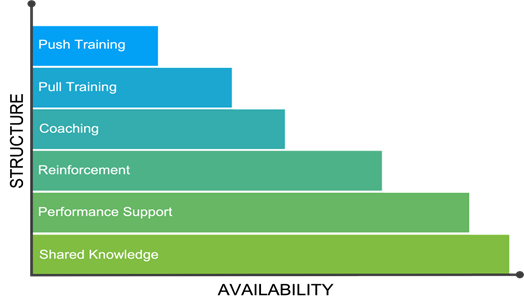
The Modern Learning Ecosystem Framework emphasizes real-time, on-demand support that fits within the everyday flow of work.
Let’s review a few training initiatives to include in your leadership development learning plan for front-line managers:
- SOPs: L&D can simplify the manager role by ensuring access to critical shared knowledge, including standard operating procedures (SOPs), essential workplace processes and proven practices for solving common problems.
- AI assistants: We can take this to the next level by providing managers with AI-powered digital assistants that are available anytime, anywhere help is needed. This can give managers a dependable source of support as they learn the job, reducing the need to figure things out on their own. It also reduces managers’ reliance on their own bosses, who are often unavailable and may view frequent questions or a lack of job understanding negatively.
- Peer networks: Peer learning and networking can be another simple-yet-powerful way L&D can alleviate manager performance struggles. Many front-line managers in industries like retail and food service are isolated from their peer groups. It’s impossible for them to know that a manager in a location hundreds of miles away has dealt with the same issue before. L&D can close this gap by fostering peer support networks. Using available communication tools, such as group chats or Microsoft Teams channels, L&D can facilitate collaborative problem solving without the need for training.
- Microlearning courses: Courses may not fit the busy manager workflow, but microlearning campaigns and reinforcement activities can easily be completed between job tasks. L&D can leverage mobile apps, email or text messaging to push short-form content directly to managers’ devices. These two to three minute exercises can challenge managers to solve real-world problems and reinforce information shared during structured training programs. Plus, asking managers to complete three minutes of training per shift is less disruptive than requiring attendance at a 60-minute webinar every month.
This drip-based approach to training your front-line managers also aligns with proven learning science principles, such as spaced reputation and retrieval practice.
Making the Case for Change
Organizations already know how critical managers are to business results. For example, managers account for 70% of the variance in team engagement. In the same report, engaged teams are 21% more profitable and 17% more productive, and experience 41% less absenteeism.
Making the case for manager enablement is easy. What’s hard is fitting enablement into the front-line manager experience without disrupting the business. When we can’t square this circle, managers fail to get the support they need. As a result, 60% of new managers fail within their first two years.
Managers want more help. One-half of front-line managers surveyed want additional training on topics like conflict resolution, emerging technology and stress management.
But there are only so many hours in the day, and managers already work overtime just to get the job done. By evolving our perspective on leadership development and adopting a modern drip-based training approach, L&D can provide managers with the tools they need to do a great job. Furthermore, L&D can leverage this approach to cover the basics while devoting structured training to more complex subjects.
It’s time to rethink leadership development and make sure managers aren’t forced to choose between themselves and the operation.


