

From content development to measurement and evaluation, training functions are responsible for numerous processes within their organizations. In fact, Training Industry research found that great training organizations excel across eight key process capabilities: strategic alignment, content development, delivery, diagnostics, reporting and analysis, technology integration, portfolio management and administrative services.
Large training organizations may have dedicated learning and development (L&D) professionals responsible for each of these processes. But in smaller organizations, managing all of the process capabilities needed to deliver great training can be challenging. For L&D teams of one, it can seem next to impossible. “Training teams of one do so much,” from developing their own content (and sometimes also delivering it) to evaluating the success of their programs, says Dr. Amy DuVernet, CPTM, Training Industry’s director of training and development.
How Common Are L&D Teams of One?
Training departments of one are less common in larger organizations, which are more likely to have the resources available to fund a larger training function. Internal Training Industry research found that just 2% of organizations with more than 10,000 employees have a training department managed by a single L&D professional. (The research found that 70% of training departments in these organizations are managed by an L&D department of more than 20 employees.)
However, 30% of organizations with less than 100 employees have a training department of one. Thus, being a team of one is not an uncommon challenge for L&D leaders working in smaller organizations.
L&D professionals working as a team of one face myriad challenges in their roles. Here, we’ll offer tips and suggestions that can help set them up for success.
6 Tips for L&D Teams of One
1. Do your homework.
Conducing a needs assessment is an essential first step in delivering strategic learning programs. Larger organizations are at an advantage here: Often, they have analytics teams that can provide pre-training performance metrics to help the training function identify needs. These metrics can also be used post-training to prove impact.
However, smaller organizations typically rely on the training function itself to gather these metrics. For this reason, DuVernet says that conducting a needs assessment is “more of a bare bones process” for teams of one. To get started, she suggests having conversations with learners and key stakeholders to determine their challenges and observing them on the job to pinpoint areas where training can help improve their performance.
Linda Bohn, CPTM, AVP, training and development officer at Summit State Bank, says that some training needs are more obvious — like leadership training — but some are more difficult to uncover. In her organization, Bohn is in the process of interviewing department heads to determine which types of training they are currently delivering, where the gaps are and what they need help with. “This will give us a clearer picture of how to address gaps on a broader scale, and maybe how to assist or guide subject matter experts in filling specialty gaps.”
2. Focus on what matters.
Receiving mounds of training requests from stakeholders is a common challenge for L&D teams of one. “Sometimes, training is seen as the answer to issues that would be better addressed by managers as performance issues,” Bohn explains. “Training may be a part of the solution, but just ‘throwing’ training at a problem is not always the answer, and can waste valuable assets and time, especially when you are a training department of one.”
It’s important for L&D teams of one to allocate their limited time and resources strategically. This means prioritizing training requests that are most critical to the business.
To determine which training requests to focus on, DuVernet suggests using the Portfolio Rationalization Model (Figure 1) to rate training requests based on how strategically aligned they are to business goals and their level of proprietary content. This will help you determine whether to custom develop the content, outsource its development (if resources allow) or eliminate it entirely.
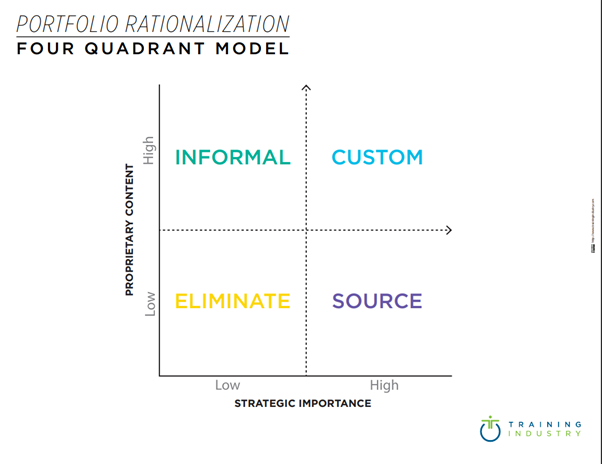
DuVernet also suggests asking stakeholders to rate requested programs based on the same parameters (i.e., strategic alignment and proprietary information). Doing so shows that you’re thinking methodically and strategically about what you decide to allocate your resources to.
3. Develop business acumen.
Developing business acumen can help training teams of one move from being seen as an “order-taker” to being seen as a trusted business partner.
Here are some suggestions for building business acumen:
- Develop basic financial acumen: Work to understand financial documents and reports. Ask your finance department to walk you through these documents and explain what they mean for both the business and the learning function. Consider taking a course or workshop to further develop your financial acumen skills.
- Sit in on business strategy and planning meetings: Ask your stakeholders if you can observe business strategy and planning meetings to better understand organizational challenges and goals. This will also help you better understand the language of the business so you can have more informed, productive conversations with your stakeholders.
- Keep up with industry trends and advancements: DuVernet suggests becoming a “student of the industry you’re in” by staying up to date on industry trends and developments. Reading industry-related journals, articles and magazines, and listening to podcasts or watching webinars produced by thought leaders in your industry, can help you stay ahead of the latest news and trends.
- Foster stakeholder relationships: Schedule regular meetings to talk with your stakeholders about current challenges and work to identify solutions (which may or may not involve training) that can help. This will help to establish yourself as a valued internal consultant to the business and help to secure your seat at the table. Bohn says she intentionally works to establish relationships with other department leaders to gain their partnership, buy-in and reinforcement of training she’s delivered. “It goes back to [providing] ‘internal customer service,’ which begins with building relationships and trust” and leads to partnerships.
4. Build your community.
L&D teams of one don’t have access to internal L&D colleagues. Thus, teams of one miss out on the learning that occurs naturally through informal, social interactions among colleagues.
DuVernet encourages teams of one to lean into networking to develop relationships with L&D professionals outside of their organizations. Connecting with other L&D professionals offers teams of one the ability to collaborate and brainstorm new ideas with their peers. It also provides insight into how other organizations are managing key training processes.
To begin building your L&D network, consider connecting with L&D professionals on LinkedIn and on other social media websites, attending industry conferences and events, or even pursing an industry certification to become part of an active alumni community.
5. Do what you can with what you have.
As a team of one with limited resources, you likely won’t be delivering next-level, immersive training programs utilizing the latest learning technologies available. That’s OK. The important thing is to deliver training that improves performance and supports business goals.
Fortunately, there’s many free resources and tools available that can help you get started. Bohn encourages teams of one to “get creative,” especially if you have budget restrictions. “You can get a lot of bang for your buck by finding what’s already out there to meet your needs and create a simple, efficient implementation plan,” Bohn says.
For example, generative artificial intelligence (AI) tools like ChatGPT or Bard can be used to create general course outlines, scripts for training videos, assessments and more. As a team of one, this can be a game-changer, saving you time and energy that can be better allotted elsewhere.
6. Don’t forget your own development.
Many training professionals struggle to make time for their own development. “We sometimes get so inundated with work that we forget that we need development, too,” DuVernet says. This is even more true for training teams of one.
To prioritize your own development, DuVernet suggests blocking time on your calendar for learning and creating a professional development plan (PDP).
Creating a PDP and checking in on your progress toward key goals can help you stay accountable and focused on achieving them. Even if you’re strapped for time, remember: Professional development doesn’t have to be a five-hour workshop or even a three-hour eLearning course. It can be 10 minutes of learning every day. “If all you can fit in is 10 minutes every day, that adds up significantly over time,” DuVernet says.
Parting Thoughts
In the end, many of the challenges that most training managers face are exacerbated for training teams of one, who have less time and resources at their disposal.
Being a training team of one isn’t easy, but by following the tips outlined above, you will be better positioned to make the most of your resources and establish yourself as a trusted partner to the business.


