

Most of us in learning and development (L&D) understand how the right leadership training program focused on the right behaviors can help leaders and their teams improve organizational performance. The question is: Do our executives, stakeholders and business partners also understand this connection?
Of course, company stakeholders hope that training investments increase the health of the organization and yield high returns, but the problem is we rarely give them any evidence of impact and return on investment (ROI) to support those expectations.
The responsibility of telling this story and proving training’s effectiveness falls squarely on us — the training professionals. And the key to telling this comprehensive “story of impact” is doing the research, aggregating the data and presenting the results.
Few L&D teams can do this well (or even attempt to). However, some have made measurement and accountability a powerful way to stand out. This case study highlights one company that successfully demonstrated the true impact of its training program.
Measuring the ROI of Leadership Training: A Case Study
Deploying the Training.
Riverside Public Utilities (RPU) is a department within the City of Riverside organization. RPU provides essential water and power services to over 300,000 residents and has approximately 600 employees.
In 2024, RPU embarked on a quest to enhance the skills of field foremen in the Water and Electric Field and Operations divisions. This program aimed to strengthen RPU’s leadership culture, improve employee retention and teach basic supervisory skills to previously untrained staff.
The City of Riverside’s internal Training and Organization Development team created a customized training experience for the Foreman, tailored content to be relevant to the role of a foreman, facilitated the entire experience and implemented an evaluation strategy.
There were a total of 13 sessions over 14 months including topics like: building trust, giving feedback, Situational Leadership II, management essentials, productive conflict, communication, emotional intelligence, coaching and leading people through change.
In addition, they offered group coaching to senior leaders and one-on-one coaching sessions for managers, with the objective to drive manager/supervisor support and accountability.
The question we needed to answer at the end of this considerable journey was: “Did it work?”
The Measurement.
Using a sample of 31 participants, this study sought to quantify how applying the skills and techniques taught in the leadership training sessions could promote key leader behaviors back on the job and drive higher performance for the organization. To measure impact, we used a six-level evaluation strategy.
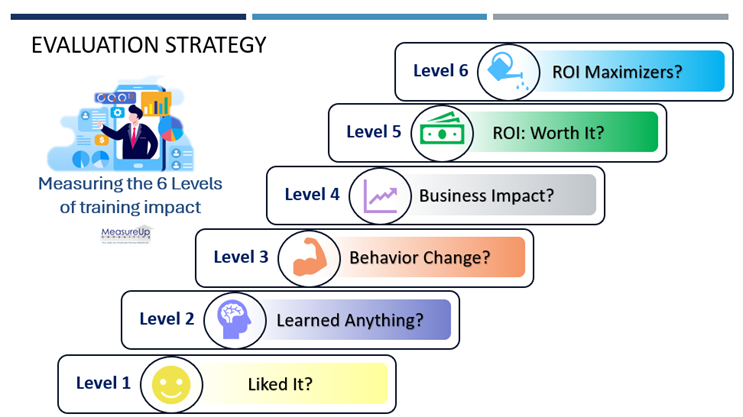
Six level approach to telling CA Riverside’s “Story of Impact.”
The Results.
Level 1
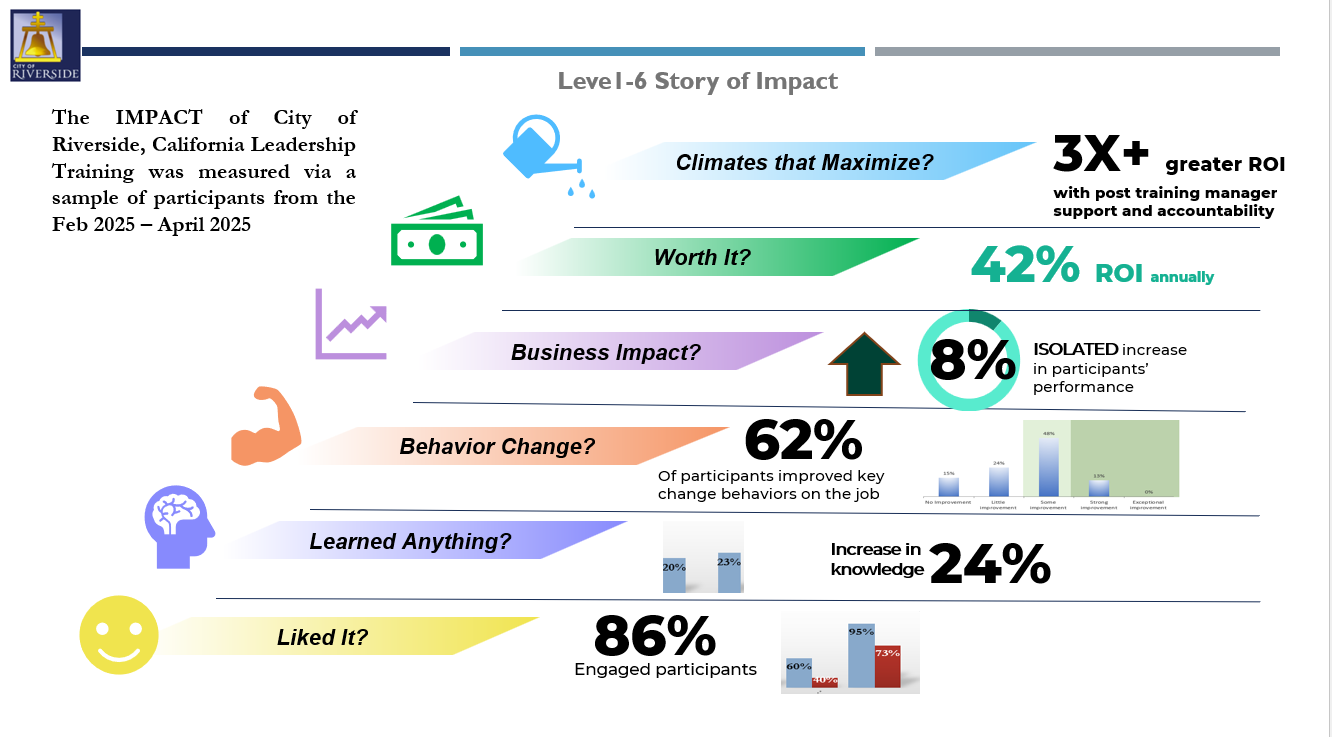
Participants rated their experience immediately after each session and results showed an overall average of 86% of participants were engaged.
Level 2
Participants were assessed on the new knowledge they gained on key topics from before to after the training experience. Results showed 96% of participants acquired new and valuable knowledge and the average before-to-after increase in that knowledge across all sessions was 24%.
Level 3
Participants were assessed for on-the job improvements in 21 specific leadership behaviors 60+ days after core training sessions. The behavioral improvements were captured on a five-point scale ranging from “no improvement” to “exceptional improvement” and key findings included 62% of participants demonstrating “some” to “exceptional” on-the-job improvement across all leadership behaviors.
Level 4
In this step, we isolated the impact of training on performance, we asked participants to first report their increases in productivity and contribution over the post-training months as a percentage (%), and then adjusted for error by factoring in only the participants who had significant behavior change on the job at Level 3. We also factored in only the amount (%) of time they actually used these leader behaviors. This brought an original estimate of 28% for everyone in the sample to an isolated and far more conservative 8%. So, our final results here showed an overall increase in productivity per participant of 8% directly attributable to training.
Level 5
To develop our ROI, we took the 8% isolated performance benefits identified at Level 4, monetized them (using a pay-for-performance industry standard), and compared them to the fully loaded costs of training over the 14-month journey. When we compared this to the fully loaded cost of training (including everything from internal facilitators to participants’ hours away from their jobs) we ended with a final ROI of 42%.
This meant for every $1 dollar invested, Riverside CA made back $1.42. It should also be noted that because the City of Riverside’s Learning & Organization Development team facilitated their own training for all 14 sessions, they realized a savings of $139,800, which if spent on external facilitators would have severely diminished their positive ROI.
Level 6
Lastly, we wanted to know: Did managers/superintendents hold participants accountable to demonstrate the learned behaviors back on the job and actively support their participants in their training journey? And if so, how did it affect the impact and ROI of the training?
To conduct this analysis, we first broke our sample into two groups: participants who had “high” manager support and those who had “low” manager support. We found that the participants who received high manager support back on the job, achieved an ROI of 113%.
Here’s a snapshot of the results at all six levels of impact:
Conclusion
The leadership training at Riverside Public Utilities transferred back to the job, increased employee performance for the organization, and yielded an impressive ROI. We were also able to show that following up with high accountability and manager support could dramatically boost the impact and ROI of the training.
But the lingering question is: If we never did this study, would we have been able to tell whether the training “worked?” More importantly, would we have been able to convince executives and stakeholders that their training investments were worth it?
Without collecting post-training data and measuring the Level 1 – 6 impact with hard numbers and dollar values, we would have never been able to tell this “story of impact.”
And without any of these positive stories, L&D will continue to be perceived as a function that takes budget instead of one that actually makes budget.
The contributions and value that L&D adds, by investing in and growing the capabilities of employees is the greatest source of health and vitality an organization can have. And it is through these types of case studies that L&D teams will finally be perceived as one of the most critical functions in the organization.


