
Personality assessments have become standard in corporate learning and development (L&D). Organizations use them to onboard new hires, coach managers, build leadership pipelines and compose balanced teams.
Yet much of their value is lost at the moment of interpretation, when a nuanced profile is collapsed into a single fixed label. A person becomes “an introvert,” “a high D” or “a red.” While the shorthand may be convenient, it quietly distorts the decisions that follow because human behavior is not fixed. It is contextual.
An earlier behavioral framework examined how learners show up in training. This one turns a similar behavioral lens on a different problem: how to read the whole person when assessment results inform coaching and talent decisions.
What Assessments Often Miss
The same individual behaves differently across situations. A manager who is decisive in a budget review can hesitate in a difficult conversation. A commanding presenter can withdraw in a one-on-one that matters deeply to them. Behavior responds to role, relationship and pressure; it is not a constant.
Personality psychology has long recognized this. Carl Jung distinguished the persona, the face a person presents to the world, from the less visible aspects beneath it. Modern assessment formalized the same insight: instruments such as the Hogan suite separate the “bright side” that appears when people are at their best from the “dark side” that surfaces under stress, fatigue or a strength overplayed. A driven leader becomes domineering; a careful one becomes indecisive. The trait did not change. The context did.
Two Layers of Personality: Core and Allied
A practical way to hold this complexity is to separate two layers of personality.
The core is who a person is at depth: their beliefs, character and underlying motives. It is relatively stable, slow to change and consistent across rooms and years. It is what makes someone recognizable as themselves regardless of circumstance.
The allied expressions are how that core shows up in the moment. They are contextual, adaptive and situational — summoned by a particular role, relationship or pressure. Eight expressions account for most of what colleagues actually observe: thinking style, communication style, behavior style, strengths-in-use, adaptability, emotional expression, stress response and influence style.
The distinction matters because most assessments describe the allied layer — the observable expressions — while users mistake them for the core. The result is a label that captures a moment and treats it as a permanent identity.
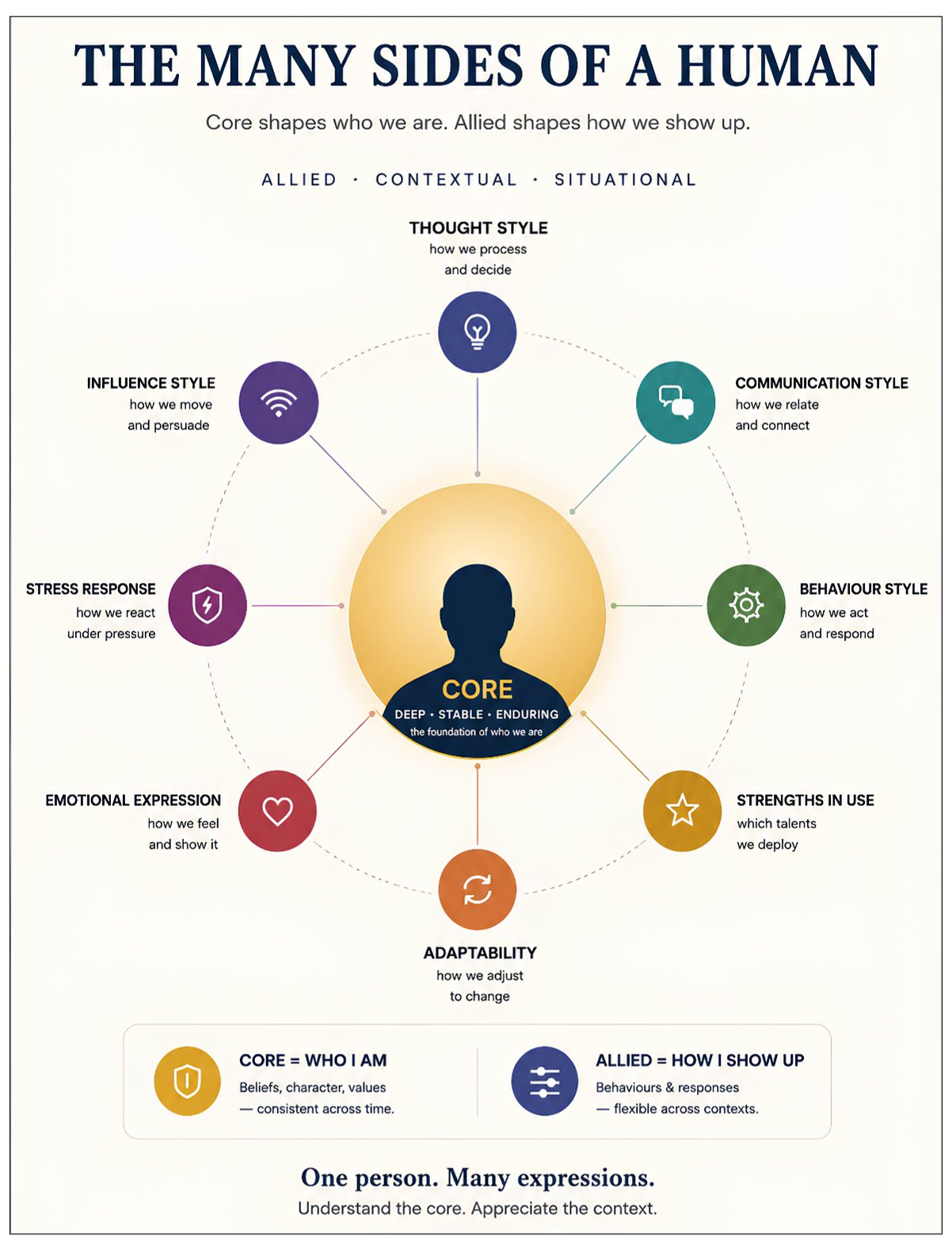
Core vs. Allied at a Glance
| Core | Allied | |
| What it is | Who I am | How I show up |
| Nature | Deep, stable, enduring | Contextual, adaptive, situational |
| Examples | Beliefs, character, motives | Thinking and communication style; behavior; strengths in use; adaptability; emotional expression; stress response; influence style |
The Labeling Trap
The cost of confusing the two layers shows up across the talent lifecycle. A profile is generated once during onboarding, filed and never revisited, even as the person grows. A candidate is screened out because a single instrument flagged low assertiveness in a context that did not call for it. A colleague labeled “difficult” stays difficult in the organization’s collective memory, because no one notices the days they are not.
Labels are sticky. Once a story about a person hardens, it becomes easier to defend than to update and the assessment that was meant to open understanding instead closes it. The instrument is rarely at fault. The interpretation is. Misinterpretations can cement perceptions and hinder growth, creating barriers that prevent individuals from reaching their full potential.
Organizations must therefore adopt a more dynamic approach to personality assessments, one that acknowledges the fluidity of human behavior and the importance of context.
By revisiting profiles regularly and considering the evolving nature of both the individual and their environment, companies can foster a culture of continuous development. This approach not only benefits the individual, who receives more tailored support and opportunities, but also enriches the organization with a more adaptable and engaged workforce.
Ultimately, the goal is to shift from static labels to a more holistic and empathetic understanding of each person’s journey. Encouraging ongoing dialogue and reflection helps dismantle outdated narratives, allowing people to be seen for who they truly are — complex, multifaceted and capable of growth.
Applying the Framework
Understanding the two layers only matters if it changes practice. Four shifts help L&D teams use assessments to develop people rather than categorize them.
1. Read the profile as a starting point, not a verdict.
Treat every debrief as the opening of a coaching conversation. The most useful question after a result is not “what type is this person?” but “what does this suggest we should explore together?” A profile is a hypothesis, not a diagnosis.
2. Equip managers to read context.
Train people leaders to ask, in the moment, “which version of this person am I seeing, and what is pulling it forward?” That single habit separates a passing state from a stable trait, and keeps a bad week from being mistaken for a character flaw.
3. Triangulate before concluding.
No instrument should stand alone. Combine assessment data with 360-degree feedback, direct observation and performance over time. Where the sources agree, confidence is warranted; where they diverge, there is something to understand rather than a single number to trust.
4. Coach the overplayed strength.
Build into leadership development the principle that a strength taken too far becomes a derailer. Helping leaders notice when their best quality is tipping into its shadow is often more valuable than adding another competency.
| Common Misuse | Best Practice |
| Treat the profile as a verdict | Use it to open a coaching conversation |
| Read once, then archive | Revisit it as a living document |
| Judge on a single instrument | Triangulate with 360s and observation |
| Celebrate strengths uncritically | Coach the overplayed strength before it derails |
A profile, in other words, is not a file to archive. It is a living document, most useful when revisited as the person and their context change.
Conclusion
Personality assessments were never meant to reduce a person to a type and move on. Used well, it does the opposite: it reveals the range a person contains and begins a more honest, ongoing conversation about how they show up — and how they might grow. The organizations that gain most from personality data are not the ones that label fastest, but the ones that keep looking. People are not one thing, and the best L&D practice is built on that truth.