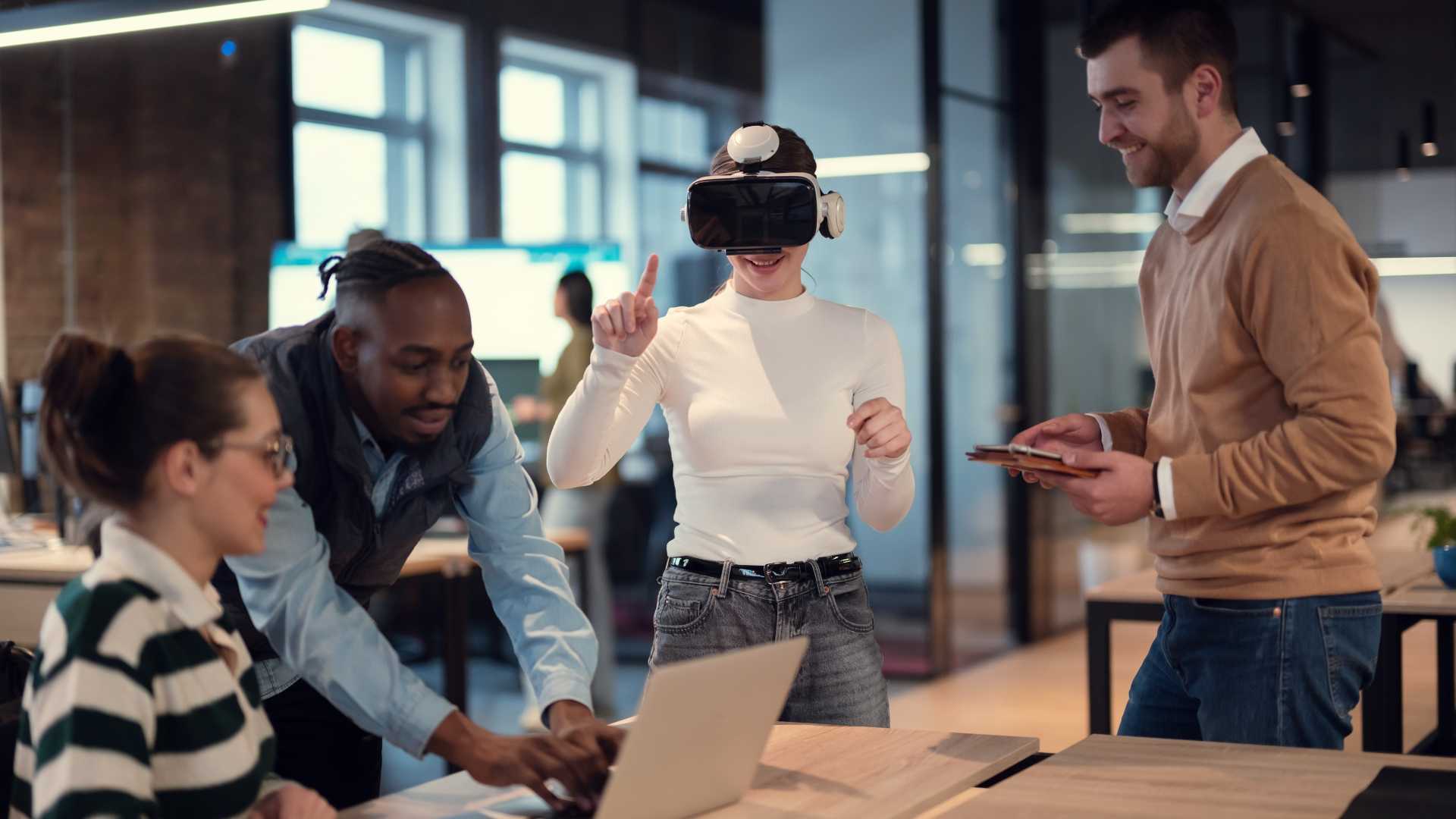
Virtual reality (VR) in training can place learners in environments that would be too costly, dangerous or difficult to recreate in real life. It can give employees repeated practice with scenarios that may happen rarely but matter deeply when they do.
As immersive learning becomes more common, learning and development (L&D) teams face a practical question: How much realism is actually needed?
Better graphics and detailed environments can make a simulation feel impressive. But training value comes from whether the experience helps learners perform better when the headset comes off. That is where full-body movement becomes an important design decision. Not every VR program needs physical locomotion. But when movement is part of the real-world task, leaving it out may create a weak point in the learning experience.
Fidelity Should Follow the Learning Objective
If the goal is knowledge transfer, basic orientation, decision-making, communication practice or the use of a specific tool, full-body movement may not add much value. In some cases, it may increase cognitive load, introduce safety concerns or distract from the actual skill being developed.
But if the goal requires the learner to move, position the body, understand distance, react under pressure, coordinate with a team or navigate a physical environment, movement becomes more than a feature. It becomes part of the skill. Practice does not make perfect. Perfect practice makes perfect. Training reinforces whatever the learner practices, including shortcuts, workarounds and bad habits.
When Movement Adds Learning Value
Full-body movement is most valuable when the learner must be in the right place while making the right decision.
This is especially relevant in high-consequence environments such as defense, emergency response and industrial safety, where physical movement is often part of the performance standard. A learner may need to move through a building, maintain spacing with a team, respond to a threat, locate equipment, avoid hazards or make decisions while tired, stressed or under time pressure.
Movement is usually worth evaluating when the task requires physical navigation, team coordination, fast reactions, spatial awareness or performance under stress. In those cases, distance, timing and positioning are not side details. They are part of the job.
When Movement May Be Unnecessary
Movement can be unnecessary when it is not connected to the risk, task or performance outcome being trained.
Some medical or technical training may center on hand skills, instrument use, sequence, judgment or communication. If the learner is practicing a specific tool or procedure, walking through a virtual room may add little value. The same may be true for soft skills training, product knowledge, basic compliance or many forms of procedural instruction.
This does not mean simpler VR is less valuable. It means the design should match the objective. The goal is not to make every training experience as realistic as possible. The goal is to make the right parts realistic.
A Risk-Based Decision Framework
Before investing in movement-enabled VR, L&D teams should ask one central question: What is the cost of getting this training wrong?
If the consequence of poor performance is low, simpler training may be enough. If the consequence is injury, equipment damage, operational failure or loss of life, the calculation changes. In high-risk training, the value of realism should be measured against the cost of not training the task correctly.
Useful questions include:
- Does the real-world task require physical movement?
- Could failure involve being in the wrong place, moving too slowly or reacting incorrectly?
- Does the learner need to understand distance, timing or spatial relationships?
- Does the task require coordination with other people?
- Will movement improve real-world transfer, or only make the experience feel more impressive?
- What operational constraints, including space, supervision, safety and budget, must be addressed?
These questions shift the conversation from novelty to performance.
Implementation Questions Before Moving Forward
Once an L&D team determines that movement may improve training value, the next step is to evaluate whether it can be implemented effectively. A strong use case can still fail if the program is difficult to operate, too expensive to scale or inaccessible to part of the learner population.
Start with learner accessibility. Will all learners be able to stand, walk, turn, crouch or move comfortably for the required amount of time? If not, the program may need alternate learning paths or accommodations that preserve the core objective.
Next, evaluate the training environment. How much space is available per learner? Will training happen in a dedicated lab, shared classroom, field setting or multiple locations? What safety protocols are required? Who will supervise the experience and assist learners who need help?
Budget should be evaluated beyond the initial technology purchase. L&D teams should consider setup time, facilitator training, maintenance, IT support, learner throughput and the opportunity cost of taking employees away from work.
Finally, define success before implementation begins. The goal should be to determine whether added movement improved performance, not simply whether learners enjoyed the experience. Useful measures may include fewer mistakes, faster reaction times, better spatial awareness, improved team coordination or better performance in a follow-on assessment.
Start With a Focused Pilot
For most organizations, the best path is a focused pilot tied to a specific training objective. A practical pilot should identify one use case where movement is likely to matter, one learner group that represents the target audience and one or two measurable outcomes.
The pilot should also surface operational realities: session length, daily learner throughput, facilitator support, learner comfort, accessibility concerns and the usefulness of the performance data. This allows L&D teams to test both the instructional value and the operational fit before committing to a larger investment.
The Real Question
Full-body movement is not necessary for every VR training program. It is most valuable when movement is tied directly to performance, risk, spatial awareness, reaction time or transfer.
The strongest immersive training programs will not be the ones that chase realism for its own sake. They will be the ones that identify what the learner needs to do and then design the simulation around that task.