
Let’s imagine that every new management training program is now required to contain these three chunks:
- Participants leave with a prescriptive action they must take to apply their newly learned supervisory skills with each of their individual employees.
- They have a specific, measurable goal to achieve based on how well they apply these newly acquired skills.
- That goal is tied directly to a bottom-line metric such as increasing revenue, reducing costs or improving employee retention or engagement.
It sounds like training 101, but I’m betting that most training programs miss the mark. Take constructive conflict training, a very popular training topic. Participants leave prepared for an employee to become cross-eyed about a work topic and then must choose from a nine-box series of approaches. Who among us would step away from this tense interaction to review and choose which box to use?
Is There Specific Employee Retention Training That Meets These Criteria?
The short answer is “yes,” but let’s first build the case for why retention matters now more than ever.
Several months ago, I reached out to the U.S. Census Bureau to ask how many employees will be left once 30 million baby boomers retire, given the U.S. birth rate has been in a 50-plus year decline. The Census Bureau sent me various charts and projections in multiple formats, with which I developed this “Great Gully” chart:
U.S. 5-Year Growth for Working Population, Ages 18 to 64
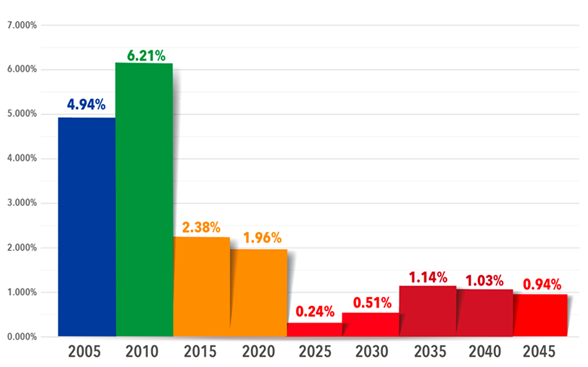
This chart compares our working population’s historical growth 20 years back to the forecasted growth that is 20 years out. The conclusion: We’re now entering a period where we’ll add only one-fifth as many working-age people as we have in the past — and this shortfall will persist as far as the Census Bureau can see. Even more striking, the Bureau projects the U.S. population will begin declining by 2080, while the World Bank predicts that by 2100, five of the ten most populated nations will be in Africa.
After gluing together this trove of data I wondered aloud, “Who knows this?”
The implications for U.S. companies are clear: Retain your good employees and prepare for immigrants to fill more of your jobs.
This reality propelled me to write my new book, “Targeting Turnover,” released in September of 2025.
A Research-Based Way to Improve Employee Retention
As a “recovering HR director,” I’ve looked at high employee turnover in the eye many times. Mid-career I went in search of a real solution. Employee exit surveys, engagement surveys, salary surveys and other types of surveys all promised a blueprint, yet turnover continued to rise. Even Gallup reports employee engagement had been stuck for two decades and then recently got worse. Retention and engagement are the two primary people management metrics, and neither had an established, research-based solution that worked.
So I partnered with an industrial organizational psychology professor who had a similar interest, and together we reviewed every academic and non-academic study that shined light on real fixes. The very major find: Top performers outperform average performers by a ratio of four to one.
Knowing this, why keep paying six figures annually for employee surveys that only measure the average? And their only outcome can be more one-size-fits-all programs that can’t retain your best talent.
But here is the stunning, you-can’t-miss-it finding based on deep research:
The No. 1 reason employees stay or leave, or engage or disengage, is how much they trust their immediate supervisors.
When speaking at conferences, I say these two joke lines every time:
- When have you heard a good employee say, “My boss treats me like dirt, but I’m holding on for employee appreciation week”?
- And when asked over dinner, “How was your day, dear?”, no one has ever answered, “My day was OK, but I just wish we had pet insurance.”
Employee appreciation activities, pet insurance and more have become the HR go-tos for retaining workers, while bypassing the number one reason employees stay or leave. And this has been happening for a long time.
Stay Interviews: The Simple and Effective Solution
In 2012, I popularized stay interviews with my second book, feeling compelled to give first-line leaders a proactive method to look each employee in the eye and ask questions like: Why do you stay? Why might you leave? What can I do to retain you? The actual invention is a bit more complex, and it remains more impactful than any of its imitators.
Over the past 15 years, stay interviews have become the centerpiece of a proven retention model outlined below:
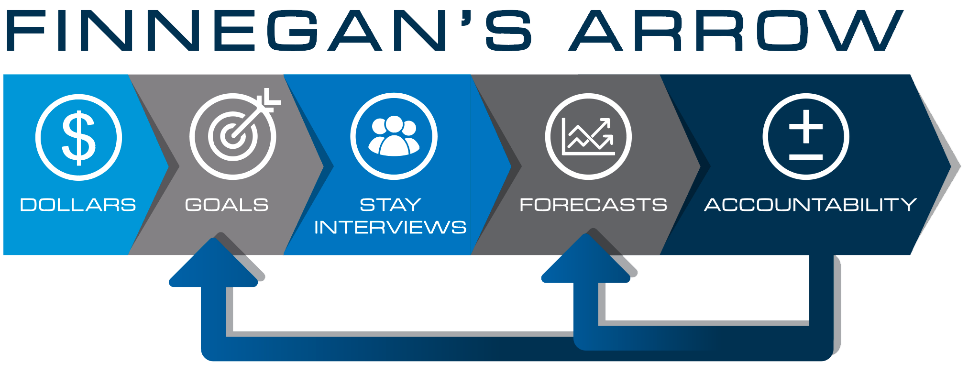
If you accept that the top reason employees stay or leave is based on their relationships with their bosses, then the essential step to improve retention is to hold those bosses to specific retention goals, causing accountability to shift from HR to operations. Front-line managers — not HR professionals — decide daily by their actions who stays and who leaves.
Getting back to our pet insurance joke, most employees’ real answers about their workday are about managers, colleagues and duties, and bosses have most impact on all three areas. Most employees don’t leave for higher pay or for “better opportunities” as exit surveys suggest, but because of a hundred paper cuts experienced in their small work circles every day.
“Dollars” and “goals” precede stay interviews in our solution because stay interviews won’t be effective unless leaders at all levels feel compelled to achieve goals. The surest way to awaken the top team’s appreciation for retention is to convert turnover data to dollars. This not only shakes them into action but also eliminates any attention to meaningless external benchmarks.
When managers conduct stay interviews with their direct reports, they gain insight into how long each employee is likely to stay and can then be held accountable for meeting retention goals. Stay interviews and forecasting go hand in hand: Managers must learn to ask five key questions, then listen actively, take notes and probe deeper to turn those five questions into meaningful conversations. Most importantly, they should create one-on-one stay plans (even if it’s just one actionable idea) to build trust and strengthen retention. This approach also boosts employee engagement, regardless of whether surveys are used.
This fix trains managers in a proactive, measurable solution tied directly to employee retention — which should be your company’s top priority.
Moving Forward Means Leadership Development and Employee Retention Integration
Leadership development and employee retention have long been treated as separate disciplines. But if retention is now the greatest workforce challenge of our time, then leadership training must evolve from awareness building to accountability building, where every manager leaves training with a specific plan to keep their people. That’s the shift I explore in “Targeting Turnover: Making Managers Accountable to Win the Workforce Crisis (Berrett-Koehler, 2025)” — a research-based roadmap for turning leadership development into measurable retention results.