

Given the pace of change businesses are facing across industries, the role of managers has never been more critical. Studies consistently show that organizations with strong managers achieve significantly higher returns, yet the proportion of employees who view their managers as highly effective has noticeably declined in recent years.
The imperative is clear: Organizations must invest in developing high-impact leaders who can drive performance, engagement and growth.
This article explores how Grant Thornton Advisors LLC, in partnership with Intrepid™ by VitalSource® (Intrepid), cracked the code on scalable manager development. Their award-winning manager development program (MDP) offers a blueprint for building leadership development that delivers measurable business impact.
The Case for Manager Development
Today’s managers must navigate economic uncertainty, regulatory change, generative artificial intelligence (AI) impacts, global conflicts and political polarization. These forces demand agility, collaborative leadership and a commitment to developing others. Building inclusive, engaged teams that champion innovation is now an essential managerial skill.
Since 2018, Grant Thornton’s leadership development team has been working to find ways to help new managers build these important skills and gain hands-on experience at scale. The MDP is a one-year program for 300-400 newly promoted managers. The program has been revised and tweaked year over year to adjust to the ongoing challenges the program has faced. Its ongoing success is evidenced by multiple industry awards, including Best Overall Course from Intrepid’s Momentum Awards and a Silver Brandon Hall Group™ HCM Excellence Awards® in learning and development (L&D) for Best Blended Learning Program.
Design Challenges in Leadership Development
Creating a scalable, high-impact manager development program is not without its challenges. Key design questions that designers and leaders need to ask include:
- How can organizations enlist executive sponsorship for critical leadership development programs?
- How do you create impactful learning journeys rather than one-off events?
- How can collaboration be promoted throughout the learning experience?
- What’s the best way to combine live and self-paced learning with cohort experiences?
- How do you reinforce leadership capabilities in the flow of work and measure business impact?
Grant Thornton’s journey offers practical answers to these questions.
Overcoming Obstacles
Over the years, the new manager learning team faced and overcame numerous challenges through intentional design and redesign.
Challenge: Low Senior Leader Awareness
To increase visibility and gain senior leader awareness, the team launched a “New Manager Celebration Hour,” inviting senior leaders to participate and share their congratulations and advice to new managers. This drove awareness with firm executives.
Challenge: Sharing the Year-Long Journey
Transitioning from an event-driven learning program to a seamless year-long learning experience required new tools.
Initially, communication with participants was through lengthy monthly emails followed by manual tracking of assignment completion. With the adoption of the Intrepid platform, with its rich set of features that support collaborative learning, participants could see the full learning journey and had a “one-stop shop” for session links, resources, assignments, discussion boards and more. No more emails — now participants went to the program’s website for all their updates and materials.
Challenge: Low Participation and Attendance:
After a year of sub-par participation and engagement, a digital badge was introduced. Grant Thornton had just launched a digital badging program, and the team created an MDP badge that, in order to earn, required participants to attend all skill-building and industry informational sessions, complete a set of self-studies and cohort activities, and successfully accomplish a set of on-the-job experiences.
Later analytics revealed that managers who earned their MDP badge billed more hours, managed more revenue and received higher upward feedback scores, making a compelling case for participation.
Challenge: Participation Trailing Off
After discovering that participation trailed off as the program progressed, the learning team rearranged the learning sessions, delivering them in the fall and reserving the spring for self-study and on-the-job experience work when professionals had more time. This, along with the introduction of a Power BI dashboard tracker, helped to maintain high attendance and maximize overall completion.
The dashboard allowed participants, and their managers, to track attendance and completion in real time, session by session and activity by activity — making it easy for everyone to know which aspects of the program were outstanding.
Success Factors
Grant Thornton’s MDP success is rooted in the team’s ongoing analysis and willingness to redesign the program for ultimate impact, as well as three key ingredients that are now a constant in the program.
- Faculty Involvement: Senior leaders are recruited as faculty, facilitating all the sessions and modeling leadership behaviors. And a set of leaders take on the role of cohort coaches, encouraging participation and providing in-the-moment personalized feedback and mentorship.
- Participant Experience: A cohort structure is used to foster relationship-building and networking and activate peer coaching. Participants grow their internal network as they engage in the program.
- World-Class Content and Speakers: Curriculum is continuously updated to stay in step with Grant Thornton’s strategic priorities and respond to evolving business challenges. Each cycle, the program features a broad array of expert speakers and integrates personalized assessments. These assessments enable managers to pinpoint their unique strengths and create targeted development plans that foster meaningful growth.
Measuring Impact
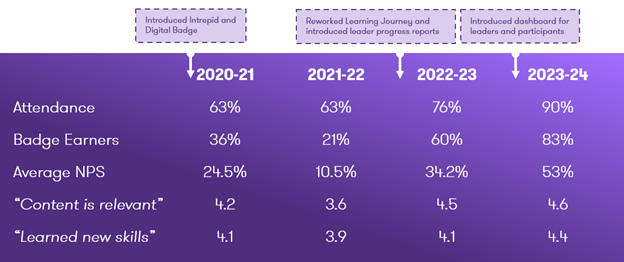
Measurement rigor is a hallmark of any successful learning program. Early on, the MDP learning team identified five key metrics that would be tracked each year from a broader list of data: attendance, badge earners, net promoter score (NPS), content relevance and skill acquisition. Annually, each metric had a goal, and the team focused on only one or two metrics to increase each year. The visual below shows changes year over year.
Early on, the attendance target was 75%. After introducing the digital badge and rearranging the learning journey, that target has increased to 90%. Additionally, the initial NPS target was 25%. After redesigning certain sessions to be more interactive, it is now 50% or higher. As the team achieved its targets, the challenge turned to maintaining and further increasing and optimizing the program.
Lessons Learned and Advice for Training Leaders
Grant Thornton’s experience offers several lessons for organizations seeking to build scalable, award-winning manager development programs:
- Secure senior leadership buy-in through visible sponsorship and regular communication.
- Design learning journeys that blend live, self-paced and on-the-job experiences.
- Use digital badging and analytics to drive engagement and demonstrate business impact.
- Foster cohort-based learning and peer-to-peer learning to build relationships and reinforce skills.
- Continuously measure and refine program elements to ensure relevance and effectiveness.
Conclusion
Building high-impact leaders requires intentional design, executive sponsorship and a commitment to continuous improvement. Grant Thornton’s MDP demonstrates that with the right structure, technology and measurement, organizations can scale leadership development and achieve award-winning results.
As the business environment continues to evolve, investing in manager development is not just a strategic imperative; it’s a competitive advantage.


