

For decades, workplace violence prevention has implicitly focused on one primary question: What do we do when someone begins to appear dangerous?
That mindset has shaped everything from active shooter response drills to emergency response planning and annual compliance training. In many organizations, workplace violence is still viewed primarily as a security issue — rare, unpredictable and disconnected from broader workplace culture and organizational health.
But a growing number of experts believe organizations are asking the wrong question. The better question may be: What if true prevention starts long before anyone appears dangerous? That shift is driving a growing movement toward empathy-centered workplace violence prevention, an approach that focuses less on identifying “bad actors” and more on recognizing psychological distress and behavioral change enough to intervene constructively. It reframes interpersonal violence prevention as a shared organizational responsibility rather than solely the job of security or human resources (HR).
A Continuum, Not a Crisis
One of the most compelling frameworks to emerge is the “Workplace Cultural & Behavioral Continuum™,” which visualizes workplace violence not as a sudden event, but as a potential endpoint of deteriorating behavioral and even cultural conditions (see Figure 1).
The model uses the analogy of a river flowing from a healthy workplace culture downstream toward increasing psychosocial strain and, in some cases, deep personal crisis. At the “headwaters” are conditions such as authentic connection, high emotional intelligence, psychological safety, and relational civility. These upstream conditions create what the framework calls “social safeguarding” — an environment where employees feel respected, connected and psychologically safe.
Figure 1. Workplace Cultural & Behavioral Continuum™
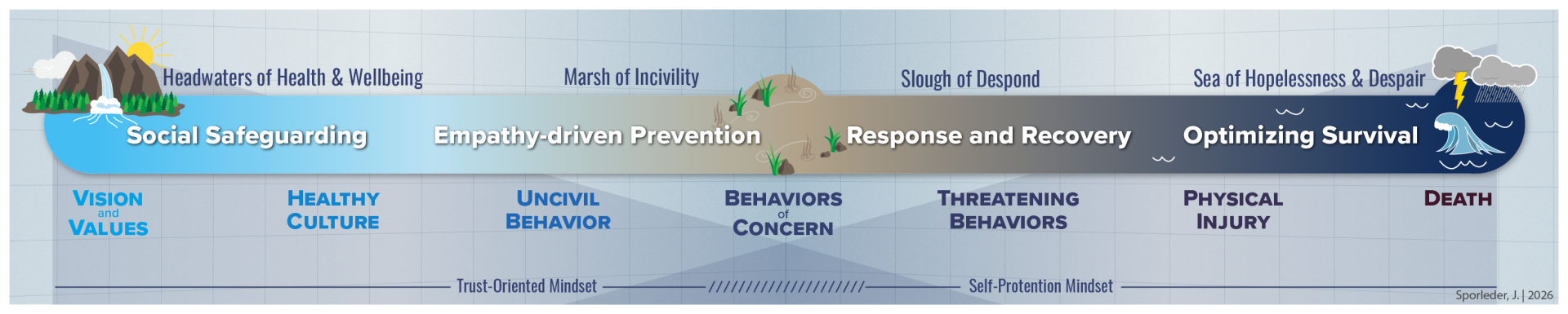
As the continuum moves downriver, it explores the psychosocial ecosystem associated with what the framework calls the Marsh of Incivility ™. This environment may be characterized by sarcasm, dismissiveness, hostility, exclusion and chronic disrespect that gradually erode trust and psychological safety. Left unaddressed, these behaviors can normalize dysfunction, weaken relational trust and increase the potential for further psychosocial strain.
Further downstream, the continuum brings into view the more traditional “behaviors of concern” often associated with workplace violence such as withdrawal, emotional volatility, grievance fixation, direct or implied threats, or a growing disregard for rules and boundaries.
Farthest downstream, the framework describes conditions associated with outright threatening behaviors and potential serious physical harm in an ecosystem described as the Sea of Hopelessness and Despair™. This is a place where relational breakdown, grievance and disconnection may manifest in the form of extreme violence such as an active shooter event.
The significance of the continuum is not simply that it maps risk. It encourages leaders and co-workers to reframe behavior within the broader context of the human condition rather than immediately reducing it to potential threats alone. That reframing creates space for empathy and curiosity, which lowers the barrier for earlier engagement and more thoughtful support, long before a crisis emerges.
The Warning Signs People Already See
Most acts of workplace violence do not emerge entirely without warning. Behavioral threat assessment research and FBI case studies consistently show that individuals who commit acts of workplace violence often display several observable behaviors of concern in the weeks or months leading up to an incident. Co-workers notice changes. Managers sense that something feels different. Teams become uneasy.
In these situations, people often hesitate to act — not out of indifference but because they’re conflicted. They worry about embarrassing someone, overreacting, damaging relationships or unfairly labeling a struggling co-worker whose behavior may reflect distress rather than danger.
Empathy-centered prevention training attempts to close the gap between observation and action. Instead of training employees to think like investigators, they’re encouraged to think like caring and engaged human beings. Employees learn to ask simple but important questions: “Am I noticing a change in this person?” and “Does this behavior leave me unsettled?” The focus shifts from attempting to prematurely prove danger to recognizing behavioral change, distress or emerging risk with greater clarity and context.
Organizations using this approach often move away from phrases like “report suspicious behavior” and toward language such as “share a concern.” Sharing a concern is more relational and supportive. “Reporting” someone can feel punitive or accusatory.
Employees learn that while raising a concern may feel uncomfortable, staying silent carries its own risks — missed opportunities to help or prevent harm.
Empathy-based approaches make a meaningful difference in employee willingness to share concerns. For example, among employees trained with Atana’s empathy-based course, 83% viewed promptly sharing a concern as urgent compared to 65% of untrained employees. Employees were also less likely to believe they should wait before sharing concerning behavior, decreasing from 20% among untrained employees to just 7% after training. Empathy, not policy awareness or fear, is the main driver.
Seeing the Hidden Risks Beneath the Surface
Ensuring that employees feel motivated, prepared and supported enough to act when concerning behaviors appear is where behavioral intelligence can play a critical role.
Behavioral intelligence solutions help organizations uncover hidden cultural and behavioral risks that traditional surveys and compliance metrics often miss. Rather than using workplace violence prevention training solely as a means of measuring policy awareness or knowledge retention, behavioral intelligence evaluates how employees are likely to respond in real-world situations involving incivility, bystander behavior, harassment, psychological safety or concerning conduct.
Realistic workplace training scenarios wrapped with decision-making assessments help identify where hesitation exists around speaking up, sharing concerns or intervening early. This data reveals where toxic behavior is normalizing, where employees distrust leadership response or where silence has become cultural, allowing teams to deploy targeted intervention where needed.
Building an Upstream Prevention Culture
A strong prevention culture does not happen because employees know policy. It happens when organizations remove the barriers that prevent people from acting.
Traditional workplace violence training often focuses heavily on emergency response. While those skills are important, empathy-centered programs spend more time helping employees recognize behavioral changes early and understand practical ways they can respond before situations move further downstream.
Sometimes the response is simple: a private conversation or genuine check-in with a fellow worker. Other situations require escalation to HR, leadership, security, or even behavioral threat management teams. But employees are far more likely to share concerns when they understand that doing so does not automatically trigger punishment or condemnation.
The future of workplace violence prevention may depend less on reacting to the final moment of crisis and more on building cultures where people feel responsible for one another and empowered to engage early when something feels amiss. In that sense, empathy is not separate from workplace safety and security — it may be foundational to both.

