
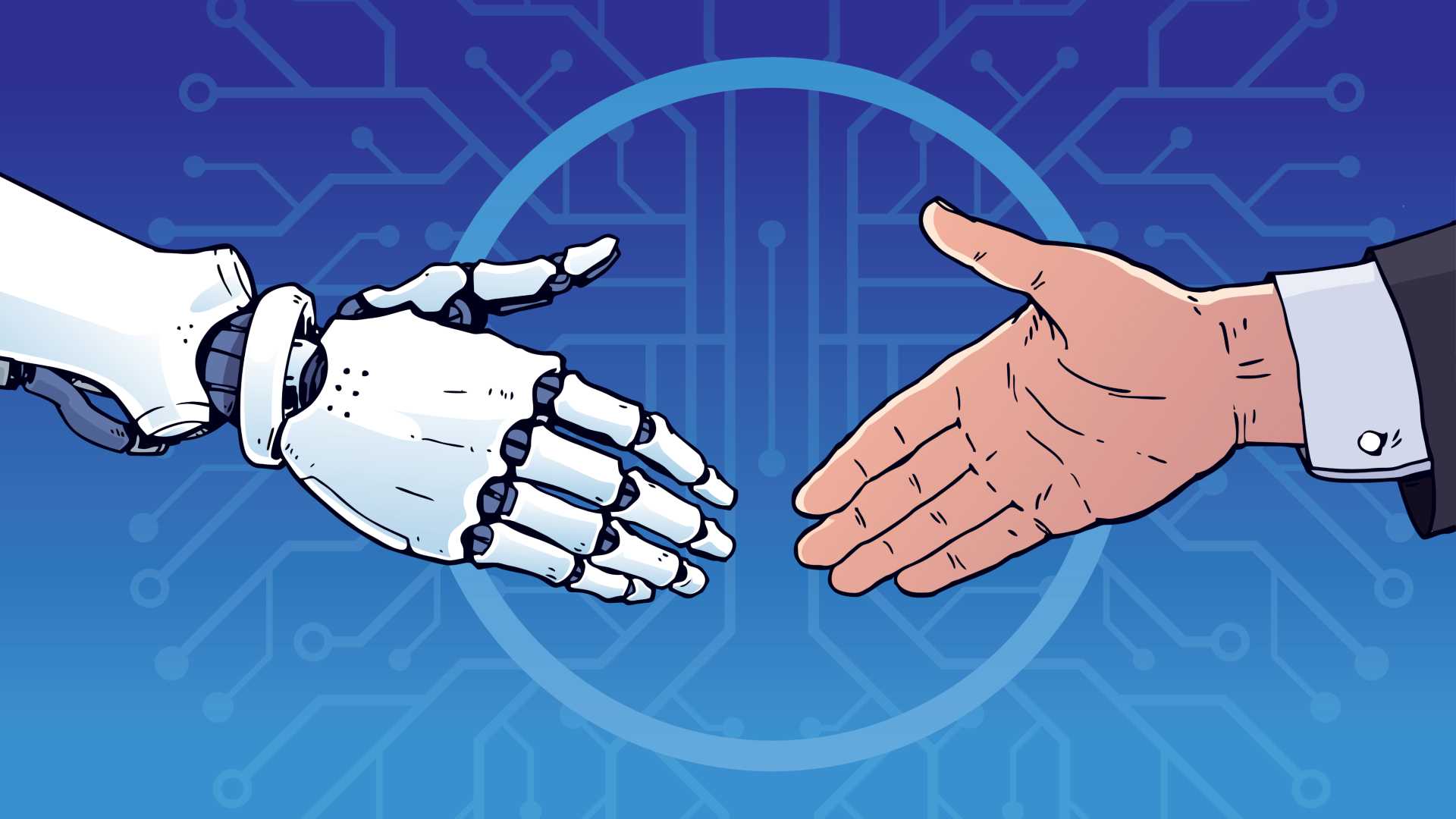
Generative artificial intelligence (AI) is a technology that creates new language, media, images, code and music by identifying and replicating patterns in existing data — and it’s increasingly being used as a tool to support collaboration and creativity.
Generative AI is brewing a new kind of digital alchemy that will stretch both leaders and leadership.
In a world that’s increasingly brittle, anxious, nonlinear and incomprehensible, traditional leadership development falls short. The real transformation isn’t about training leaders to use AI — it’s about developing leaders who can be augmented by AI while becoming even more human.
BANI: Beyond VUCA Leadership
Our colleague Jamais Cascio introduced a robust framework known as BANI (brittle, anxious, nonlinear, and incomprehensible) to summarize this increasingly chaotic future and improve on the VUCA framing.
- Brittle: Brittle systems do not fail gracefully — they don’t just break, they shatter.
- Anxious: Anxiety carries with it a sense of helplessness, a fear that no matter what we do, it will be the wrong thing.
- Nonlinear: In a nonlinear world, cause and effect are seemingly disconnected or disproportionate. Small decisions end up with massive consequences.
- Incomprehensible: It isn’t that we don’t understand what is happening; rather, incomprehensible means that it is very difficult to understand why something is happening.
The most effective leaders will anticipate a BANI world and still find ways to shape a better future. With disciplined foresight, they can make smarter decisions today that pave the way for a stronger tomorrow.
10 AI-Augmented Leadership Skills for Learning Leaders
Thinking “futureback” from 10 years ahead, what leadership skills will be needed to thrive in the future? How could each skill be amplified through thoughtful use of generative AI?
Consider the following:
- The “Futureback” Curiosity Skill: Cultivating a mindset of curiosity that encourages leaders to imagine future possibilities without being constrained by current assumptions
- The Clarity Skill: Training leaders to communicate clearly and simply, even during uncertainty, without oversimplifying complex issues.
- The Dilemma-Flipping Skill: Helping leaders learn to reframe unsolvable problems in ways that lead to meaningful improvement, even if a full solution isn’t possible.
- The Bio-Engagement Skill: Encouraging leaders to draw insights from nature — or “bio-empathy” — as inspiration for sustainable, systems-based thinking.\
- The Immersive Learning Skill: Enabling leaders to expand their perspectives by engaging with unfamiliar environments, both physical and digital, to build adaptability and empathy.
- The Depolarizing Skill: Equipping leaders with techniques to de-escalate polarized conflicts and move discussions toward productive resolution.
- The Commons Creating Skill: Supporting leaders in designing shared spaces or resources that foster both collaboration and healthy competition.
- The Smart Mob Swarming Skill: Developing leaders’ ability to mobilize and coordinate people and digital agents (like AI tools) across various platforms to achieve a shared goal.
- The Strength — With Humility — Skill: Encouraging leaders to lead with confidence, openness and authenticity — without self-promotion or ego-driven behavior.
- The Human Calming Skill: Training leaders to act with intentionality, emotional discipline and discernment, especially in high-stress or uncertain situations.
For all but the last skill, we have added the word “augmented” to explore how generative AI will disrupt each of them.
Augmented — Not Automated — Leadership
When we use the term “augment,” we build on the pioneering work of Douglas C. Engelbart, who first described his vision of “augmenting the human intellect” in 1962.
For leaders, “augment” means to amplify, enhance and stretch our abilities as human leaders to face an increasingly chaotic world.
The direction of change is summarized below:
- From efficiency and speed toward effectiveness and calm: While efficiency is attractive, the long-term value of generative AI for leaders will be effectiveness. Meaningful outcomes will be more important than streamlined processes.
- From prompts and answer-finding toward mind-stretching interactions: Generative AI will be so much more than a question-and-answer machine for information retrieval. The exchange between a human and generative AI should be more like a conversation.
- From automation toward your augmentation: The urge to automate is tempting. On the other hand, overly relying on automation is a danger that will increase with generative AI. Our conclusion is that thinking “futureback,” all leaders will be augmented — but few leadership roles will be automated.
- From certainty seeking toward your clarity story: The best leaders will develop their clarity but moderate their certainty. In a BANI future, certainty will be both impossible and dangerous if attempted.
- From personal agents toward human/agent swarms: Generative AI agents bridge ideas to action. Over the next decade, individual agents will be organized into agents for collective actions.
- From guardrails toward bounce ropes: Bounce ropes encircle wrestling rings to keep the wrestlers safe in a strong yet flexible way. For a technology as emergent as generative AI, bounce ropes are a much more appropriate metaphor than guardrails.
- From hallucinations toward meaning making: A generative AI hallucination may contribute to a human’s creativity. What we call “hallucinations” are a feature of generative AI systems, not a bug.
- From increasing secular control toward re-enchanting our world: The urge to control is tempting, but the ability to control is limited. What if generative AI can help us explore the unexpected?
The “I Want Help” Template for Learning Leaders
We propose a new template for leaders in the format of “I want help _________, in order to _________.”
This template will guide leaders as they specify how they want to be amplified and augmented.
What help will you seek from generative AI? For example:
I want help…stretching my thinking, in order to…develop my ideas more fully as I am thinking through the core ideas and writing.
I want help…drafting early drafts of small chunks of text, in order to…get past the blank-page syndrome.
I want help…picking more evocative words or phrases, in order to…write my way out of being stuck.
I want help…finding and filtering new signals, in order to…illustrate ideas about the future with examples from the present.
I want help…questioning my own assumptions, in order to…get beyond my own biases.
What if learning leaders brought this template to their leadership development programs? How might they augment their own capabilities and those of the leaders they develop?
The future of leadership development isn’t about making leaders more technical —it’s about making them more augmented and more human at the same time.


