
In my experience, using artificial intelligence (AI) is like working with an exceptionally smart, incredibly fast intern. It can be a powerful thought partner and time-saver. But getting real value still depends on me — where and how I choose to apply AI and the discernment and experience I bring to evaluate its output.
Across many organizations FranklinCovey works with, AI is being used in much the same way. We’ve all, in effect, deployed armies of AI interns to their employees. And team members are starting to largely embrace these new AI collaborators. In a new research study, conducted by FranklinCovey Institute, “AI Transformation & the Human Imperative,” 570 knowledge workers were surveyed who use AI at work, and 74% agreed that “AI makes my work better,” while 80% said they can clearly articulate how AI improves their work. These responses provide an encouraging counter-narrative to the hand-wringing that still dominates the discourse around AI. The uncertainty about how AI changes our work and life longer term is still prevalent, but when it comes to everyday use, workers are starting to get it: They are beginning to see how AI fits in. This is the dawn of hybrid intelligence, in which AI needs us as much as we need it. And for those involved in enabling organizations to adopt and adapt to AI through training or coaching, it presents important opportunities.
Let’s take a closer look at what we’re seeing in the data and in workplaces.
Insight No. 1: Even as they embrace AI, employees still need more from their leaders.
With more employees experiencing AI as a net positive — one that makes their work better and more efficient — why does the broader conversation still center on failed deployments, rework and “slop”? If employees see the value, what’s preventing organizations from turning that momentum into true transformation?
One explanation is that many leaders have yet to define the strategic intent behind their AI deployments. Let’s go back to our intern analogy.
Highly successful organizations would likely not deploy an army of interns without a clear and measurable purpose, without a plan or adequate training, and without clear guidance for employees on how to engage them and put them to work to get the best return.
In much the same way, highly successful organizations shouldn’t deploy AI without a plan, vision or measurable outcomes. One reason is that without a plan, AI gets applied unevenly.
Some team members may give their AI only rote tasks, such as helping write email correspondence or turning 30-page documents into one-page summaries. This would be equivalent to sending an intern out to get coffee or having them take notes in your meetings. It’s helpful but definitely not the highest-leverage use of their capabilities.
On the other hand, there are those who delegate serious analytical work to AI or use it to create automations of complex processes that pull inputs from multiple applications. They become power users, and their collaboration with AI has the potential to be transformative. But their teams may not have the process or trust to share and coalesce around these new solutions.
Unfortunately, in many cases today, organizations have not yet defined an AI strategy, set a high bar for its use, or created a system to expand on promising efforts on teams to deliver broader process improvement or business model reinvention.
In FranklinCovey Institute’s AI General Attitudes survey of 3,000 AI-at-work users, the leadership gap is pronounced. When we asked leaders, roughly 70% said they clearly understand how their teams are using AI. Yet, if you ask their team members, 80% described their leaders’ approach to AI as “hands-off.” The message is hard to miss: Leaders believe they have visibility and control, while employees feel they are using AI in a vacuum.
Insight No. 2: Leaders are not yet intentionally deploying AI in service of true transformation.
The most effective organizations recognize that AI demands new thinking and new modes of action, that it will reward those who are actively and strategically deploying it. They’re focused on building a hybrid intelligence capacity, where human wisdom and machine capability combine to unlock new value and drive transformational outcomes.
But such organizations are more the exception than the rule. FranklinCovey Institute’s new research shows that, despite the growing and constructive embrace of AI, the work of tapping into the hybrid intelligence is still in front of us. We asked respondents to provide insight on whether they use AI for higher-value work. The table below makes clear that, when it comes to such work, the humans (i.e., the blue bar) are still doing the lion’s share. For nearly every example given, technology (i.e., the orange bar) plays only a very small role in the work of inspiring and engaging people, organizing activities, making decisions, anticipating the future and innovating.
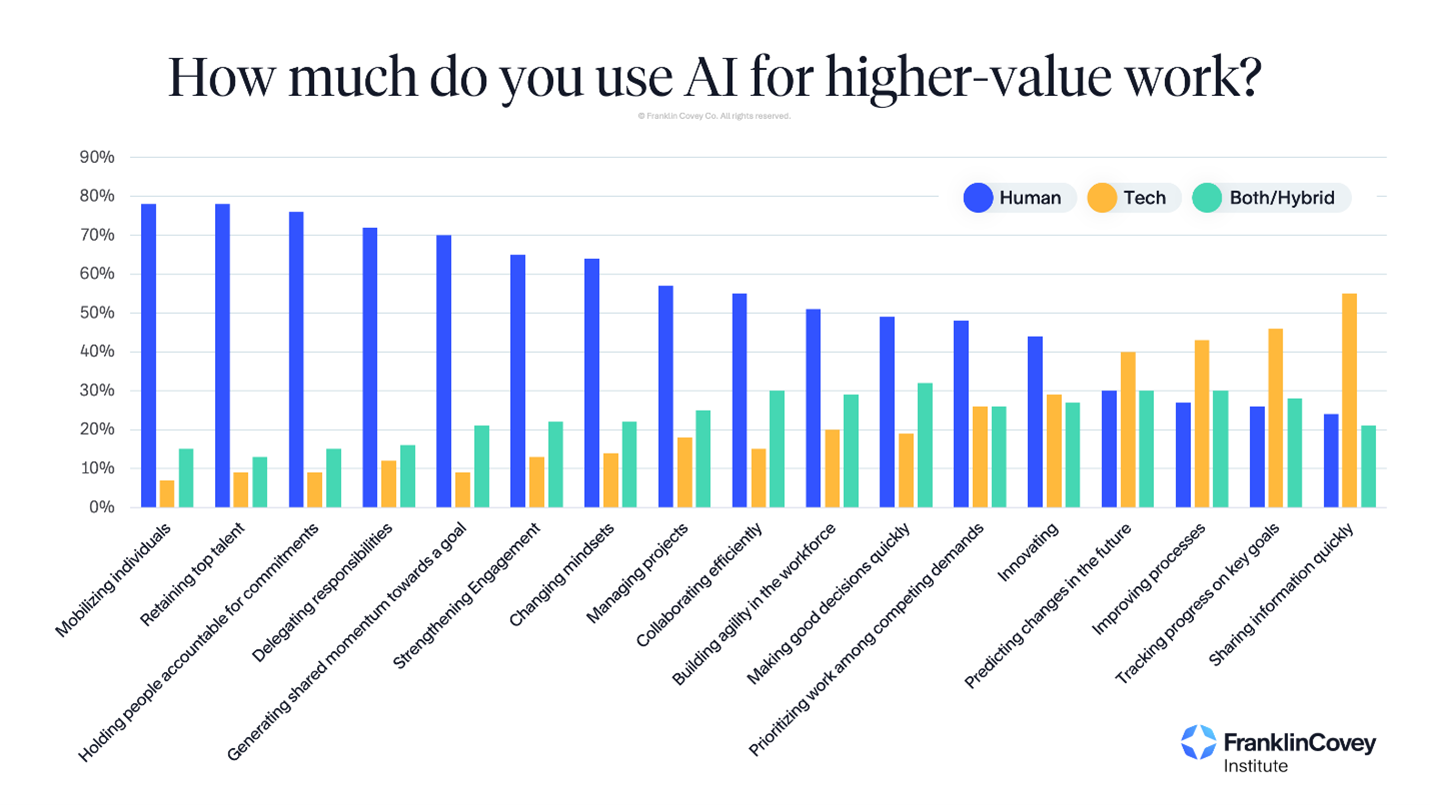
Leaders who look closely at this data will notice some important nuances. They will see three categories of higher-value work in which technology does in fact out-score humans: sharing information quickly, tracking progress on key goals and improving processes.
They might also take note of the green bars, indicating a “both” category. This is an emerging space, where workforces are finding their way into the dynamics of human-machine collaboration — which is the emerging hybrid intelligence needed to do our best work.
To develop these opportunities, leaders are going to need to step up. Some 24% of survey respondents said they feel overwhelmed by the sheer volume of AI knowledge they’re expected to master. Today, teams are gaining efficiencies, but also new tensions. Workers are asked to adopt AI tools while still carrying the full emotional, relational and decision-making load of their roles. Instead of replacing effort, AI can feel like an additional system to manage, explain and justify, adding complexity to jobs that already depend heavily on human judgment and coordination.
Insight No. 3: Leaders need to find the greatest leverage points for AI to help teams transform.
The third insight is directly relevant for learning and development (L&D) professionals: AI raises the bar. Organizations will never meet the full potential of what could be the biggest transformation the world has ever seen without strong leadership from top to bottom.
The data show we are not there yet. Many workers still feel they aren’t getting what they need from leadership on AI. In the same study, roughly one-third, or more, of respondents disagreed with statements such as: “My manager clearly explains the why behind AI use” (35% disagree); “My manager communicates openly about how AI will impact jobs” (40%); “Expectations for AI use are communicated consistently from corporate leaders to my manager” (31%); and “Our leaders clearly explain why we are rolling out new technology and AI” (32%).
Even as the glass is more than half full, managers and executives can’t forget the bar for AI success is set higher than small efficiencies, but to achieve meaningful transformation. AI won’t deliver business model reinvention on its own. It requires strategic leadership and active engagement, especially when it comes to driving behavior change at scale.
Organizations that want to realize AI’s potential need to focus intentionally on three areas.
- Clarify and elevate the AI vision. For organizations seeking to stay competitive, 2026 must be the year in which they move from pilots to strategic deployment. L&D leaders can surface and communicate where strategies are forming, and push leaders to make the intent explicit.
- Build the operating acumen for hybrid intelligence. Technology is the vehicle; human skills are the driver; and the breakthrough is effective human-AI collaboration. But most important, leadership is the enabler. Leaders need to go first to build operating acumen, which in turn engenders trust and enthusiasm for teams to try new things.
- Raise the bar on everyday AI use. L&D can translate AI momentum into practical skill-building, team norms, and workflows that cultivate engagement while improving performance and outcomes. Many employees value AI for small conveniences — drafting an email, summarizing notes, “getting the coffee.” L&D can help them move beyond tasks to see AI as a contributor to higher-value work: better problem framing, stronger analysis and higher-quality decisions. This requires clear accountability for when AI is, and isn’t, the right tool. Information sharing is critical here and will require trust.
Today’s leaders must recognize that realizing AI’s potential requires intentionally combining AI capabilities with human strengths. When done well, this approach shapes both strategy and execution — translating intent into elevated day-to-day work. That puts a premium on distinctly human potential: trust, collaboration, creativity and the ability to lead through uncertainty.