

Published in Fall 2026
Most senior training leaders got where they are by being excellent at training. They designed programs that worked, delivered content that resonated, ran platforms and operations that scaled; however, once promoted into senior and executive roles, many discover that the job at the top of the learning function is not a bigger version of the job below it. It is a different job entirely.
The transition from functional expert to executive is the defining challenge of senior learning leadership. This report introduces a competency model designed to define what that transition requires. Functional excellence is what earns the promotion, but executive leadership is what the role actually demands. At the senior leader level, the questions change from “Am I running an impactful training function?” to “How can I use my learning and development expertise to help lead the organization?”; from “How do I manage day-to-day training operations?” to “How do I influence peers, defend investments and lead the enterprise through change?”
Few learning and development (L&D) professionals are ever deliberately developed to make that shift. Organizations have many resources available for providing training and development to their workforce, but far less for building executives out of those professionals who lead their training and development functions. This means learning is frequently managed without a true executive voice, which makes it harder for the function to gain strategic traction, and harder for practitioners to see a path into executive roles. The cycle reinforces itself.
Training Industry’s Senior L&D Leader Competency Model™
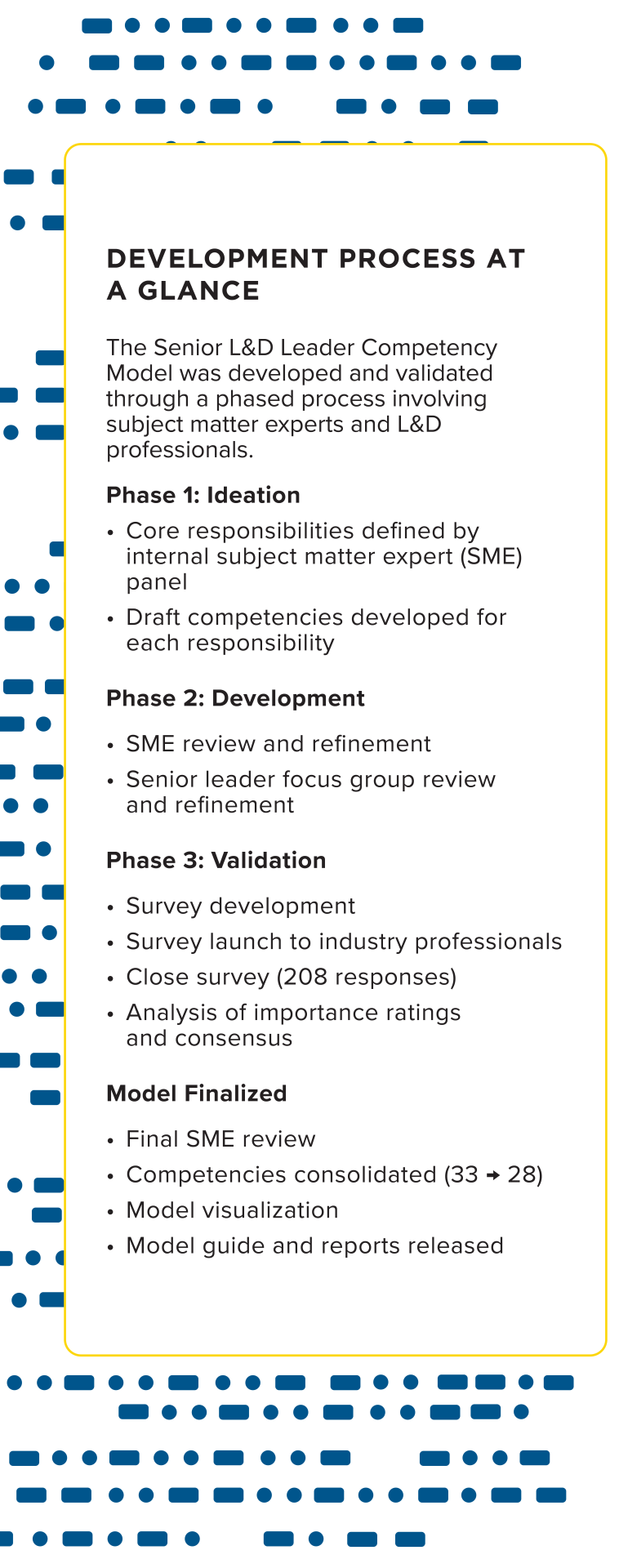
Training Industry, Inc.’s Senior L&D Leader Competency Model™ was built to define that gap and provide a framework for addressing it. Developed through internal research, practitioner feedback and industry-wide validation, the model defines the responsibilities and capabilities required to lead learning as a strategic business function and serves as a practical map of the territory between training expert and learning executive.
The Core Responsibilities of Senior Learning Leaders
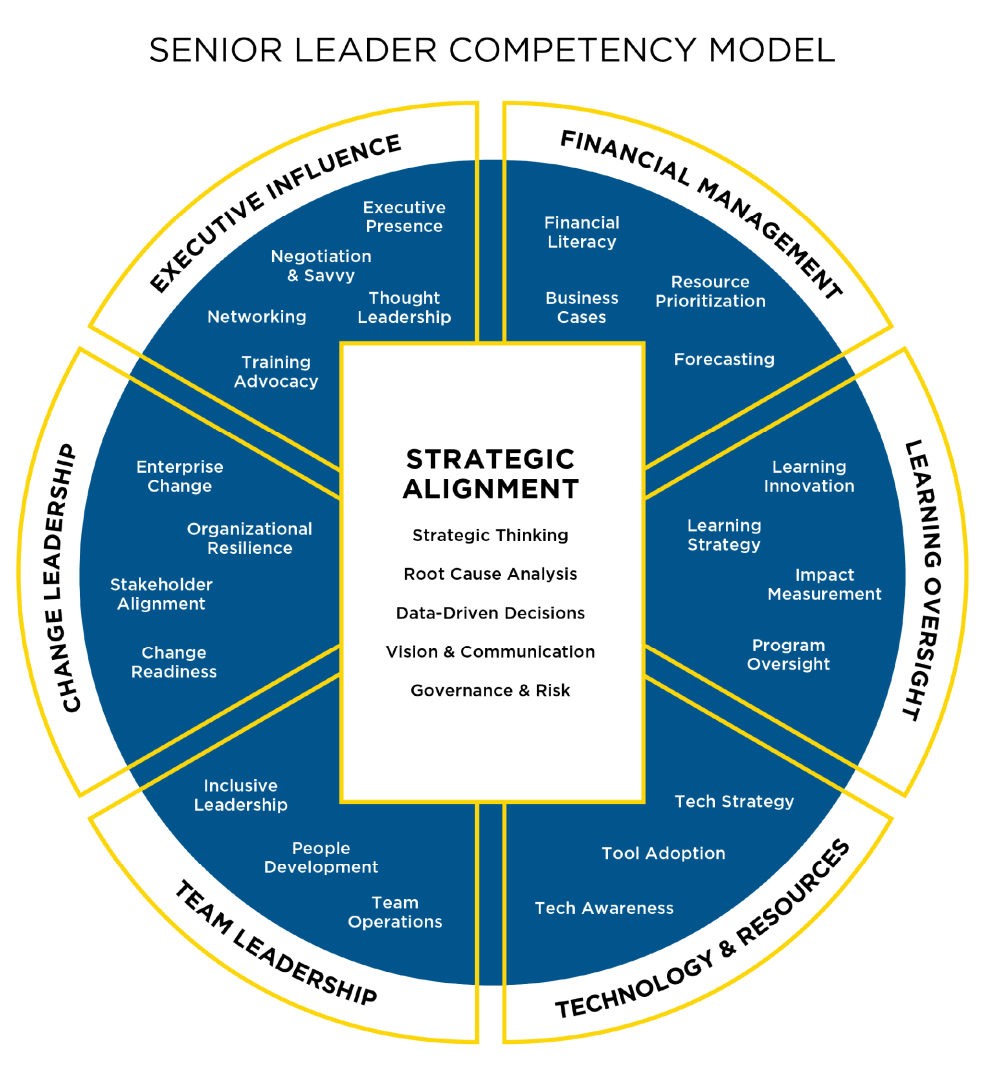
The model is organized around seven core responsibilities that define effective leadership at the executive level of the learning profession. Within each responsibility sit the specific competencies that support success. Together, they describe what the executive version of the learning role looks like.
1. Strategic Alignment: Aligning learning strategy with enterprise goals and business priorities. This is the anchor of the model. Everything a senior learning leader does should trace back to what the business is trying to accomplish.
Key competencies: Strategic thinking, root cause analysis, data-driven decision making, vision crafting and communication, and governance and risk ownership.
2. Executive Influence: Building the relationships, presence and credibility to shape decisions at the highest levels of the organization. Senior learning leaders earn a seat at the table by operating as peers to other executives, not as service providers to them.
Key competencies: Executive presence, negotiation and political savvy, networking, thought leadership, and serving as an advocate and ambassador for training.
3. Financial Management: Managing learning investments, budgets and organizational resources to maximize business impact. Senior learning leaders must be able to make, defend and prioritize investments in learning based on business value.
Key competencies: Financial literacy, business case development, resource investment and prioritization, and business and financial forecasting.
4. Learning Function Oversight: Ensuring the learning function itself is innovative, aligned and demonstrably valuable. This is where deep functional expertise still matters, but applied through a governance and portfolio lens rather than a program-by-program one.
Key competencies: Learning innovation enablement, learning strategy, performance and impact measurement, and program and portfolio oversight.
5. Technology and Resource Management: Building scalable, future-ready learning ecosystems. As learning technology reshapes learning capabilities, senior leaders must set the technology strategy rather than react to it.
Key competencies: Learning technology strategy, technology and tool adoption leadership, and learning tech market awareness.
6. Team Leadership: Leading the learning team itself through inclusive leadership, people development and operational accountability. Even at the executive level, senior leaders remain responsible for growing the capabilities and performance of the people doing the work.
Key competencies: Visionary and inclusive leadership, people development, and team operations and standards.
7. Change Leadership: Supporting organizational transformation, resilience and readiness for change. Learning leaders are uniquely positioned to build the capabilities organizations need to navigate constant change.
Key competencies: Leading enterprise change, stakeholder engagement and alignment, building organizational resilience and change readiness capability development.
Notice what the list is not. It is not a catalog of instructional design skills, delivery techniques or platform administration. Nor is it an expanded version of Training Industry’s Training Manager Competency Model™, which defines the level below: the training manager role responsible for leading the training function as a whole, not just developing and delivering programs. The difference between the two models is the difference between the two roles. The training manager is responsible for the training function; the senior L&D leader is responsible for advancing the organization through training. That is why so much of the executive model extends beyond the learning function itself. At the executive level, the buffer of a purely functional mandate disappears. You are accountable for the performance of the enterprise as a whole, and that is what this model was built to reflect.
Validating the Model
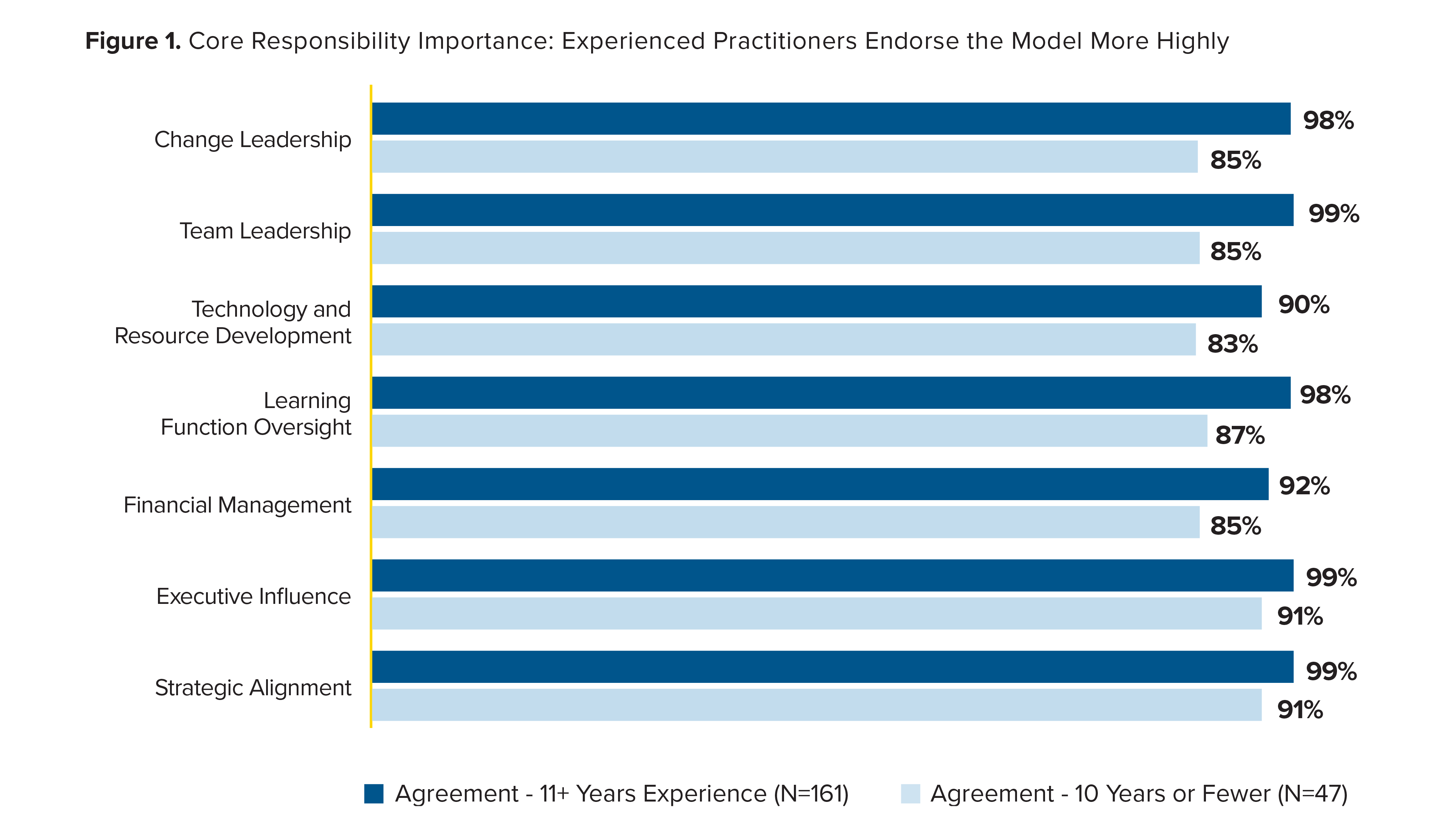
Validation results showed strong endorsement of the importance of the core responsibilities: at least 88% of the 208 professionals surveyed endorsed every responsibility as important to the executive role, and five of the seven were endorsed by 95% or more (Figure 1).
This was particularly true for respondents with more than 10 years in the field, most notably for team leadership and change leadership, meaning the practitioners with the greatest level of experience were the most likely to endorse the importance of each responsibility. This suggests that professionals who are early in their career should consider investing in these skills now, with confidence that they will grow in importance as their career progresses.
Overall, study results confirmed confidence in the validity of the model in its representation of higher-order responsibilities and competencies that are reflective of an executive-level role.
Also of note: Those responsibilities with relatively lower importance ratings overall were those that may be perceived as falling outside the scope of traditional L&D expertise (i.e., technology and resource management, and financial management), but which are unquestionably responsibilities of an executive. Despite their lower ratings, the evidence for their importance was still strong enough to support their inclusion in the model.
The competency-level results revealed a similar pattern, with financial forecasting, governance and compliance ownership, portfolio governance, technology market awareness and HR practices awareness scoring lowest. These findings highlight an important challenge for aspiring learning executives, some of the capabilities required at the executive level may also be the ones that they’ve had the least opportunity to develop.
How We Use the Model Today
The Senior Leader Competency Model is designed to be more than a description of the skills associated with executive-level learning leadership. It provides a framework for understanding the responsibilities of the role and identifying the capabilities leaders may need to strengthen as they move from functional expertise to enterprise leadership.
The model also provides a foundation for Training Industry’s work with senior learning leaders, informing our research, content and development initiatives around the challenges and capabilities most relevant to the role. By grounding this work in the model, we can maintain a consistent focus on the evolving responsibilities of senior L&D leaders and the skills required to lead learning as a strategic business function.
For practitioners, the model can serve as a reference point for career development, leadership development and conversations about what effective executive-level learning leadership looks like. Its purpose is not to prescribe a single path to leadership, but to provide a common framework for understanding the role and preparing for its demands.
Next Steps for Senior Leaders
Moving into senior learning leadership requires deliberately developing capabilities beyond traditional L&D expertise. Whether you are preparing for a senior L&D role or already in one, the model can help you identify where to focus your development. To elevate your impact and strengthen your position as a strategic business leader, consider the following actions:
- Assess your readiness: Take the Executive Leader Quiz to know if the executive level is the right next step for you. Uncover barriers and gaps for improvement.
- Choose a development priority: Choose one core responsibility to emphasize in the next quarter, such as financial management or team leadership.
- Create opportunities to practice it: Seek work that requires you to build a business case, influence senior stakeholders, participate in enterprise change, make investment decisions or shape technology strategy.
- Collaborate intentionally: Build partnerships with leaders across the business, particularly in finance, HR, technology and business operations, to connect learning strategy to organizational priorities.
- Invest in growth: Explore professional development opportunities, such as the Training Industry Senior Leaders Program, that align with the model.
The path to senior L&D leadership is not simply about becoming better at managing learning. It requires expanding how you think about your role, from leading your training team to helping lead the organization. The seven responsibilities in the Senior L&D Leader Competency Model provide a framework for making that shift. By taking intentional steps, senior L&D leaders can position themselves as organizational leaders who shape strategy, influence performance and drive measurable outcomes.