

Published in Fall 2026
The corporate ladder speech is a staple of early career advice. Climb well, stay in your lane and eventually reach the top. It is tidy. It fits neatly on an org chart. And for most employees, it bears almost no resemblance to how their careers actually unfold.
Workforce development has long rested on the assumption that progress means moving up within a single, narrow function. But when a large public-sector transportation agency analyzed the full career histories of 38,000 employees across more than 550,000 individual job records, that assumption did not hold. The straight line was not just rare. It was the exception.
The question driving the analysis was straightforward: If employees are given real access to move sideways, across job families and disciplines, do they stay longer? The answer, backed by five decades of workforce data, is yes.
What the Data Shows
The analysis grouped employees into three categories based on their job histories. The first group never moved: same role, same job family, no structural change throughout their tenure. The second group followed a linear path: steady advancement within a single specialty. Think of an engineering technician progressing to senior technician and eventually to project inspector. Expertise deepening in one lane.
The third group jumped tracks entirely. A maintenance worker who moved into a safety coordinator role, then into emergency management. These were not minor title adjustments. They were total shifts in the kind of work a person does every day — the kind of moves that rarely appear in a formal succession plan but that turn out to matter more than almost anything else for how long people stay.

A Canyon in Retention Rates
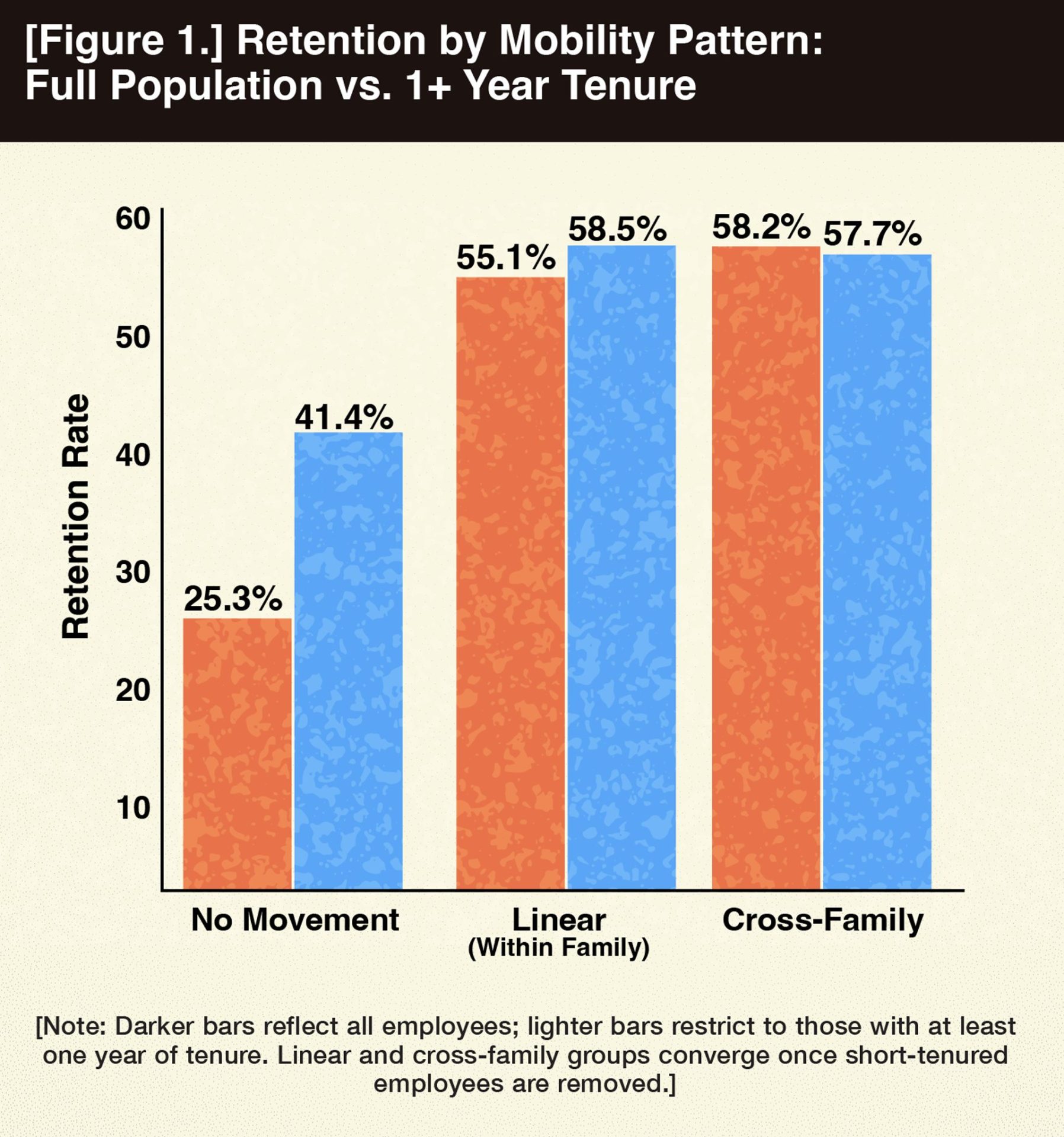
The retention gap between employees who moved roles and those who did not is substantial. Among employees who never changed roles at all, the retention rate was 25.2%. Among those who moved within a job family, the retention rate was 55.1%. Among those who crossed job families entirely, it was 58.2%. Their likelihood of staying more than doubled compared to those who never changed roles (see Figure 1).
The obvious objection is that short-tenured employees inflate the no-movement floor: interns, temp-to-perm hires, people who never intended to stay. To test for that, the analysis filtered for employees with at least one year of tenure. The no-movement group remained at 41.4%. Linear movers and cross-family movers came in at 58.5% and 57.7% respectively, less than one point apart. While the jump is not as large, the gap did not go away. The direction of movement still did not predict retention. Access to movement did.
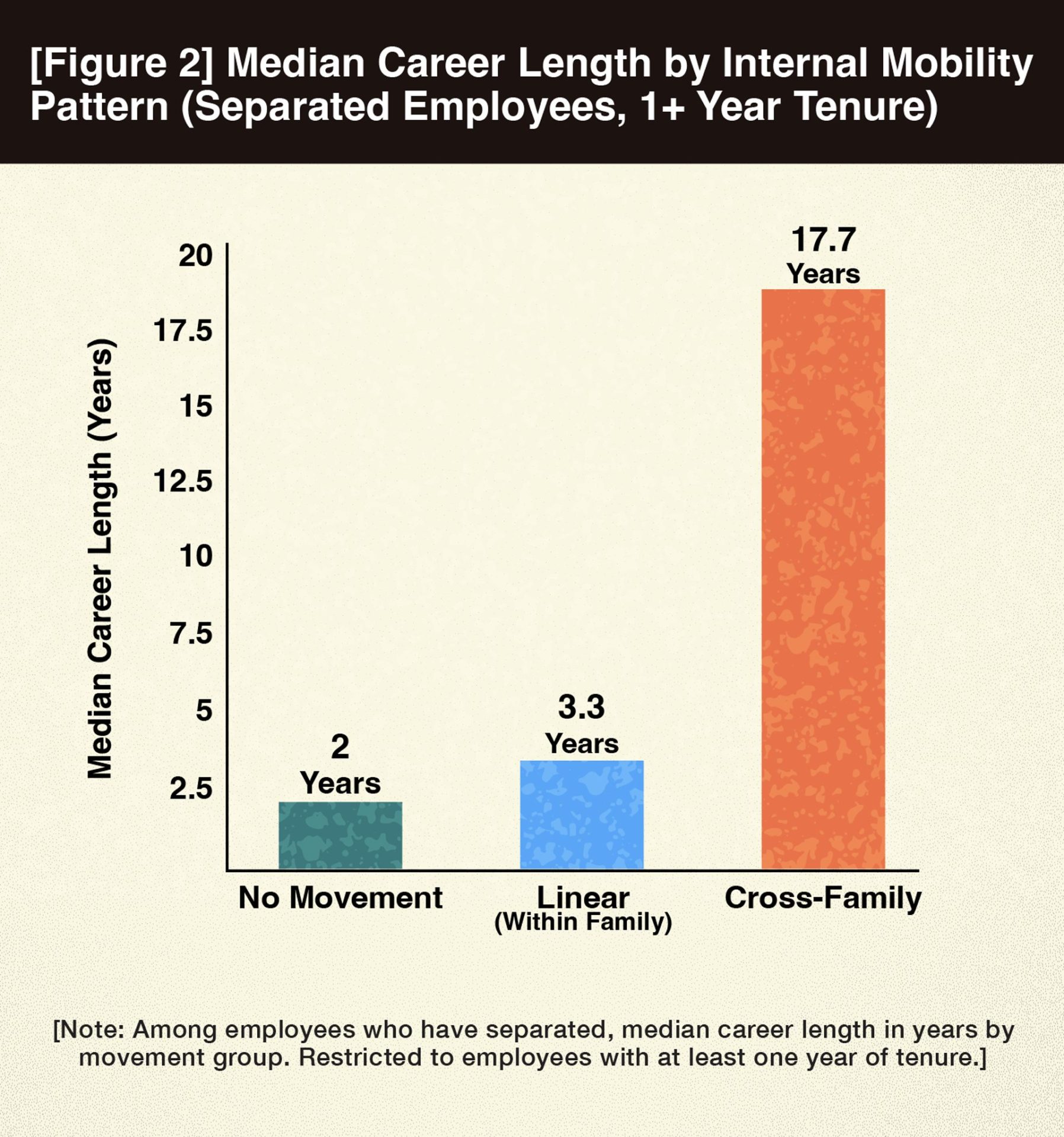
The most striking number is career length. Among employees who eventually left, those who never moved had a median career of just two years. Those who moved within job family had a median career of 3.3 years. Those who crossed job families had a median career of 17.7 years. That is not a marginal difference. It is the difference between someone who made a pit-stop and someone who built their working life inside one organization (see Figure 2).
When an employee moves across job families, they don’t just change their desk. They carry the logic of their old department into a new context (transfer of learning anyone?). While we shouldn’t claim that moving families causes someone to stay 17 years, we can see that the people who stay 17 years are the ones who were given the space to evolve. They didn’t just stay in one lane: they built a whole new road.
What Cross-Family Movement Actually Looks Like
The linear path is easy to see on paper. A technician-one becomes a technician-two, then a technician-supervisor. Organizations tend to build for this path because it maps cleanly onto a career framework.
Cross-family paths produce a different kind of value, one that is harder to quantify. Consider a maintenance technician who moves into safety coordination and then into emergency management. By that third role, the person is not just a safety expert. They are a safety expert who knows what it actually feels like to be on a crew at 2 a.m. in a storm and can coordinate and prioritize emergency operations with context. They can write a protocol that field crews will follow, because they have been on that crew. That knowledge builds over years of internal movement and it walks out the door when the organization stops offering the next step.
What This Means for L&D Strategy
The data shows that lateral and cross-family moves are not detours from a career path. For the majority of employees, they are the career path. Learning and development (L&D) strategy built primarily around vertical advancement is optimized for the 12%, not the 88%.
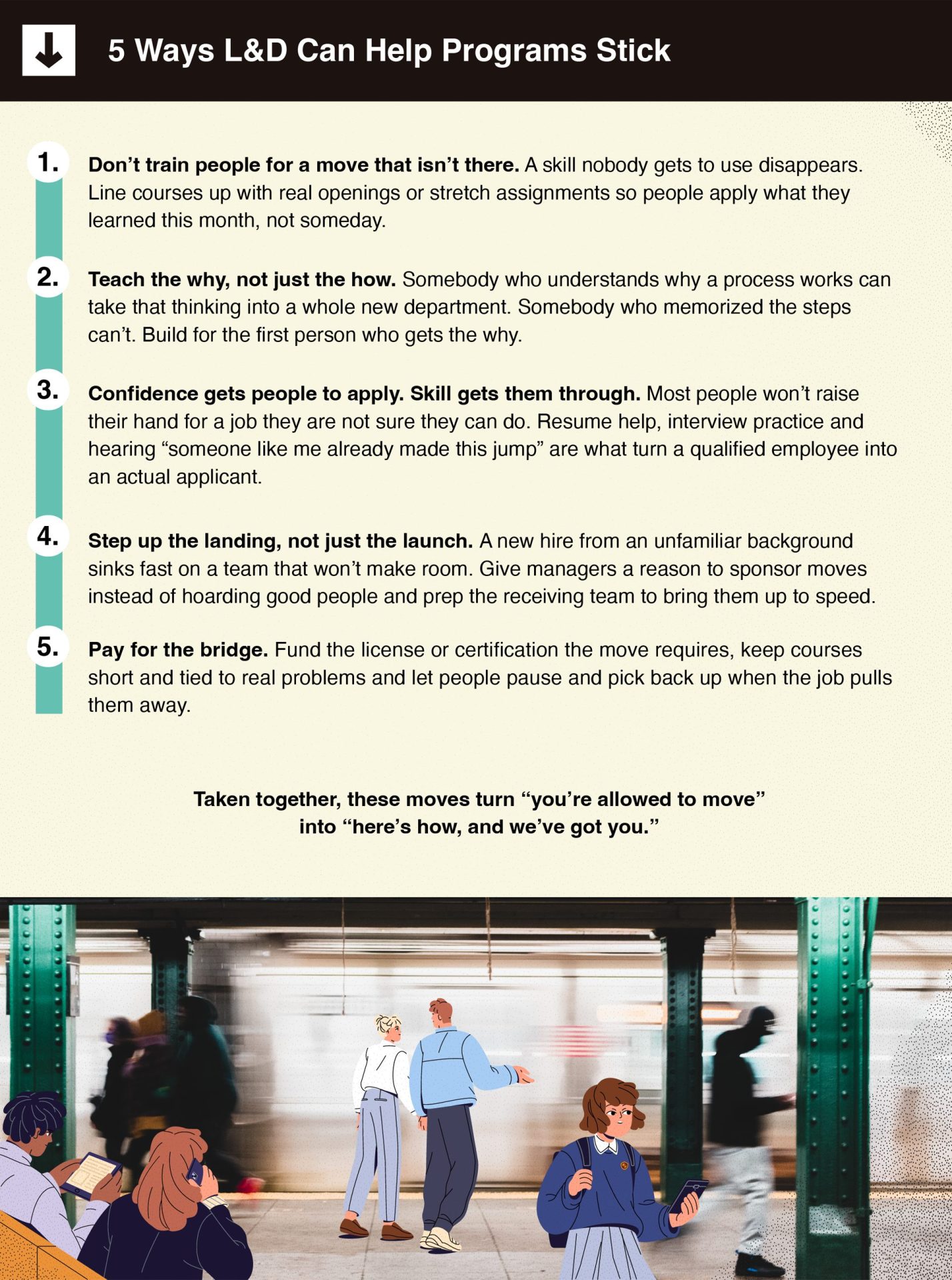
Everything starts with letting employees see what’s possible. TxDOT offers career-exploration coursework built around self-assessment, helping people name their own skills and interests before pointing them at a destination role. That groundwork feeds directly into a career path dashboard, which turns decades of movement data into a map employees can use. Soft-skills training is included to give employees the belief that a lateral move is theirs to make.
And once they have a desired path and confidence to pursue it, they also benefit from guidance on how to write a resume for a role outside their current job family, how to talk about their experience in an interview for a job they have never done and how to tell their own success story out loud. TxDOT builds that directly into its career programming: resume workshops, elevator-pitch practice, and coaching for interviewing into internal openings. TxDOT treats these as career services, not soft extras. They are what turns an eligible employee into an applicant.
The harder case is also the clearest example: bridging real technical gaps between job families. A maintenance worker with no heavy-equipment background can move into equipment operation because TxDOT will fund and outline the commercial drivers license and equipment training required to get there. The same is true for the path from maintenance into construction inspection, a role in chronic short supply across the industry. The organization does not just permit the jump. It pays for and sequences the training that makes the jump survivable.
The programs themselves are built to be used, not admired. Most run two weeks or less, a handful stretch to a month, and they follow adult-learning principles: timely, relevant to a problem the employee has right now and short enough to finish. When winter weather or flooding pulls trainees back to the field, TxDOT pauses the course and resumes it rather than making them start over. Infrastructure that cannot flex around a real job does not get used by people who have one.
Build the Infrastructure, Not Just the Pathway
A workforce that moves internally tends to be one that understands how the whole organization functions. People who have worked across multiple disciplines carry a broader view than those who have stayed in one area. That cross-disciplinary fluency is difficult to hire for and nearly impossible to build quickly. It accumulates over time, one internal move at a time.
The ladder was built for a workforce that moved predictably through a fixed set of roles. That is not the workforce most organizations have now. The job of L&D is not to push people up one vertical track. It is to build the infrastructure that lets them find their own direction and stay while they do it.