

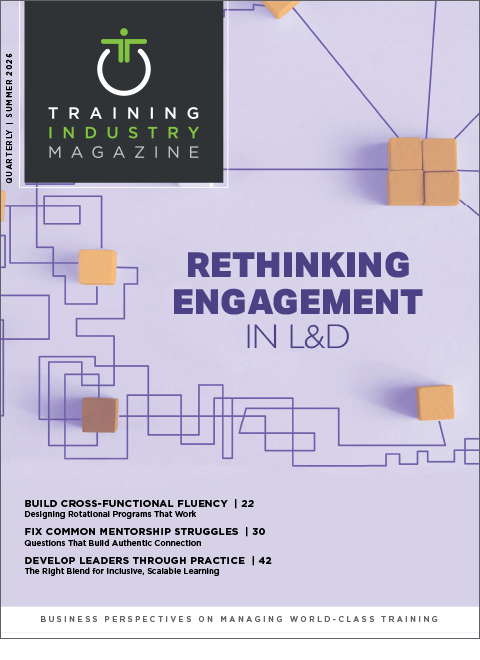
Published in Summer 2026
A learning and development (L&D) team attempts to design an excellent training module. An internal design team starts creating a learning module, but they fail to validate whether it meets a need at their organization. They use artificial intelligence (AI) tools to draft an outline, slide decks and exercises. The module goes live, and they celebrate. However, in the coming weeks, sign-ups are sparse. Employees who complete the module say that it was too long and unhelpful. What went wrong?
This team should’ve recognized the importance of getting feedback from stakeholders early and often while using time-tested frameworks to guide their decisions. To get employees excited about learning, it must be clearly integrated into their job and growth trajectory. When done well, this leads to immersive, relevant and motivating experiences.
This article explores how to make training relevant, design motivating material, embrace the role that managers (and others) play in guiding employees’ learning journeys and implement a robust learning culture at your own organization.
Make Learning Relevant to Employees
Whether a learning module succeeds or fails is determined well before it launches. Its success hinges on the quality of its design and whether it addresses the underlying needs of an organization.
Using common-sense AI prompts to generate content that seems relevant on the surface may seem like a quick win. But in practice, it often misses the mark. A better approach involves a deep understanding of what the organization is solving for and a rigorous evaluation of potential solutions.
L&D professionals need to ask these questions:
- What need is the organization trying to fulfill?
- What are the best practices for fulfilling that need? How do competitors approach it?
- What does research say about the topic?
- Does the learning module fit with the company’s culture?
- How are employees expected to show up daily?
- Is the content engaging and consistent with how employees want to be immersed and learn?
- What feedback do stakeholders have as the module is being developed?
The last question is the most important one; learning modules cannot be developed in isolation. Of course, the design team must collaborate, but other stakeholders must weigh in early. These questions must be answered at the start.
Help Employees Engage With Learning
Designing phenomenal learning opportunities is only the start. L&D professionals have a hand in guiding employees to engage with the learning. More than promoting the availability of new module, their guidance should focus on enhancing perceptions of a learning opportunity’s accessibility and effectiveness. One of the best ways to accomplish this is by advocating for a support system that makes it easier for employees to learn.
The Role of the Manager
Managers are essential to workforce development. They must lead an employee’s developmental trajectory just as much as the employee does.
Managers set priorities, balance deadlines and engage in conversations about career growth. This means managers can assess the best times for their employees to engage in learning in a way that benefits the employee and their team.
There are multiple touchpoints that managers can use to accelerate their employees’ learning. However, about a third of managers don’t make space for learning opportunities, according to research from Truist Leadership Institute. An even greater percentage don’t promote unique developmental opportunities, like encouraging their employee to network across the organization. Without their manager’s guidance, employees might not know these opportunities exist.
Managers and employees should collaboratively remove these barriers. Employees may feel too overwhelmed to spend time on learning, but managers can circumvent these concerns. The key is giving employees time and bandwidth to learn. Managers can shift priorities, prompt co-workers to trade off responsibilities, assign relevant stretch assignments or make introductions to new collaborators. Importantly, all employees (not just people leaders) must be eligible for these opportunities for a learning culture to proliferate.
Managers are why learning goes beyond “one and done” and extends into a journey lasting an employee’s entire tenure.
The Role of Other Employees
The burden isn’t entirely on managers to develop their employees.
Building a learning culture requires identifying each person’s role. Learners play a role in attending, engaging with and applying their learning, but their ability to do so relies on the organizational norms and support that connects them to learning experiences. L&D designers create environments that make this easier to do by tapping into learner’s preferences for specific modes of learning.
Many organizations also promote mentoring relationships. Unlocking the performance-related and cultural benefits of mentorship requires deliberate effort. For example, it’s fruitful to promote mentor-mentee connections at multiple points in one’s career, not just at the beginning.
Success is likelier when the following is true:
- An infrastructure is in place to help mentees find mentors.
- Mentorship roles are formalized.
- Mentees practice autonomy and apply their learning.
- There is a standard of honest feedback between the mentor and mentee.
- Mentors guide mentees based on what worked well for them in their learning journey.
The entire organization contributes to the power of social proof. Employees witnessing others taking learning seriously signals that they should do the same.
The Role of Technology
Another emerging learning resource is AI in training. AI can retain information about an employee’s role, projects and their career goals. Some AI software can recommend which learning opportunities an employee should engage in next.
Despite AI’s advantages, some employees are intimidated by it. They might fear being left behind by those proficient with the technology or the capabilities of the technology itself.
Employees aren’t in this alone. Their peers are learning the technology, too. Turning learning into a social endeavor amplifies retention and the transmission of knowledge. This can involve simple actions like asking a coworker for help with troubleshooting an AI application or holding a sharing session. These opportunities help employees feel less overwhelmed when they begin a formal learning journey on a new subject like AI.
AI is a partner in effective learning, but learners and designers must remember that it can’t replace thoughtful design for creating programs or managerial guidance for developing employees.
Implementing a Learning Culture: Start Here
Multiple team members engaging in learning opportunities forges a shared language and a culture of learning. Instead of one employee developing an edge, the entire team maneuvers better together, especially over the long term. Their accumulated experiences help them recognize how their team can continuously learn and grow.
A first step for enabling this culture at your organization is taking a hard look at your L&D strategy. Implementing irrelevant measures — or good measures at the wrong time — results in wasted effort.
An authentic assessment of your organization’s learning culture is an investment in the organization’s future. When approached with evidence and resonant frameworks, this assessment helps your organization prepare relevant offerings that plug into an accessible learning infrastructure that is easily used and reinforced over employees’ entire tenure.
Organizations with nascent learning cultures should focus on educating managers to build learning capacity on their teams while ensuring that relevant offerings are available once their employees are inspired to engage.
Seasoned organizations should use technology and managerial connections to identify their best talent and develop those individuals via stretch projects and succession planning. These L&D processes can be refined over time through feedback systems, especially as an organization retains tenured employees that enable a wealth of institutional knowledge.
Regardless of where your organization is in implementing a learning culture, much can be done to connect employees with opportunities that will accelerate their performance. Organizations that are honest about where they are and how else they can sharpen their offerings will maintain an edge.
Organizations cannot reliably stem the tide of change, but their employees can be well-armed with knowledge and prepared for everything that comes next.
Truist Leadership Institute Disclaimer
This content is provided to you for general information purposes only. This content does not constitute legal, tax, accounting, financial, investment or mental health advice. You are encouraged to consult with competent legal, tax, accounting, financial investment or mental health professionals based on your specific circumstances. Unless otherwise specifically stated, any views or opinions expressed herein are solely those of the individual authors listed, and are not the product of, and may differ from the views of, Truist Financial Corporation, its affiliates and/or subsidiaries. We do not make any warranties as to accuracy or completeness of this information, do not endorse any third-party companies, products or services described here, and take no liability for your use of this information. Opinions and content represent the individual author’s judgment as of the date of this material and are subject to change without notice. We assume no duty to update any information in this material in the event that such information changes.