
Digital twins have many applications but one of the most interesting is their use as full-blown training ecosystems. Instead of static standard operating procedures (SOPs) or one-off classroom demos, organizations are building living, data-driven replicas of assets, workflows and environments where employees can practice high-risk, high-variability tasks safely and repeatedly.
This article examines where digital twins for training deliver the biggest workforce gains today. We unpack the how and the why to extract cross-industry lessons that learning and development (L&D) and operations leaders can apply to build realistic, scalable training programs.
Understanding Digital Twins in Training
A digital twin is a synchronized virtual representation of a physical asset, process or system. In training, that synchronization turns into a persistent practice ground with behavior and constraints that mirror the job site. Modern twins bring together internet of things (IoT) signals and logs, combine them with physics or discrete-event models, and surface insights via artificial intelligence (AI)/machine learning (ML) that predict outcomes and recommend next actions.
When wrapped in 3D, virtual reality (VR) or augmented reality (AR) interfaces, they become richly interactive simulations that learners can enter from anywhere, with performance data captured for coaching and compliance.
What separates a twin from a “pretty 3D model” is the feedback loop. Performance data from each session updates the model, tunes difficulty and captures tacit know-how for the next cohort. Recently announced toolchains are also lowering the lift to build training-ready twins at scale.
Top 5 Industries Revolutionizing Training With Digital Twins
While digital twins can be useful for training across a huge swathe of industries, there are some that are already reaping the benefits.
Manufacturing
Manufacturing couples high-value equipment with abundant telemetry and unforgiving takt times, making the sector a natural leader. Currently, manufacturers can utilize plant- and factory-scale twins that fuse computer-aided design (CAD), programmable logic controller (PLC) logic and manufacturing execution system (MES) data so teams can commission lines virtually, rehearse changeovers and onboard operators without pausing production. When it comes to training, AR-enabled classroom experiences built around engine and line twins standardize instructions and scale skills transfer globally.
These comprehensive digital twins give trainers the same physics and constraints the shop floor faces. That continuity is what makes twin-based practice stick: operators rehearse exactly the logic they will encounter when operating heavy machinery. Market outlooks for 2025–2030 keep manufacturing among the fastest-growing adopters as twins expand from design offices to cells, lines and whole factories, tying classroom learning to measurable throughput, quality and safety outcomes.
Aviation and Aerospace
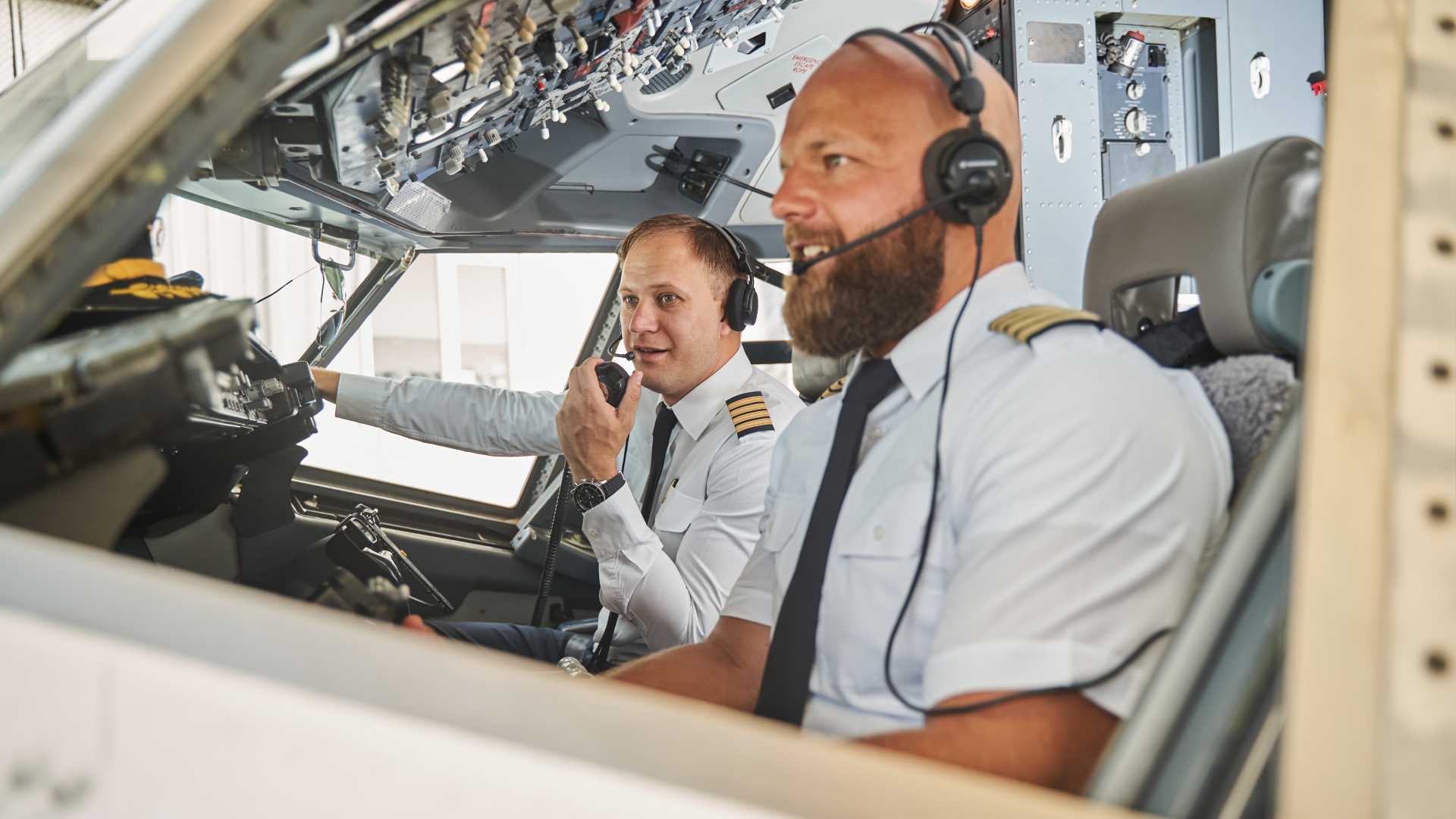
Aviation’s safety culture and system complexity have long favored high-fidelity simulation; what’s new is the breadth of roles now training inside twins. Current recommendations support a full twin-based ecosystem for maintenance education, connecting asset data and standard procedures to realistic practice modules that improve technician readiness.
Airlines are also extending twins beyond flight decks to cabin and ramp operations. Dutch airline KLM uses navigable digital twins of aircraft interiors so crews can “walk the plane” from any device, supplementing simulator time with repeatable, on-demand familiarization and procedure rehearsal that reduces classroom bottlenecks.
The ecosystem view stretches to airports and original equipment manufacturers (OEMs), where system-level twins let cross-functional teams rehearse disruption response and turnaround optimization before pushing changes onto the ramp. AI-enhanced twins can compress time to competency across maintenance, repair and operations (MRO) roles and improve operational resilience, which is critical as fleets evolve and maintenance backlogs strain capacity.
Health Care
Health care is adopting digital twins both for clinical training and for the operational choreography that shapes patient experience. Hospital twins can act as discrete-event models tuned to health care’s variability (arrivals, staffing, modality constraints, etc.) so teams can test scheduling, triage and imaging workflows, then apply the winning configuration.
Health care digital twin training technology ranges from patient-level and organ-level twins (including “digital hearts”) to hospital-wide operational twins, with studies demonstrating how twins support training, decision-making and “what-if” rehearsal.
The Mater Private Hospital in Dublin, Ireland, used a radiology-department twin to redesign layouts and protocols, which reported utilization lifts of roughly 26–32% with meaningful reductions in CT/MRI waits, evidence that practicing flow changes in a twin can translate directly into capacity and experience gains.
Energy and Utilities
Utilities manage hazardous work, distributed assets and strict reliability targets, all of which benefit from risk-free rehearsal. Responding to these needs, there are VR systems that let apprentices manipulate a substation’s digital twin and see immediate impacts on grid behavior, including reconstructed fault conditions, without touching live equipment.
Grid-level twins allow planners and operators to test restoration strategies for extreme weather or cybersecurity scenarios and to validate technology changes before they touch the real system.
Network owners are also knitting the ecosystem together. In the UK, planners and standards bodies are formalizing common data environments and sector-wide twin initiatives so teams can model whole-system scenarios and run multi-party exercises. These foundations make workforce drills as lifelike as the grid itself, minus the risk.
Defense
Defense organizations increasingly treat digital twins as essential to mission rehearsal, sustainment and talent development. Digital twins capture expert knowledge, simulate weapons and platform behaviors and let units practice high-consequence scenarios safely and repeatedly. This turns scarce subject matter expertise into codified training content.
U.S. services are formalizing digital-engineering policy and pushing programs to adopt digital threads and twins earlier to shorten acquisition timelines and improve readiness. Industry leaders such as Lockheed Martin are publicizing “e-pilot” and human-twin concepts that blend platform and operator models for richer training.
Other Industries Benefiting From Digital Twins for Training
Construction, automotive, telecom and mining are quickly adapting the same playbook. Contractors are building site-scale twins for pre-task planning and safety walk-throughs so crews can memorize hazards and staging before arrival; case examples describe “virtual site visits” and gamified instruction used to standardize driver orientation and improve safety conversations.
Automakers are pairing plant twins with AR/VR to train technicians on inspection and rework, connecting collaborative robots (cobots), AI and twins to shorten ramp-ups and reduce scrap.
Telecommunications providers are using 5G network twins to train engineers on configuration, assurance and optimization in emulated environments that behave like live networks.
Mining operators are doing the same for safety-critical workflows, using twins to rehearse procedures and optimize heavy-equipment operations before crews head underground.
Challenges and Considerations
Powerful as they are, twins aren’t plug-and-play.
Security and privacy come first, because realistic models may mirror sensitive production states or patient information, strict cloud security, identity controls and encryption are essential. Integration is equally important: training value depends on a clean data layer and interoperability between CAD, supervisory control and data acquisition (SCADA), electronic health records (EHRs) and learning management systems (LMSs).
High-fidelity simulation can test compute budgets, so leaders need to balance realism with scale and choose where to use physics-accurate models versus lighter-weight approximations.
Finally, instructor readiness matters: Educators and supervisors need time and guidance to translate SOPs and tacit knowledge into scenario-based content and to act on the analytics twins produce.
Conclusion and Future Outlook
Digital twins are becoming the scaffolding for modern workforce development. Manufacturers commission lines faster because operators practice in virtual plants that behave like the real thing. Airlines and MROs are standardizing instruction across aircraft types and ground roles with twins that compress time to competency. Health systems are applying hospital and patient twins to improve flow and rehearse care decisions. Utilities are preparing crews for rare but critical events in grid-level twins.
Across sectors, the common thread is the same: hands-on practice in a realistic, data-rich model drives speed, safety and confidence. The takeaway for learning leaders is clear: Start scoped, connect learning metrics to operational KPIs and design for continuous updates so the twin remains a faithful, living training ground as the work itself evolves.


