

Employee engagement often reflects how committed and connected an individual feels to their organization. Leaders can use both quantitative and qualitative methods to measure engagement levels, gaining insight into how to better support and empower employees. When the relationship between employees and the organization is strong, employees can be more likely to go above and beyond —contributing innovative ideas and taking initiative without being prompted by a manager. This means that employees proactively address issues, showing initiative and commitment to the job.
Measuring Employee Engagement
Engagement is typically measured using a questionnaire that employees complete on their own. These questionnaires use rating scales made up of related questions that reflect different aspects of engagement.
For example, the Utrecht Work Engagement Scale (UWES) measures three key areas:
- Vigor (energy, enthusiasm, and resilience at work).
- Dedication (feelings of significance, inspiration, pride, and challenge).
- Absorption (a sense of deep focus, concentration, and flow while working).
Responses are given using a Likert-type scale, where employees rate how often they experience each feeling — from “Never” (0) to “Always” (6).
There are many measurement tools for evaluating employee engagement. Some estimates indicate the average cost of employee engagement surveys ranges between $3,000 and $30,000.
Simply measuring employee engagement offers limited value on its own. The true benefit lies in the insights gained — and more importantly, in how those insights are used. Without meaningful action, even the most accurate data becomes irrelevant. Lasting impact comes from turning insights into informed decisions that drive positive change.
The Value of Investing Employee Engagement
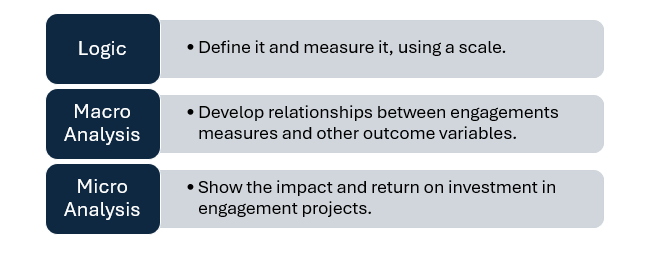
Many organizations invest billions each year to address gaps in their engagement measures. How do they know those investments are paying off? Reasons to fund engagement have evolved over three stages.
- Logic and intuition.
In the early stages, funding was based on logic and intuition. Logically, it makes sense to ensure employees are committed to their work. If measures indicate otherwise, efforts to improve the measures are the responsible thing to do. The image of disengaged employees caused executives to fund engagement. - Macro-level analysis.
Later, engagement was funded based on the linkage of engagement to important outcomes. Statistical analysis between measures on a given engagement survey and measures of perceived company performance, or in some cases, actual company performance, often indicate a positive relationship. Based on these models, the theory is as engagement goes in a direction, so goes company performance. Unfortunately, these studies do not always reflect the behaviors and actions taken by leaders and employees or the impact of those actions. According to Gallup, in 2024 employee engagement was at an all-time low while labor productivity was increasing. A study reported in the Harvard Business Review demonstrated no relationship between engagement and average hours worked. This suggests that even though survey data say employees are engaged, they are not going out of their way to solve work challenges as they arise without being prompted by a manager. - Micro-level analysis.
Now, the basis for funding engagement is cost-benefit analysis. This level of analysis can demonstrate the direct connection between investments in employee engagement and the impact of those investments.
Micro analysis can give learning leaders direct, credible evidence that prove investments in employee engagement are paying off.
The Importance of Micro Analysis
Micro analysis is the evaluation of engagement investments at the program or solution level, or, in some cases, an aspect of a program. Programs might include:
- Rewards and recognition.
- Talent development opportunities.
- Work-life balance initiatives.
- Culture change initiatives.
- Collaboration opportunities.
- Talent acquisition processes.
Analysis of the specific programs is important because most functional areas in an organization have limited resources. Having limited resources means there must be a process to determine where to shift resources so that they are utilized most efficiently. Measures of value most important at this level of analysis, depend on stakeholder perspective.
| Measure of Value | Typical Indicators | Most Important To |
| Input | Types of topics, content Number of people Hours of involvementCosts | Program owner Key stakeholder Senior leaders |
| Reaction and Perceived Value | Relevance Importance Usefulness Appropriateness Intent to use Motivational Recommend to Others | Program participants Program owners |
| Learning and Confidence | Skills Knowledge Competencies Confidence Contacts Insight | Program participants Program owners |
| Implementation | Behavior change Extent of use Frequency of use Actions completed Engagement Collaboration | Supervisors Managers |
| Impact | Productivity Revenue Quality Time Efficiency, costs Accidents, incidents Retention Customer satisfaction Innovation | Senior leaders/C-Suite |
| Return on Investment | Benefit-cost ratio (BCR) ROI (%) Payback period | Senior leaders/C-Suite |
This is not to say that every engagement program demonstrates value from all perspectives. Simple incentives that cost little are nice to do for employees. Major investments strategically aligned with the business, however, warrant evaluation to ensure they made an impact and return on investment (ROI).
Micro–analysis at work.
Consider this example:
A manufacturer of high-quality, lightweight plastics was concerned about the cost of controllable waste and the amount of time spent on rework. They felt that a boost in employee commitment to and pride in the job would help. So, they set out to enhance the capabilities of immediate mangers to positively influence line employees’ work engagement as measured by the Utrecht Work Engagement Scale. The primary solution was a developmental opportunity where immediate managers learned five self-coaching sills and how to foster a motivational work environment. The study used quasi-experimental research design to analyze changes in engagement for line employees assigned to two of 14 business units. Production served as the test group; maintenance was the comparison group.
The results showed that while engagement in both business units was on the increase three months after program implementation, production (test group) maintained a significantly higher level of engagement than maintenance. Additionally, when comparing controllable waste and time spent on rework eight months post-program, production outperformed maintenance. This notion was further supported by management who provided additional estimates of the relationship between the program and improved business measures.
When converting controllable waste and time spent on rework to money and comparing these monetary benefits to the cost of the solution, the ROI was 399%.
Employee Engagement’s Value Proposition
Engagement has become one of the most important metrics in talent management. Investments in it are significant and rightfully so. While there are nice things to do for employees that cost little, in today’s environment costly, strategic investment are being made — investments that must deliver value. Defining the value proposition of engagement has evolved over time — from trusting logic and intuition, to defining statistical relationships between measures and outcomes, and now to creating a direct connection between the investment and the measures that matter most, including the return on investment.

