

Your boss is leaving the organization. Good news? Bad news? How will it feel not to have them around and available for direction and support? If your manager leaving is good news and you feel a huge weight has just been lifted from your everyday routine, you might not have a very good manager. If this is bad news and you miss the connection you made and the work you do together, then you’re among the lucky ones that have a good manager.
Either way, the point is managers have a tremendous amount of influence on the way we show up (or even whether we show up) to work every day. The plus side to this high level of influence is that even small training-inspired improvements from managers can carry huge return on investments (ROIs) via profoundly positive impacts on the motivation, performance, and productivity of their direct reports.
This study highlights how a well-known FinTech company implemented a manager development program, made their managers perform better, increased productivity for their direct reports and achieved a very impressive ROI.
The Training Program
Participants began with a manager assessment administered to self and direct reports. Based on this assessment results, a six-week customized program was created, including four core virtual classes targeting key manager behaviors, as well as two experiential practice labs where participants got to practice the key manager behaviors they learned from the classes.
The program was designed to drive and improve behaviors like connecting on a more personal level, helping directs to find their own solutions, avoiding micro-managing, giving more frequent and productive feedback, and following through on commitments. The expectation was that these behaviors would then drive the overall performance of their direct reports and teams.
The Measurement Strategy
To quantify the effectiveness and ROI of the training, we used the Six Levels of Training Evaluation, and set out to answer these simple questions:
- Did the employees enjoy the training?
- Did they gain new and valuable knowledge for their manager roles?
- Did employees apply their learning and improve critical manager behaviors on the job 2+ months after the training?
- Did these improved manager behaviors affect their direct reports’ performance?
- Was there a positive ROI considering the benefits vs. the costs of training?
- Did manager support back on the job (from participant’s managers) and attending the practice labs maximize the impact and ROI of the training?
The Measurement Strategy: 6 Levels of Training Evaluation
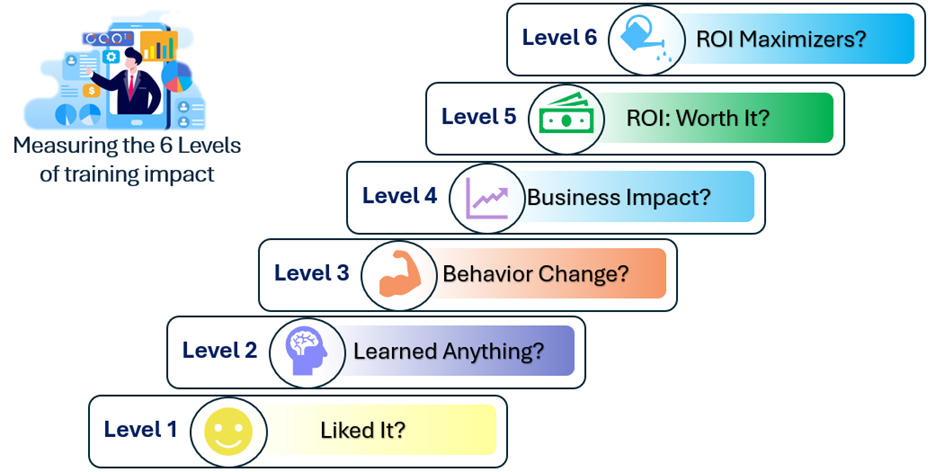
The Results
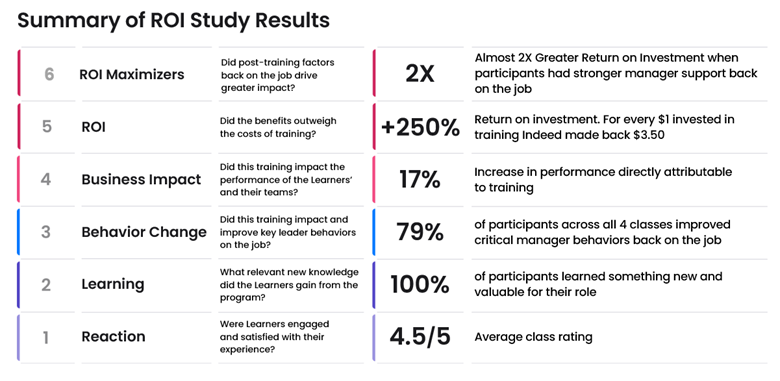
LEVEL 1 Satisfaction: Participants rated the experience 4.5 out 5.
LEVEL 2 New learning: 100% of participants learned new and valuable knowledge for their roles
LEVEL 3 Improvements in Behaviors: Participants’ improvements on specific manager behaviors were assessed 60+ days after training. The behavioral outcomes were reported on a five-point scale ranging from “no improvement” to “exceptional improvement.”
At the same time, direct reports of these managers were also asked about the same behaviors to corroborate specific improvement had indeed occurred in the post-training months.
Key results include:
- 79% of participants showed improvement in all 8 core behaviors back on the job.
- 77% of direct reports observed and corroborated these improvements took place within the post-training months.
- The greatest improvements (as corroborated by directs) was in “Communicating what needs to be done without micromanaging” and “Making genuine attempts to connect on a personal level.”
LEVEL 4 Performance improvements: As a result of these manager improvements, and after ISOLATING the specific effects of their training, the company saw an increase in both the managers’ performance and their teams’ performance.
Key results included:
- 17% increase in the manager’s performance
- 18% increase in their teams’ performance
- The more improvement managers showed back on the job, the greater the performance improvements of their direct reports. In fact, the directs who had high improvement managers vs. those who had low improvement managers, had performance improvements that were more than 3X higher!
LEVEL 5 Return on investment: When these benefits of training per participant were monetized and compared to the fully loaded cost of training per participant, we found the company achieved a positive ROI of 250%.
LEVEL 6 Reinforcement:
For Level 6, the two questions we wanted to answer were:
- Did manager support back on the job enhance the impact and ROI of training?
- Did attending the prescribed post-training Practice Labs enhance the impact and ROI of training?
To conduct this analysis, we first broke our sample into two groups: those participants who had “high” manager support and those that had “low” manager support. Here we found those participants that received high manager support back on the job had almost two times higher ROI (see diagram below)
Second, to test the incremental added effect of practice labs, we broke the sample into two groups: Those that attended both post-training practice labs, and those that attended just one practice lab. The findings showed that attending just one resulted in an ROI of 209% while attending both resulted in a 312% ROI.
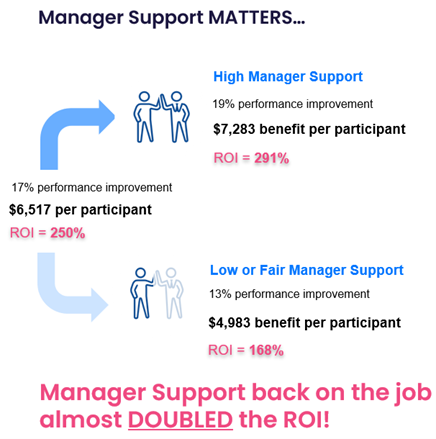
These results suggest that business impact and ROI can increase dramatically when participants are given post-training resources to help them practice and apply the learned behaviors.
The Bottom Line
This case study showed with real numbers that investing in manager development can yield extremely positive returns. When managers get even a little better at certain core behaviors, their teams take notice and pay them back with higher motivation and greater performance.
This is what I call the “Leadership ROI.” When we pay for individual contributors to be trained, we may increase the performance of that individual person, but when we pay for our leaders to be trained, we not only reap the benefits of their performance improvements, but also the performance improvements of their direct reports. So, embrace that double-edged sword of highly influential leaders and make sure it only cuts one way. Make your managers better and their direct reports will also want to perform higher. It is through the increases in their teams’ performance that you’ll achieve your most positive ROIs.


