
Training and coaching leaders in organizations on emotional intelligence (EI) isn’t easy — whether you are a training professional working within an organization or serving external clients.
Some common challenges include:
- EI is still seen by some leaders and executives as a “soft skill” — rather than a hard intelligence that can impact the bottom line.
- The EI world has been plagued by multiple models and different tools that are largely based on traits such as: optimistic, achievement orientation, self-actualization and trustworthiness.
- Most EI measurement tools are based on self-reports.
This means that there can be no right or wrong answers, as traits are preferences. So how can trait assessment inform leaders on how they might learn and develop? First, let’s be clear: There is good value in knowing our own personality and core traits (i.e., preferences, habits, comfort zones, biases), and knowing the same for others so we can flex to the styles and preferences of others to connect more meaningfully.
However, the key to building EI is to ascertain the starting point for our leaders in terms of their EI knowledge, understanding, skills and ability to apply these in real-life situations; it is not good enough to use self-reports alone for this. After all, we would never accept an IQ score from an individual’s self-perception — or from 360-degree feedback.
Being a leader is a tough job and relies on getting things done through people. This means that leaders’ conversations with team members are often emotionally charged, in contexts such as:
- Maintaining and building staff well-being.
- Performance management.
- Staff grievances.
- Talent management and promotions.
- Hiring, dismissal and redundancies.
EI is a vital skill in facilitating such conversations, and in relationship building and conflict resolution more broadly. Most employers (71%) value EI over IQ. Research has also found that when the leaders of an organization had high EI, there was more overall job satisfaction experienced by the employees.
Leaders must “get the job done” while also having to be empathic and compassionate toward their team members. Employees are human beings, who may come to work with a unique set of their own personal challenges, such as relationship changes, family matters, financial pressures, health concerns, career transitions or relocation. Effectively managing these complexities requires EI — which we are not born with. Rather, EI must be developed and honed. To help leaders build EI, coaches and training professionals must first be clear on what EI is. Below is a recent definition and EI model that scientists who study EI agree on.
What Is EI?
EI is defined as “the ability to perceive, understand and influence our own and others’ emotions across a range of contexts to guide our current thinking and actions to help us to achieve our
goals.”
It’s comprised of roughly 12 abilities within four quadrants:
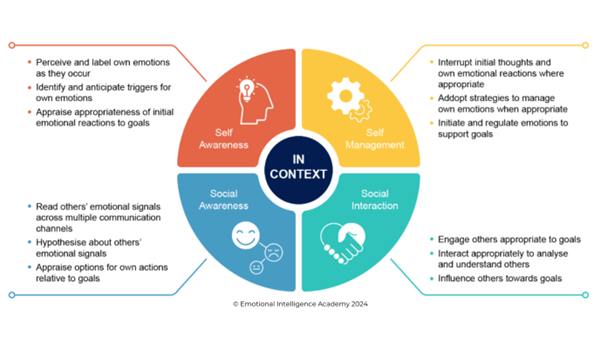
Leaders must support and lead professionals across the organization who may be technically excellent (e.g., in finance, sales, marketing, operations), although they may not be operating at their optimum level due to their people skills (i.e., their EI abilities). Leadership trainers and coaches must therefore be clear on what these abilities are, and model these attributes themselves. Technical skills are no longer enough, especially in the age of the artificial intelligence (AI)-driven workplace. This was revealed in a study with financial planners across the globe, captured in the book “Heart of Finance.” The difference between success and failure was found to lie in the adviser’s ability to respond in the right way, enhancing and growing relationships rather than damaging them.
By objectively and proactively assessing EI, coaches and trainers can identify both strengths and areas for improvement. This enables organizations to allocate coaching and training resources effectively, focusing on areas that need development while avoiding unnecessary investment in skills leaders have already mastered.
To make the most of EI training for your leaders, here are some key tips to keep in mind:
- Don’t rely on self-report methods alone. They are subjective and susceptible to distortion, so they are unreliable as a measure of EI ability. Include an objective ability measure and 360-degree feedback around application in the real world.
- As a trainer or coach, be clear yourself on the definition of EI and the abilities that are being assessed. Remember: Traits and preferences are not abilities. Just because a leader has a strong trait, or preference doesn’t mean they are good at it.
- It’s useful to assess personality traits, but it’s important to frame them as individual preferences, biases or heuristics. Leadership development involves recognizing these tendencies in oneself and in others, then flexing one’s own preferences to engage meaningfully with others.
- Identify the starting level of a leader’s EI to measure strengths and development priorities and keep track of progress in relation to the training by using pre- and post-training assessments.
Conclusion
EI is not always about suppressing emotions, nor is it always about expressing what we feel. Rather, it involves recognizing, managing, and using emotions effectively while navigating interactions with others in a way that is appropriate to the context and goals.
By developing leaders’ EI, and building EI across the organization, we can optimize individual and corporate performance while also enhancing psychological safety and well-being for employees — and ourselves.